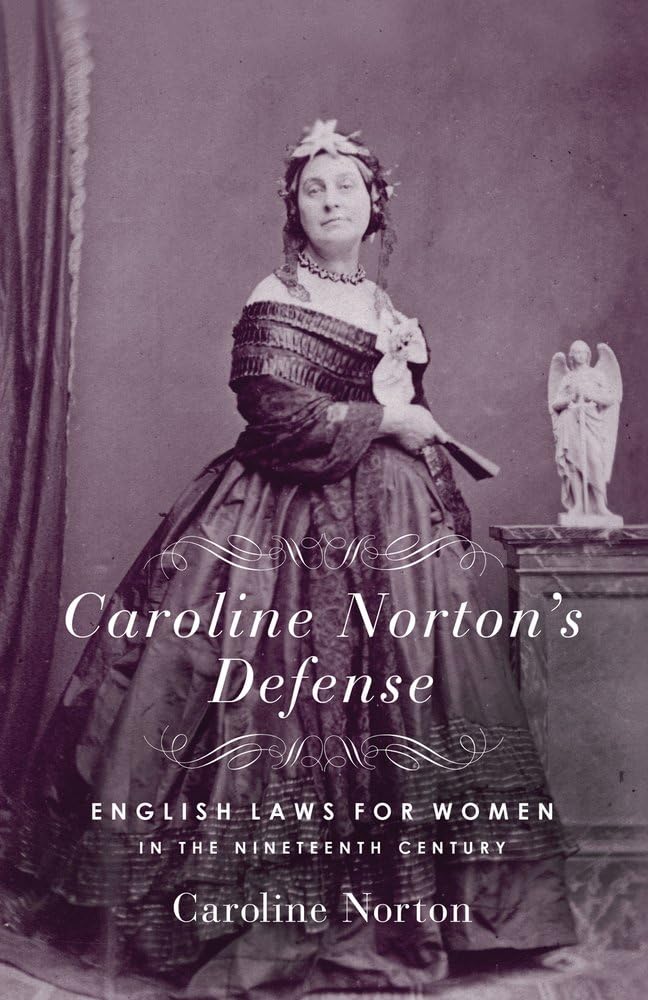
Caroline Norton's Defense: English Laws for Women in the 19th Century
$14.95
by Caroline Norton



This account of the author's experience at the hands of an "imperfect state of law" in early 19th-century England makes a passionate plea for equal justice for women. Largely as a result of this book the passage of the Married Women's Property Act and reform of the English Marriage and Divorce Laws occurred some years later. Caroline Norton's Defense English Laws for Women in the Nineteenth Century By Caroline Norton Chicago Review Press Incorporated Copyright © 1982 Joan Huddleston All rights reserved. ISBN: 978-0-915864-88-1 CHAPTER 1 I begin by an explanation of our mutual position as to money-matters; because Mr Norton has brought our disputes to a crisis on a pecuniary claim; because he has falsified the whole history of those matters; and because, from the first, our position in this respect was extraordinary and anomalous; inasmuch as instead of Mr Norton being, either by the exercise of his profession or patrimonial property, what Germans call the "Bread finder," it was on my literary talents and the interest of my family, that our support almost entirely depended, while I still had a home. Mr Norton has lately spoken (in the fabulous histories he has given to the public through the medium of the newspapers) of the profound and patient attachment he entertained for me previous to our union. I do most solemnly declare that at the time he first demanded me of my mother in marriage, I had not exchanged six sentences with him on any subject whatever. Mr Norton was brother to Lord Grantley; and the governess to whose care I was confided, happening to be sister to Lord Grantley's agent, the female members of the Norton family, from courtesy to this lady, invited her and such of her pupils as she chose to accompany her, to Lord Grantley's house. A sister of Mr Norton's, an eccentric person who affected masculine habits and played a little on the violin, amused herself with my early verses and my love of music, and took more notice of me than of my companions. The occasions on which I saw this lady were not frequent; and still more rare were the occasions on which I had also seen her brother; it was therefore with a feeling of mere astonishment, that I received from my governess the intelligence that she thought it right to refuse me the indulgence of accompanying her again to Lord Grantley's till she had heard from my mother; as Mr Norton had professed his intention of asking me in marriage. This lady is still living, and can answer for the exact truth of my statement. Almost the first step Mr Norton took, after he had made my mother's acquaintance, was to beg her interest with a member of the royal family, whose good work with the Chancellor Eldon was to procure him a small legal appointment; and from the day we were married, he never ceased impressing upon me, that as I brought him no present fortune (my portion being only payable on my mother's death), I was bound to use every effort with the political friends of my grandfather, to get him lucrative promotion in his profession. I found this more difficult than I expected. The memory of Mr Sheridan among the Whig party, was not held in that affection which in my inexperience I had fancied; and if it had been, I do not know that it would have been a sufficient plea for serving Mr Norton, who could put forward no personal claims for employment. I did, however, what my husband requested. I besieged, with variously worded letters of importunity, the friends whom I knew as the great names linked with the career of my grandfather; and while waiting the result of the petitions I had sown on so wide a field, I turned my literary ability to account, by selling the copyright of my first poem to Messrs. Ebers of Bond street. It is not without a certain degree of romantic pride that I look back, and know, that the first expenses of my son's life were defrayed from the price of that first creation of my brain; and before that child was two years old, I had procured for my husband, — (for the husband who has lately overwhelmed me, my sons, and his dead patron with slander, rather than yield a miserable annuity) — a place worth a thousand a year; the arduous duty of which consisted in attending three days in the week, for five hours, to hear causes tried in the simplest forms of law. From that day to the present, my husband has always considered that I ought to assist him — instead of his supporting me. The dependance upon my literary efforts for all extra resources, runs, as a matter of course, through all the letters I received from him during our union. The names of my publishers occur as if they were Mr Norton's bankers. If Murray of Albemarle street will not accept a poem, — if Bull of Holies street does not continue a magazine, — if Heath does not offer the editorship of an Annual, — if Saunders and Otley do not buy the MS. of a novel, — if Colburn's agreement is not satisfactory and sufficient, — if Power delays payment for a set of ballads,