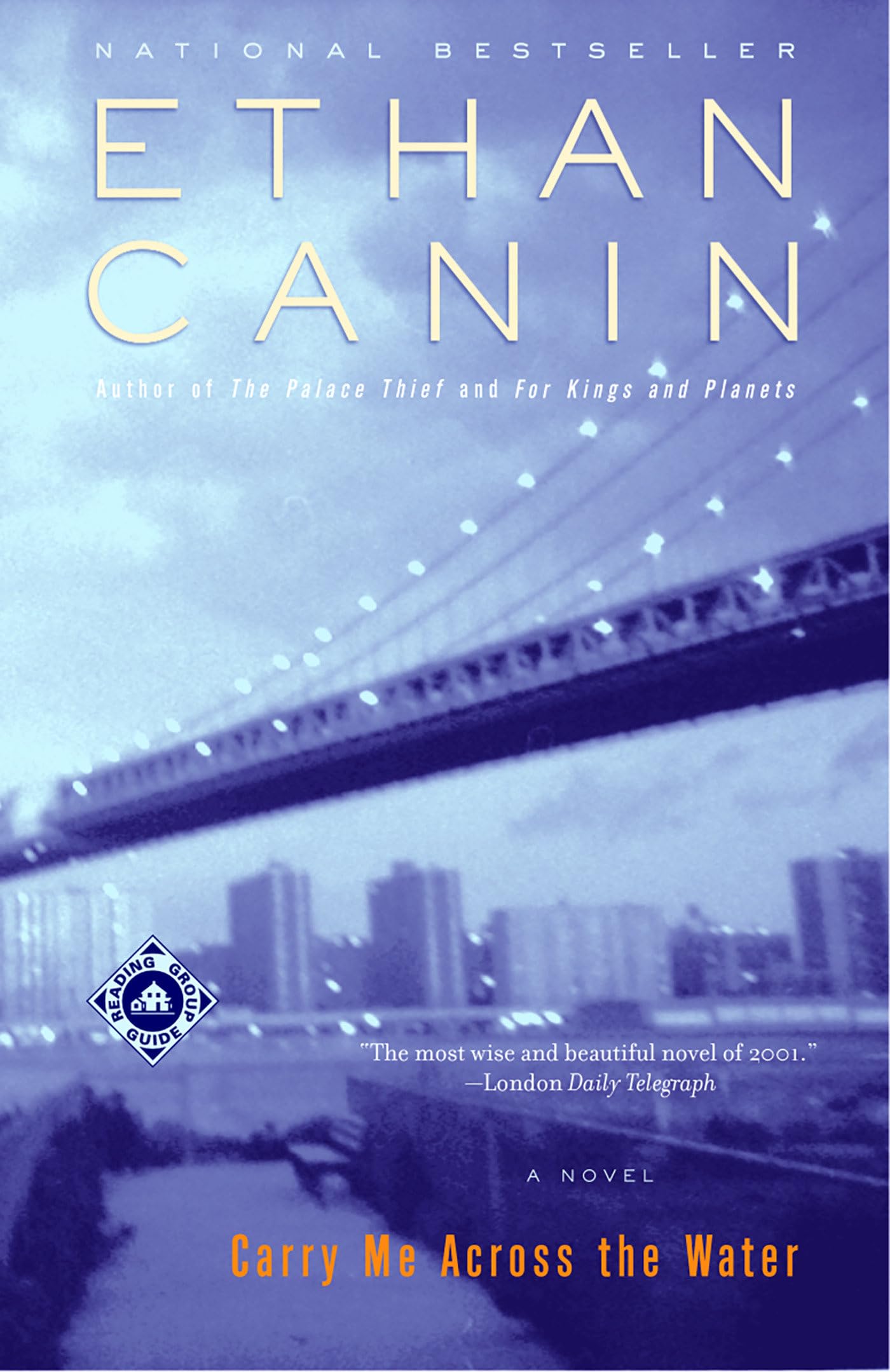



Breathtaking in its suspense and beauty, Carry Me Across the Water is the story of a man’s turbulent journey, with his family, through the central years of the twentieth century. Young August Kleinman escapes from Nazi Germany to America, where his mother’s words—“Take the advice of no one”—fate him to a life of boldness and originality, from the poor streets of New York to the marble mansions of industrial Pittsburgh, from old world Hamburg to the jungle islands of the Pacific. Ultimately, near the end of a long and bountiful life, his resolution of a haunting encounter with a Japanese soldier during World War Two finally illuminates, at the deepest levels, the way authentic lives truly unfold. From the writer hailed as “the most mature and accomplished novelist of his generation” (Alan Cheuse, National Public Radio) comes this “exquisitely modulated short novel” ( Los Angeles Times ), which “eases its silky-smooth way into a reader’s consciousness even as it plumbs the depths” ( Newsday ). “The most wise and beautiful novel of 2001.”—London Daily Telegraph “ Carry Me Across the Water reconfirms Canin’s stature as one of the best fiction writers of his generation.” — The Miami Herald “A daring and heartbreaking success.”— The Atlanta Journal-Constitution “It’s [a] testament to Canin’s mastery that he’s able to encompass the largest possible themes—life and death, war and peace, mortality and transcendence—with such elliptical precision. . . . The novel represents such a powerfully transformative experience—for protagonist and reader alike.”—Chicago Sun-Times “A hypnotic, intricately structured, elegiac novel.” — L.A. Weekly Breathtaking in its suspense and beauty, "Carry Me Across the Water is the story of a man's turbulent journey, with his family, through the central years of the twentieth century. Young August Kleinman escapes from Nazi Germany to America, where his mother's words--"Take the advice of no one"--fate him to a life of boldness and originality, from the poor streets of New York to the marble mansions of industrial Pittsburgh, from old world Hamburg to the jungle islands of the Pacific. Ultimately, near the end of a long and bountiful life, his resolution of a haunting encounter with a Japanese soldier during World War Two finally illuminates, at the deepest levels, the way authentic lives truly unfold. From the writer hailed as "the most mature and accomplished novelist of his generation" (Alan Cheuse, National Public Radio) comes this "exquisitely modulated short novel" ("Los Angeles "Times), which "eases its silky-smooth way into a reader's consciousness even as it plumbs the depths" ("Newsday). Ethan Canin is the author of For Kings and Planets , The Palace Thief , Blue River , and Emperor of Air . He is a graduate of Harvard Medical School and on the faculty of the University of Iowa’s Workshop. He lives in California and Iowa. March 19th, 1945 (Monday? Sunday?) Aguni-jima, East China Sea My Most Divine Umi— You cannot imagine how I long for you. When I think of my real life (or shall I say my past life? For this, now, is my real life) so much of it vanishes -- Sounzan, the mountain, even my beloved parents — and all that remains of my time on earth are the days that I have spent with you. And two of these days you know nothing about! Are you aware that I spent the Saturday before my departure with you? No, how could you know? You and Kakuzo, with little Teiji in his basket, walked that morning to the inlet of turtles, and Kakuzo carried a gift melon, no doubt offered in honor of Teiji’s birth. You shared it, then brought Teiji to the water and dipped his tiny feet. I believe I saw in Kakuzo, as he stood at the edge of the shore stones, a hesitancy to touch the baby: is it possible? I know such details, my love, because I was in the cherry trees watching you. My life I give to the two of you. From my hiding place, I watched Teiji closely. He is quite still — a sign in a baby, I believe, of the artist’s vision. I believe he is watching everything: the folds of cotton at the rim of his basket, the pale Sounzan sky, the mountain painting itself on the quiet of Lake Ashi. He is watching and recording, and one day he will astonish you. Perhaps he will draw a grove of cherries and, in it, hidden by leaves and branches, a heart that is plundered, watching you. Or perhaps he will attempt to draw the mountain itself, inverted in the lake, perfection as it exists and therefore the stumblestone of all who would attempt its capture. Allow me, if I might, to hope. And then there was Tuesday morning, the morning I reported to my regiment, when on the way to the Odawara train I passed by Kakuzo’s shop. I do not know what I was planning to do. Our beautiful Sounzan was still in darkness, and I had thoughts of entering the shop and telling Kakuzo the truth; but when I came to the window, there he was inside, sewing a mat, and before I had the chance to enter, I saw that you w