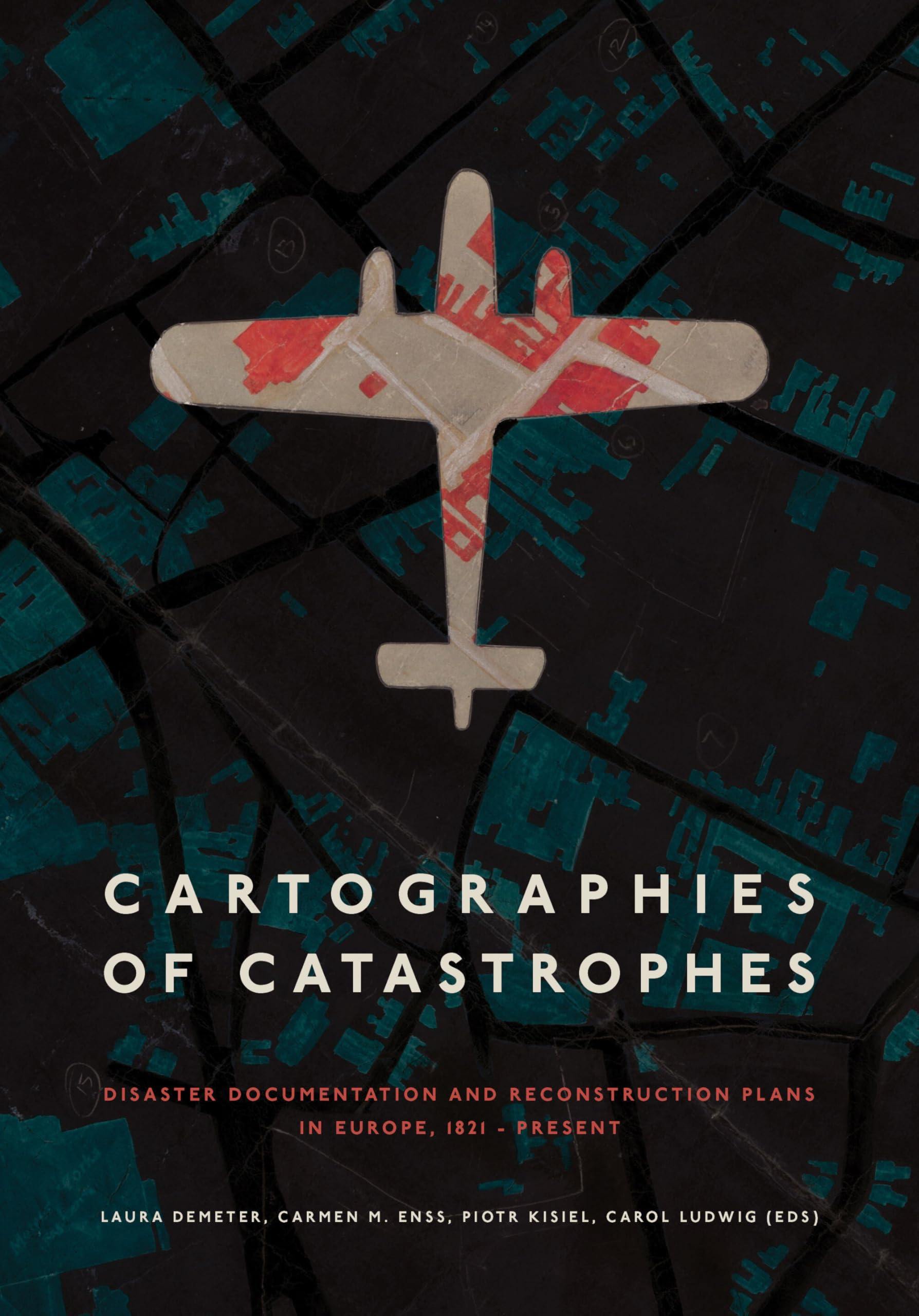
Cartographies of Catastrophes: Disaster Documentation and Reconstruction Plans in Europe, 1821–Present
$69.00
by Laura Demeter



Cartographies of Catastrophes is an in-depth exploration of how disasters, whether due to wars or to natural calamities, have been documented and mapped over the past two centuries. This interdisciplinary volume brings together historians, urban planners, and architects to examine the role of maps in understanding, responding to, and reconstructing after catastrophic events. From the Greek War of Independence to the ongoing conflict in Ukraine, this book offers a unique perspective on how maps shape our perception of disasters and their aftermath. With case studies spanning Europe, it provides a compelling narrative of resilience, reconstruction, and the enduring impact of catastrophes on our cities and landscapes. Essential reading for anyone interested in the intersection of history, cartography, and urban planning. A valuable resource for cartographers and those interested in post-war reconstruction, this book offers an innovative, interdisciplinary perspective on the documentation of destruction and its role in reconstruction processes. It broadens our understanding of how destruction has been observed, recorded and systematised over time and is an essential reference for researchers in the field. - Michal Chodorowski, Bialystok University of Technology This transdisciplinary collection is an important contribution to the role of cartography in responding to disaster and catastrophe. Spanning a long historical period from the early nineteenth century to the present with examples judiciously assembled from across Europe it graphically illustrates the techniques and underlying politics and polemical purposes brought into play. It is an essential source for understanding the role of maps in, for example, on the one hand nation-building or, on the other, histories of planning and reconstruction. - John Pendlebury, Newcastle University Laura Demeter is a researcher at the Centre for Heritage Conservation Studies and Technologies at the Otto-Friedrich University of Bamberg. She holds a PhD in cultural heritage management and development (2017). Her research focuses on heritage-making processes in the context of conflict and regime change, discourses of value creation, and war damage documentation. Carmen M. Enss is an architectural historian and specialist in urban conservation at the Centre for Heritage Conservation Studies and Technologies at the University of Bamberg. She is head of the UrbanMetaMapping research network. Piotr Kisiel is a historian affiliated with the Leibniz Institute for Research on Society and Space (IRS), specialising in urban history, heritage and nationalism studies. After studying law and history in Poland and Scotland, he completed his PhD in Florence. Carol Ludwig is a social geographer and city planner, with expertise in postwar planning strategies and heritage conservation at Saarland University. She has worked in planning practice and universities in UK and Germany.