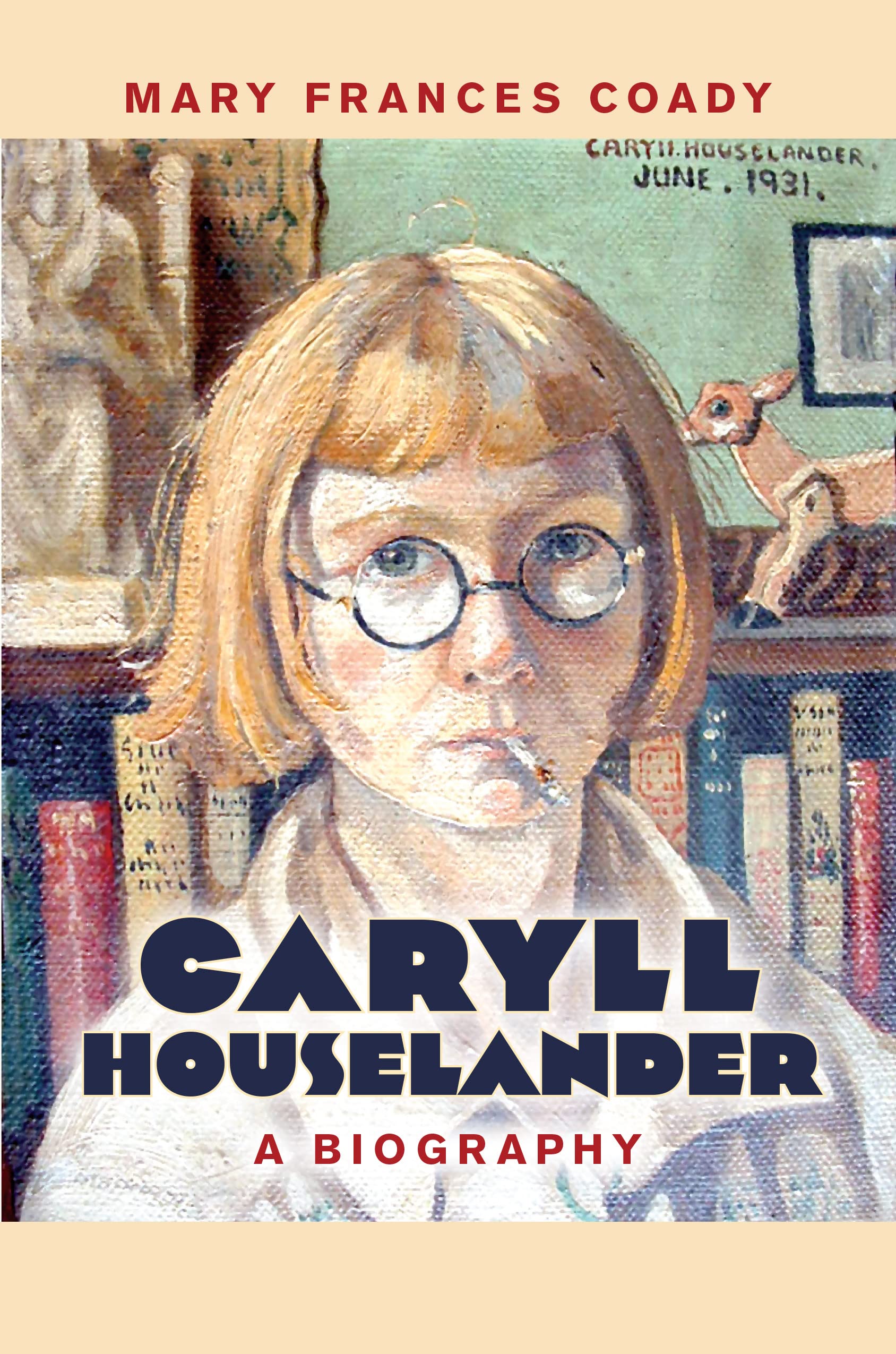



This biography tells the life of the elusive 20 th -century English writer, Caryll Houselander, who saved no personal letters (although, fortunately, others saved their letters from her) and left only her books, which included a short autobiography, a few classics of Catholic spirituality, and some unpublished personal scratchings. She never had robust health, and mentally she had the tendency to live in her own world. Her one aim in life, as she discovered from adolescence onward (although it would take many years for her to state it this way), was to see the suffering Christ in humanity. The opportunity for this discovery had already been given to her: a broken home, which she experienced at the age of 9, and thus she and her sister were subsequently brought up in convent boarding schools. Born in 1901, Caryll was of the generation that lived through two world wars, and by the time of the second she had already been marked by the first. In between the two were the days of wandering: art school, bohemianism (a tendency that would always remain with her), a love affair, self-torture as she desperately sought to find herself in her search for God. Living in London during the entire Second World War, she found herself at the heart of catastrophe in the form of nightly bombing, known as the Blitz. The suffering of human beings in war, which she equated with the suffering Body of Christ, led to her first book, This War is the Passion . Other books followed, all circling around the Christ-life. Her own life was cut short by cancer, about which she wrote, as if matter-of-factly making plans for the day ahead (she had long since found God―or, perhaps, in the way of the poet Francis Thompson, whom she admired, God had found her): “Well, if God wants me to die, it’s all right.” "Maisie Ward, who knew Caryll Houselander and published many of her books, called her a “Divine Eccentric.” Houselander suffered much in her short life. She was singular, awkward, and odd, and also the most popular and prolific writer for Catholics in postwar England. She focused on the passion of Christ and how personal suffering might be linked to it. Based on deep research, grounded in the historical and religious context, and written in accessible prose, Mary Frances Coady’s biography of Caryll Houselander adds to understanding this “Divine Eccentric.” "- Dana Greene, is dean emerita of Oxford College of Emory University an author of “The Living of Maisie Ward” and four other biographies. RELIGION / Christianity / Catholic LITERARY CRITICISM / Modern / 20th Century US$28.00 Mary Frances Coady CARYLL HOUSELANDER A Biography [Orbis Logo] ISBN 978-1-62698-530-8 Mary Frances Coady’s books include Merton & Waugh: A Monk, a Crusty Old Man, and The Seven Storey Mountain (Paraclete Press). She taught professional communication at Ryerson University (now called Toronto Metropolitan University) in Toronto. Her work on Caryll Houselander was supported by a travel grant from the Cushwa Center for the Study of American Catholicism at the University of Notre Dame. She lives in Toronto. A Rocking-Horse Beginning (1901–1917) The nearest one can get to that backward glance from eternity on this earth is, I suppose, to look back across the years to one’s childhood. ―Born Catholics She looked like a medieval saint―or perhaps a medieval tumbler― who had stepped out of a stained-glass window onto the ancient streets of London. So said a friend about the artist and writer Caryll Houselander, who was born in 1901 and died in 1954.1 Her hair was carrot-colored, cut irregularly in adult years, with a fringe that hung down to her eyebrows. It clashed with the purple smock she donned in her studio. She wore a white substance on her face in adulthood― perhaps a form of cosmetic powder, although another friend said she looked as if she had dipped her face in a bag of flour. As a result, she drew stares. Her round, dark-rimmed glasses sat at a slight angle on her face, giving an off-center look to a small-framed body. Her strange appearance provided the cover for a complex woman who, according to her publisher, had a touch of genius. Over the course of only fourteen years she wrote books that formed the spiritual reading of choice for monasteries, convents, rectories, and ordinary Catholic households. During those fourteen years Caryll Houselander became the best-selling author for her publisher, Sheed & Ward. Her most popular book, The Reed of God, remains a classic. The years immediately preceding the Second Vatican Council were an unlikely period for an unknown English woman of early middle age to become a best-selling Catholic author. Her writing was as clear and sharp and penetrating as that of a medieval mystic, and in fact it has been compared with that of the medieval anchoress Julian of Norwich. It is, perhaps, not a coincidence that the best of it appeared during the Second World War, amid the screech of air-raid sirens and bombed-out devas