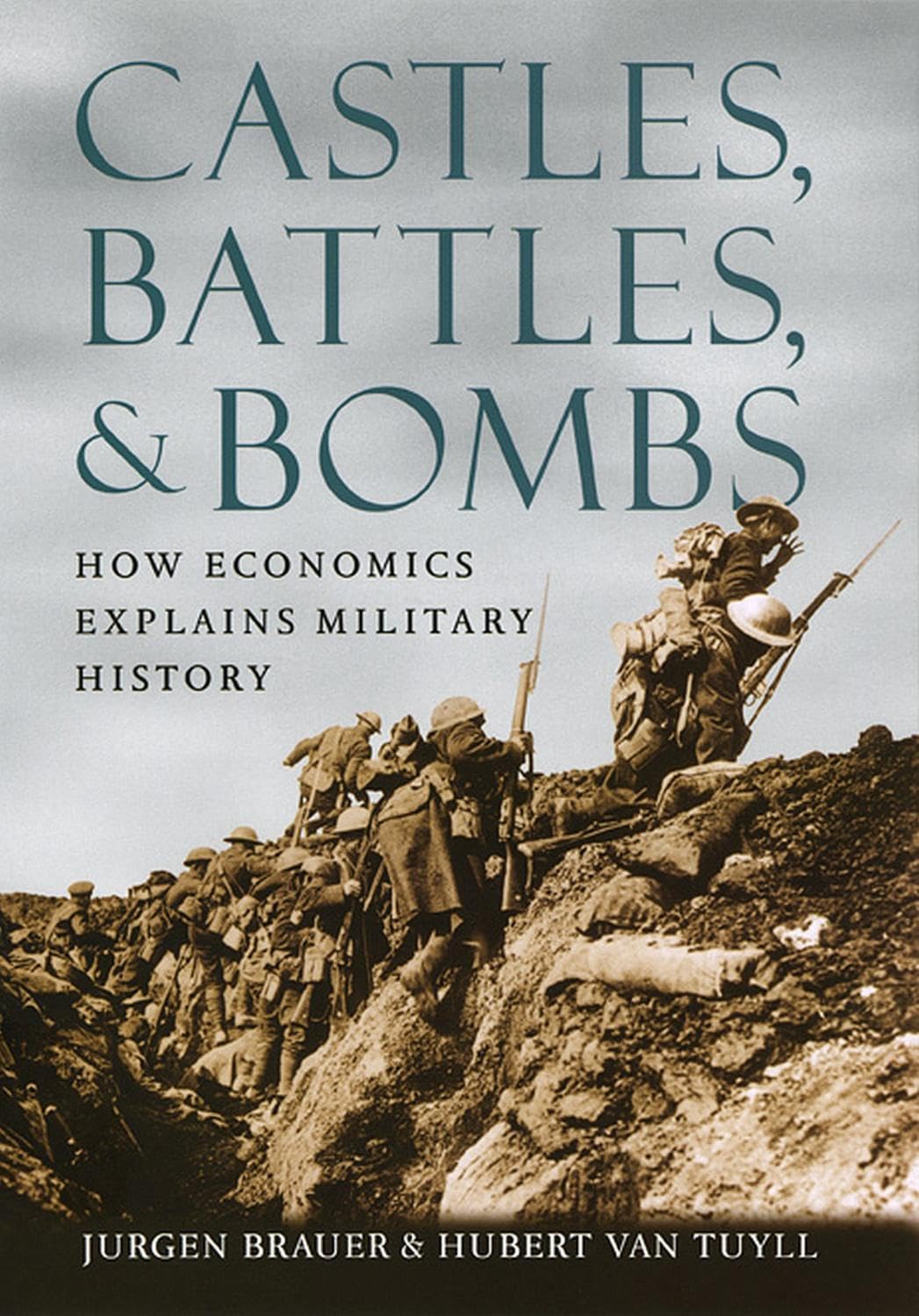
Castles, Battles, and Bombs: How Economics Explains Military History
$42.45
by Jurgen Brauer



Castles, Battles, and Bombs reconsiders key episodes of military history from the point of view of economics—with dramatically insightful results. For example, when looked at as a question of sheer cost, the building of castles in the High Middle Ages seems almost inevitable: though stunningly expensive, a strong castle was far cheaper to maintain than a standing army. The authors also reexamine the strategic bombing of Germany in World War II and provide new insights into France’s decision to develop nuclear weapons. Drawing on these examples and more, Brauer and Van Tuyll suggest lessons for today’s military, from counterterrorist strategy and military manpower planning to the use of private military companies in Afghanistan and Iraq. "In bringing economics into assessments of military history, [the authors] also bring illumination. . . . [The authors] turn their interdisciplinary lens on the mercenary arrangements of Renaissance Italy; the wars of Marlborough, Frederick the Great, and Napoleon; Grant's campaigns in the Civil War; and the strategic bombings of World War II. The results are invariably stimulating."—Martin Walker, Wilson Quarterly "This study is serious, creative, important. As an economist I am happy to see economics so professionally applied to illuminate major decisions in the history of warfare."—Thomas C. Schelling, Winner of the 2005 Nobel Prize in Economics "My skepticism was relieved by the preface, my expectations enhanced by the first chapter, my confidence assured by the second. This study is serious, creative, important. As an economist I am happy to see economics so professionally applied to illuminate major decisions in the history of warfare." -- Thomas C. Schelling, University of Maryland, winner of the 2005 Nobel Prize in Economics “Rarely does reading a book offer such rewards. Unarguably scholarly, cast in Jared Diamond’s mold, Brauer and van Tuyll’s work transported this economic historian across centuries and into realms that opened my eyes and engaged my imagination, both as an historian and an economist. My understanding of a past I thought I knew has been broadened and deepened and my teaching of that past forever altered. I enjoyed the journey. I am in the authors’ debt.” -- John J. McCusker, Trinity University "In bringing economics into assessments of military history, [the authors] also bring illumination. . . . [The authors] turn their interdisciplinary lens on the mercenary arrangements of Renaissance Italy; the wars of Marlborough, Frederick the Great, and Napoleon; Grant's campaigns in the Civil War; and the strategic bombings of World War II. The results are invariably stimulating." -- Martin Walker ― Wilson Quarterly "The authors have cogently synthesized an extensive literature to effectively demonstrate to nonspecialists how basic economic concepts can provide insights into the nature of war." ― Choice “[Brauer and van Tuyll’s] analysis and discussion of military history is fascinating and mirrors the substantial recent interest on the economic dimensions of conflicts and the fiscal important of strategic choices. . . . The strengths of this book include the clarity of the material and the writing style, the accessibility of both the economic theory and historical cases used, and the various illustrations and additional materials. . . . I can heartily recommend this for everyone interested in military history and on how economics theory can help us understand historical outcomes better.” -- Jari Eloranta ― Journal of Economic History "There is a need for a closer study of the historical relationship between economics and war....This is not that book. Its title suggests that it might be something else, at once more narrow and yet possibly more instructive: an attempt to explain decisions taken in war as a product of economic considerations." ― The International History Review Jurgen Brauer is professor of economics in the James M. Hull College of Business at Augusta State University and the author of Arms Trade and Economic Development . Hubert P. van Tuyll is professor of history and chair of the Department of History, Anthropology, and Philosophy at Augusta State University. He is the author of The Netherlands and World War I . CASTLES, BATTLES, & BOMBS HOW ECONOMICS EXPLAINS MILITARY HISTORY By JURGEN BRAUER HUBERT VAN TUYLL THE UNIVERSITY OF CHICAGO PRESS Copyright © 2008 The University of Chicago All right reserved. ISBN: 978-0-226-07163-3 Contents List of Figures and Tables..................................................................................................................................xiPreface.....................................................................................................................................................xiiiONE Economics.........................................................................................................................