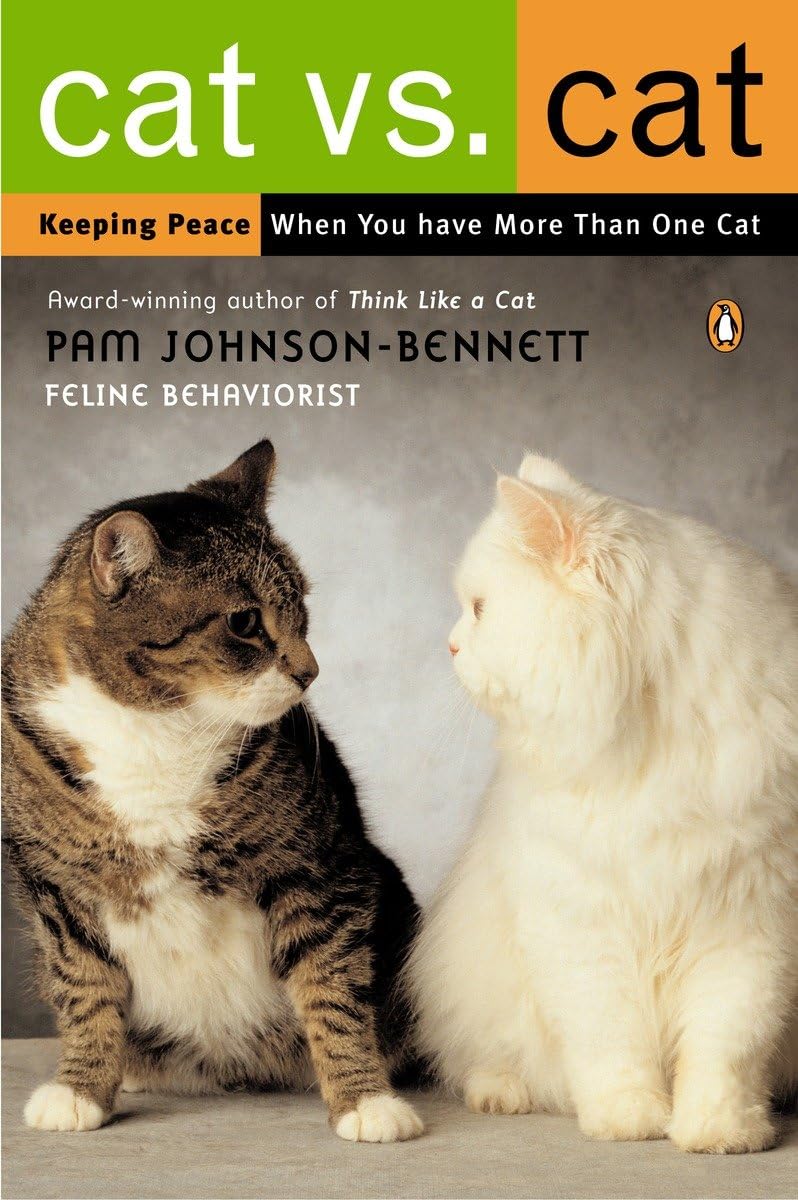



From the author of Catwise and Think Like a Cat , the ultimate resource for managing a multi-pet household. Pam Johnson-Bennett, the award-winning author and feline behaviorist, shows how adding another cat to your home does not have to be the start of a kitty apocalypse. Although cats are often misunderstood as natural loners, Johnson-Bennett shows how to plan, set up, and maintain a home environment that will help multiple cats—and their owners—live in peace. Cat vs. Cat will help readers understand the importance of territory, the specialized communication cats use to establish relationships and hierarchies, and how to interpret the so-called “bad behavior” that leads so many owners to needless frustration. Offering a wealth of information on how to diffuse tension, prevent squabbles and ambushes, blend two families, or help the elder kitty in your family, Cat vs. Cat is a welcome resource for both seasoned and prospective guardians of cat families large and small. "A comprehensive guide in clear, friendly prose." -- Dr. Marty Becker, Good Morning America contributor and coauthor of Chicken Soup for the Pet Lover's Soul "Gives you the tools you need to have more than one cat and peace as well." --Janice Willard, DVM, MS, columnist for Knight Ridder Tribune "A must read for anyone who is contemplating adding 'just one more cat' to their household." --Darlene Arden, author of The Angell Memorial Animal Hospital Book of Wellness and Preventive Care of Dogs Pam Johnson-Bennett hosted the Animal Planet UK series "Psycho Kitty." She is best-selling author of 7 books on cat behavior. With a career that began in 1982, Pam is considered a pioneer in the field of cat behavior consulting. Pam was vice president of the International Association of Animal Behavior Consultants and the founder and longtime chair of the IAABC cat division. She served on the American Humane Association's Advisory Board on Animal Behavior and Training and the American Humane Association Cat Health and Welfare Forum. She is also on the Advisory Board for Tree House Humane Society. She lectures worldwide at veterinary conferences and animal welfare organizations. Pam is the recipient of numerous awards, including the Winn Feline Foundation Media Award and the IAABC cat division award. In addition to her work with cats, Pam is the co-author of Cookies for Dinner. This book chronicles the funny and often embarrassing side of motherhood. The sequel to Cookies for Dinner is set for release in late 2015/early2016. Pam owns Cat Behavior Associates, LLC. Website catbehaviorassociates.com 1 The Feline Social Structure You may look at your multicat household as one happy family; you love your cats equally and feel there shouldn't be any reason for fighting or squabbling. In reality, though, your cats don't view each other as equals, nor should they. Whether you have two cats or twenty, there is a bit of a pecking order. It may bother you to think that a few cats might have higher status than others, but some form of a hierarchy is necessary in feline society. In a free-roaming environment, it prevents overcrowding of the colony and gives cats a sense of order and security. It used to be that cats weren't thought of as being social animals, especially when compared to their canine counterparts. Even today, many people imagine that their cats are solitary, even antisocial, but they're misinterpreting what they see. Cats are solitary hunters, and they're looking out for themselves. They capture only prey large enough for one meal. Watching them on the prowl, many people incorrectly label them as solitary animals in all aspects of their lives. Another behavior that adds to cats' mistakenly labeled reputation as asocial is their territorial instinct and their attitude toward newcomers. We recognize dogs as social creatures-pack animals-because existing canine households will often easily accept a new puppy. When cat parents think of adding another cat, visions of hissing, scratching, fights, and, in general, disaster come to mind. This hardly inspires one to label cats as social. But it can work, so long as you go about it in a way that makes sense to the cats involved. It's important to understand and then work out territorial issues before putting two cats together; if you do, they can become friends and develop a long-term relationship. Cats can readily adapt to living in groups, and although they may still maintain some preferred personal areas, many enjoy companionship and benefit from group living. It just takes a little finesse. The social structure is complex and easy to misunderstand. It's built around resource availability. The need for food and other resources often outweighs the desire to fight. Cats will coexist in closer proximity to one another near a common food source or shelter. Even in those situations, most cats may avoid each other and "live alone" in a group. Between the independent ferals and the