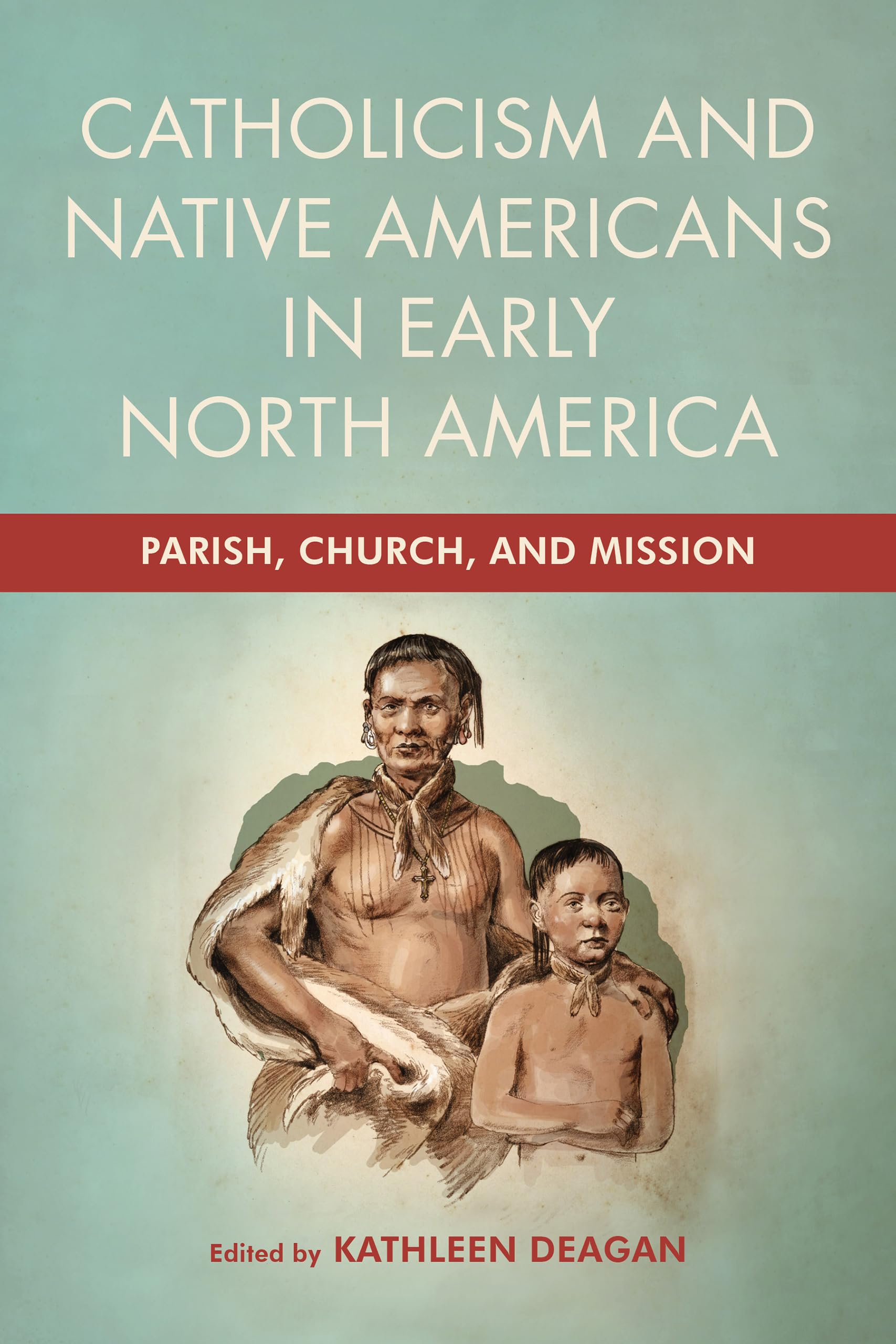
Catholicism and Native Americans in Early North America: Parish, Church, and Mission
$44.43
by Kathleen Deagan



Catholicism and Native Americans in Early North America interrogates the profound cultural impacts of Catholic policies and practice in La Florida during the sixteenth and seventeenth centuries. Catholicism and Native Americans in Early North America explores the ways in which the church negotiated the founding of a Catholic society in colonial America, beginning in St. Augustine, Florida, in 1565. Although the church was deeply involved in all aspects of daily life and institutional organization, the book underscores the tensions inherent in creating and sustaining a Catholic tradition in an unfamiliar and socially diverse population. Using new primary academic scholarship, the contributors explore missionaries’ accommodations to Catholic practice in the process of conversion; the ways in which social and racial differentiation were played out in the treatment of the dead; Native literacy and the production of religious texts; the impacts of differing conversion philosophies among various religious orders; and the historical and theological backgrounds of Catholicism in sixteenth- and seventeenth-century America. Bringing together insights from archaeology, social history, linguistics, and theology, this groundbreaking volume moves beyond the missions to reveal how Native people, friars, secular priests, and Spanish parishioners practiced Catholicism across what is now the southeastern United States. Contributors: Kathleen Deagan, Keith Ashley, George Aaron Broadwell, José Antonio Crespo-Francés Y Valero, Timothy J. Johnson, Rochelle Marrinan, Susan Richbourg Parker, David Hurst Thomas, Gifford Waters “ Catholicism and Native Americans in Early North America is a major contribution to understanding the impacts and outcomes of Spanish-American colonial presence and the profound cultural impacts of Catholic policies and practice in colonial America.” ―Russell K. Skowronek, co-editor of Ceramic Production in Early Hispanic California “ Catholicism and Native Americans in Early North America is a must-have for anyone studying the missions or religion of the Spanish borderlands of North America.” ―Lee M. Panich, author of Narratives of Persistence "Deagan summarizes the histories and relocations of the town and mission of Nombre de Dios and the shrine, hermitage, and image of Nuestra Señora de la Leche y Buen Parto. Her own part in the long campaign to preserve the footprint and foundations of St. Augustine could be pieced together from her extensive books, reports, and papers." ― American Catholic Studies "A primary strength of this edited volume is the diversity of topics and perspectives covered. The result is a book that appeals to a wide audience, including scholars interested in La Florida as well as researchers studying Spanish colonialism elsewhere in the Americas. . . . New insights explored in this book and the emphasis on Catholicism help to fill a critical gap in the existing literature." – American Antiquity Kathleen Deagan is Distinguished Research Curator Emerita and Lockwood Professor Emerita of Caribbean and Florida Archaeology at the University of Florida’s Florida Museum of Natural History. She received the J. C. Harrington Award from the Society for Historical Archaeology in 2004. Deagan is co-author of Columbus’s Outpost among the Taínos and co-author of Fort Mose: Colonial America’s Black Fortress of Freedom . Secular priests attended Menendez’s founding of St. Augustine, and within a year, Jesuit friars began ministering to La Florida’s original inhabitants. Menendez’s plan was to station Jesuits at missions and garrison outposts in strategic locations along the coastal frontier of La Florida, from south Florida to Chesapeake Bay. In effect, Spain’s goal was to create a “pax hispanica” that would assimilate a subjugated Native population, an endeavor that ultimately failed (see also Thomas, this volume Chapter 4). Among the earliest Jesuit missionaries was Fray Pedro Martinez, who on his maiden voyage to La Florida in 1567 became lost, went ashore for directions, and was allegedly killed by several Mocama Indians somewhere between Ft. George and Cumberland islands. Menendez blamed Tacatacuru for this killing and others, leading him to order the capture and death of the Mocama leader. Sensing failure, beleaguered Jesuits officials formally ended missionary efforts in La Florida in 1572. Responsibility for missionizing among the Indigenous peoples soon fell to brown-robed friars of the Franciscan Order. After first landing in St. Augustine in 1573, the number of friars grew slowly, with missionaries dispersing from St. Augustine to the Mocama frontier in 1587 and north to Guale territory in 1595. As friars gained entrance into these new locations―by being invited to join these communities by Indigenous leaders―existing Native towns within the mission system became known to the Spanish as doctrinas and visitas . Doctrinas were mission communities with a sturdy church and