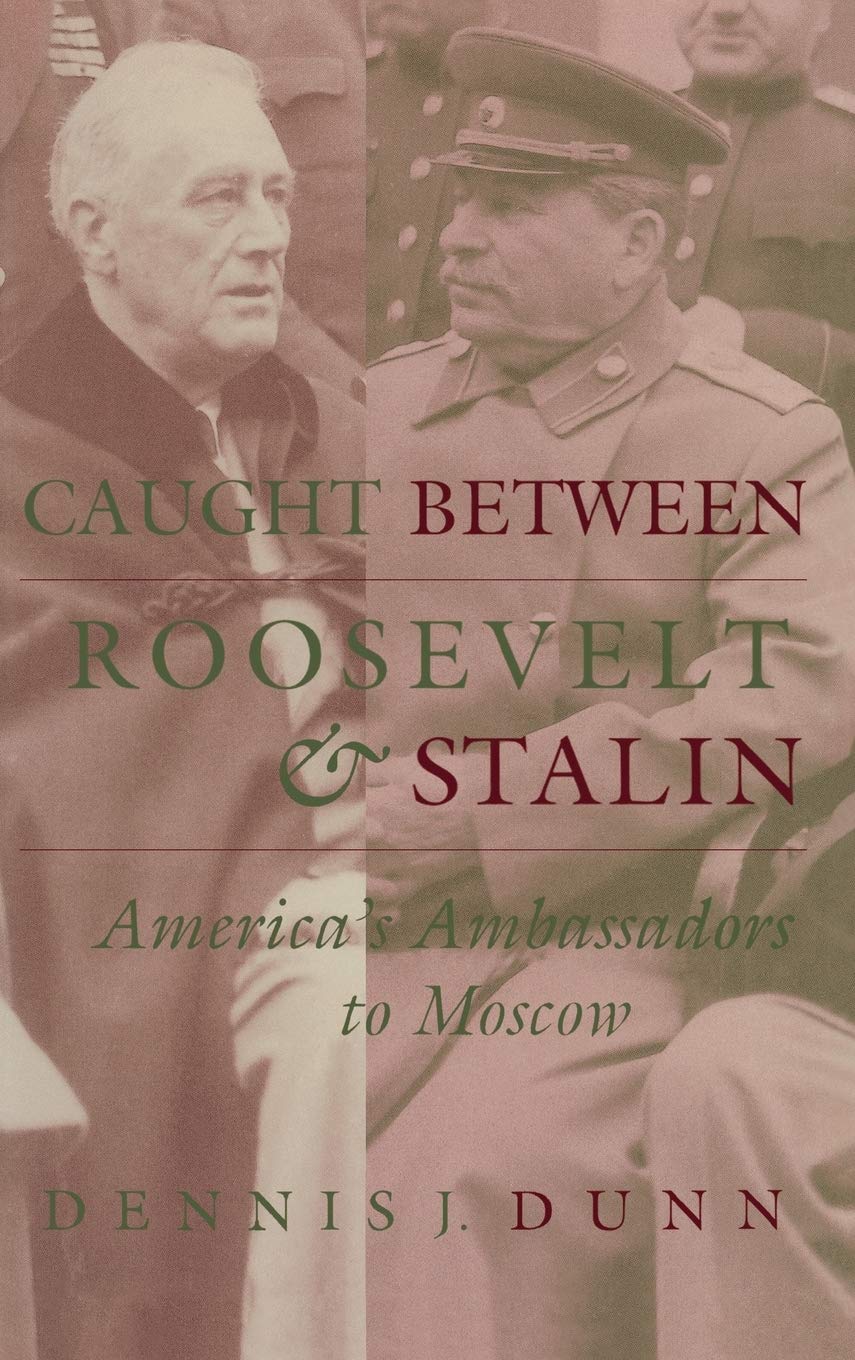
Caught between Roosevelt and Stalin: America's Ambassadors to Moscow
$40.00
by Dennis J. Dunn



On November 16, 1933, Franklin D. Roosevelt and Soviet Commissar of Foreign Affairs Maxim Litvinov signed an agreement establishing diplomatic ties between the United States and the Soviet Union. Two days later Roosevelt named the first of five ambassadors he would place in Moscow between 1933 and 1945. Caught between Roosevelt and Stalin tells the dramatic and important story of these ambassadors and their often contentious relationships with the two most powerful men in the world. More than fifty years after his death, Roosevelt's foreign policy, especially regarding the Soviet Union, remains a subject of intense debate. Dennis Dunn offers an ambitious new appraisal of the apparent confusion and contradiction in Roosevelt's policy one moment publicizing the four freedoms and the Atlantic Charter and the next moment giving tacit approval to Stalin's control of parts of Eastern Europe and northeast Asia. Dunn argues that "Rooseveltism," the president's belief that the Soviet Union and the United States were both developing into modern social democracies, blinded Roosevelt to the true nature of Stalin's brutal dictatorship despite repeated warnings from his ambassadors in Moscow. Focusing on the ambassadors themselves, William C. Bullitt, Joseph E. Davies, Laurence A. Steinhardt, William C. Standley, and W. Averell Harriman, Dunn details their bruising arguments with Roosevelt over the president's repeated concessions to Stalin. Using information uncovered during extensive research in the Soviet archives, Dunn reveals much about Stalin's policy toward the United States and demonstrates that in ignoring his ambassadors' good advice, Roosevelt appeased the Soviet leader unnecessarily. Sure to generate new discussion concerning the origins of the Cold War, this controversial assessment of Roosevelt's failed Soviet policy will be read for years to come. Historical opinion has traveled the spectrum from loving to hating Roosevelt, and Dunn (director of international studies, Southwest Texas State Univ.) is clearly in the disliking camp. Basing his study on research in the United States and the newly opened Russian archives, Dunn tells again the story of U.S.-Soviet relations during the war. According to Dunn, FDR underestimated Stalin's capacity for evil and tragically ignored the advice of his ambassadors. Dunn also believes, as many others have, that FDR was blinded by his naive faith that the Soviet Union was evolving into a social democracy. Dunn treats FDR's personal diplomacy harshly, yet for this reason his book can serve as a starting point for another round of reassessments of FDR and his presidency. Recommended for academic and large public libraries.?Edward Goedeken, Iowa State Univ. Lib., Ames Copyright 1997 Reed Business Information, Inc. "Demonstrates clearly . . . the struggle between FDR and the state department concerning divergent interpretations of Stalin, Stalinism, and the Soviet Union"― Amos Perlmutter, editor, Journal of Strategic Studies "The first study to incorporate the history of all the ambassadors and aides who succeeded William C. Bullitt, the first U.S. ambassador to the Soviet Union."― Canadian Review of American Studies "What is sure to excite discussion is his assertion that Roosevelt, by separating democracy from morality, misunderstood and propped up Stalinist Russian and ironically contributed to the postponement of its fall until the 1990's."― Choice "Dunn has drawn upon Soviet, British, and American sources to produce a well-written account of Roosevelt's policies toward the Soviet Union and his relationships with U.S. diplomatic envoys in Moscow."― H-Net Reviews "Dunn provides vivid intellectual-political portraits of the five ambassadors who represented President Franklin Roosevelt in Embassy Moscow."― International History Review "A valuable contribution for the study of a complex and difficult period in the relationship of the greatest powers during the crucial years 1933-1945."―John Lukacs "An excellent book. . . . Will remain a diplomatic classic for years if not decades to come."― Journal of Slavic Military Studies "A superbly written, well-researched book that examines in-depth the US-Soviet relationship in the years preceding and during World War II through the eyes of the US's first ambassadors to Moscow."― Journal of Slavic Military Studies "Dunn treats FDR's personal diplomacy harshly, yet for this reason his book can serve as a starting point for another round of reassessments of FDR and his presidency. Recommended."― Library Journal "Descriptions of the ambassadors personalities and ideologies are insightful portrayals of the upper-crust types who served as America's top diplomats in Moscow, and they personalize what can often be a dry topic."― Publishers Weekly "Demolishes some of the conventional explanations for why Franklin Roosevelt accepted arrangements at Yalta that doomed Poland and the rest of Eastern Europe to Stalinist domina