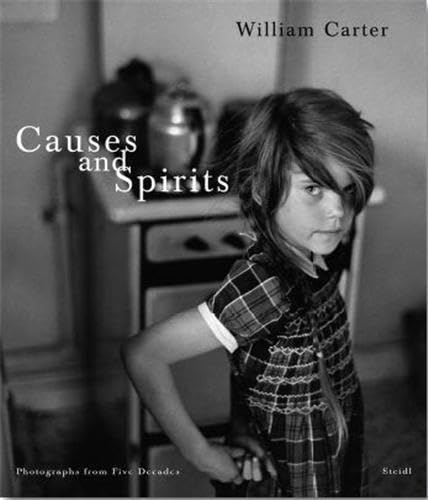



"Watch any mother kneeling beside her toddler, pointing and explaining what they are looking at. Our urge to see, and to connect, starts there." William Carter. This book is both an autobiography of William Carter and a study of people. Carter's photographs, beginning in 1960, take the viewer on his travels throughout the world, from home to New York and Kurdistan, from Dublin to Gaza. Whether working as a photojournalist or purely for himself, Carter focuses on the gestures and expressions of people (sometimes charming, sometimes unsettling), and on streets and landscapes that often long for human presence. The subtitle "Photographs from Five Decades" might seem misleading as it implies a "typical" photobook where the sequence of images is primary. For Carter, however, it is the interplay between his photographs and writings that allows him to see into himself and his subjects: indeed he calls himself a "photographer-writer". In Carter's words, his work aims to capture the "hidden implications, eye-blink compositions, odd ironies and happy accidents" of the world. William Carter's fifth book is his most comprehensive, most searching -- most personal.The subject is humanity. Causes and Spirits spans a career of fifty years (and counting). Whether Carter was covering the Iraqi Kurds for LIFE, the streets of London for Women's Wear Daily, premature babies for the Stanford University Hospital, the historic American West for book projects, or classic nudes for gallery and museum exhibitions, his most deeply seen images all have an "extra something." Many are published here for the first time.This book's autobiographical text extends the careful compositions by enhancing the subtle connective tissue between the surfaces exposed by the photographer's sensitive eye.A 2007 J. Paul Getty Museum wall caption describing a Carter print can be abbreviated to describe this wider spectrum of his work: "Carter enjoyed a successful career as a photojournalist before turning to the nude. An artist of sensitivity and deep understanding, he creates pictures that communicate natural beauty and spirituality...an awareness of an awe-inspiring locus where life begins that gives the pictures their symbolic weight."Incorporating the author's pictures of people world-wide, Causes and Spirits is a rotunda of bright windows on the human soul. Born in Los Angeles in 1934, William Carter majored in the Humanities Honors Program at Stanford University, from which he graduated in 1957. Moving to Berkeley, he became engrossed in photography and subsequently became a professional photographer, writer, and editor.Carter moved to New York in 1962, where he worked as an editor at the book publisher Harper & Row, and as a freelance photographer. From 1964 to 1966 he lived in Beirut, Lebanon, handling photojournalistic assignments for New York agencies.Based in London from 1966 to 1969, Carter continued to freelance for a variety of worldwide clients. He returned to the San Francisco Bay Area in 1969 for a two-year project: roaming the back roads of the Far West to produce Ghost Towns of the West, a bestselling Sunset pictorial book.He followed this with a volume on America's prairie heartland, Middle West Country (Houghton Mifflin, 1975), and with Preservation Hall (W.W. Norton, 1991), detailing Carter's long, passionate association with the music and musicians of New Orleans. A clarinetist, he appears on a dozen traditional jazz albums.By 1990 Carter's photography was moving from the printed page to gallery walls. This fulfillment of long-held personal values inspired a fifteen-year project photographing the nude, resulting in the publication of his Illuminations (1996).Continuing to travel and photograph, and to revisit his earlier work with new eyes, William Carter lives near San Francisco with his wife Ulla Morris-Carter. "use another eye"Rumi William Carter, born in 1934 in Los Angeles, is a photographer, writer and part-time jazz musician. He has exhibited and published widely, and his work is held in public and private collections in the USA and Europe. Combining his photographic and written work is Carter's preferred approach to bookmaking, as seen in such publications as Ghost Towns of the West (1971) and Preservation Hall (1996).