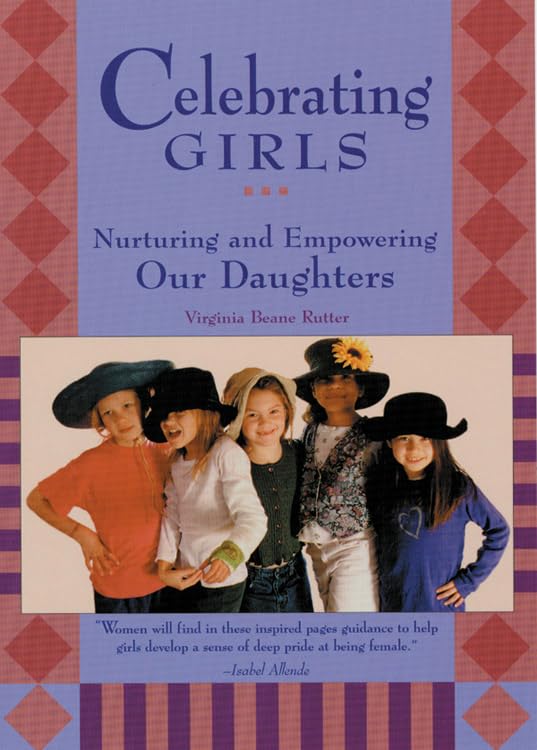



Jungian psychologist Virginia Beane Rutter offers a wide variety of everyday things women can do to strengthen a girl's sense of self and ensure confidence and healthy self-esteem throughout her lifetime. Each chapter highlights an aspect of the passage from infancy to adolescence a practical response to Reviving Ophelia. Raising a daughter? As Peggy Orenstein concluded in Schoolgirls , girls still view their gender as a liability. How then, can parents who are concerned about the sexist restrictions society tends to heap on girls help their daughters honor the feminine inside? What kinds of modern daily rituals and special initiation ceremonies can help a girl through her transitions, and help her celebrate her life? In Celebrating Girls, Virginia Beane Rutter offers specific ways to help raise self-esteem, make girls understand that they do matter, assure their physical self-confidence, empower their minds, and support their creativity. Family therapist Gurian (Mothers, Sons, and Lovers, LJ 12/93) offers a sweeping look at what makes boys and men act the way they do. He begins by thoroughly defining gender differences. Citing the strong push to hunt and reproduce, he argues that men need to compete and do combat and that society must accommodate these needs more productively. A boy needs a tribe, says Gurian, and not one but three families (birth or adoptive parents, extended families, and culture/community) are required to help him become a healthy man. Also, Gurian stresses discipline, spiritual principles, and "husbandry," which he defines as "generating and maintaining stable relationships with self, family, community, culture, and earth." All told, there is much to ponder and much to challenge readers here. On the other hand, Jungian analyst Rutter (Woman Changing Woman, LJ 7/93) begins with a large chip on her shoulder, whining from the start that girls are subjected to unbelievable pressures that diminish their self-esteem. Though she seeks to "celebrate" womanhood, the result is the opposite?the tone turns ever inward, focusing almost solely on issues of self-worth. Rutter praises rites of passage, coming-of-age ceremonies, and informal rituals (e.g., sharing a candlelit bath with your daughter, buying a first bra together) as the keys to enhancing self-esteem. She also recommends books and films that she feels reproduce positive images for women, including Thelma and Louise. Ultimately, however, what Rutter seems to be doing is turning mothers and daughters into members of a self-absorbed "me" generation. Not recommended.?Linda Beck, Indian Valley P.L., Telford, Pa. Copyright 1996 Reed Business Information, Inc. "Women will find in these inspired pages guidance to help girls develop a sense of deep pride at being female." - Isabel Allende ― Reviews Virginia Beane Rutter is a psychotherapist and Jungian analyst on the faculty of the C.G. Jung Institute in San Francisco. She is married and the mother of two children, and has a private practice in Mill Valley, California. Her previous books are Woman Changing Woman and Celebrating Girls . Celebrating GIRLS Nurturing and Empowering Our Daughters By Virginia Beane Rutter Red Wheel/Weiser, LLC Copyright © 1996 Virginia Beane Rutter All rights reserved. ISBN: 978-1-57324-053-6 Contents ONE Celebrating GirlsTWO Raising a DaughterTHREE Bathing: Nourishing Emotional IntegrityFOUR Holding: Assuring Physical Self-ConfidenceFIVE Haircombing: Empowering Her MindSIX Dressing: Developing Social AwarenessSEVEN Adorning: Meaning, Spirit, and the ArtsEIGHT Storytelling: Teaching and LearningNINE Strengthening Her Body: Sports and MenstruationTEN Walking into Beauty: Coming of Age and SexualityBibliographyAdditional Resources for Girls and Women CHAPTER 1 Celebrating Girls The word celebrate comes from the ancient Greek word melpo —meaning to sing, todance, to praise! I offer this book in praise of girls, to help nurture andempower them. It addresses the question of what we can do to enhance ourdaughters' feminine self-worth. Thanks to groundbreaking books such as In a Different Voice by Carol Gilliganand Reviving Ophelia: Saving the Selves of Adolescent Girls by Mary Pipher, weare all aware of the severe pressures and dangers that diminish girls' self-esteemas they approach adolescence. Girls who are free-thinking and expressive,who speak their minds and their hearts, suddenly begin to lose their voices andbecome silent. They reject their individuality for a cultural norm about the waygirls "should" look ("thin") and behave ("good"). As Peggy Orenstein concludedin Schoolgirls: Young Women, Self-Esteem and the Confidence Gap , girls stillview their gender as a liability. "By sixth grade, it is clear that both girlsand boys have learned to equate maleness with opportunity and femininity withconstraint." In short, girls begin early in life to stop believing inthemselves. As concerned mothers, we read all this depres