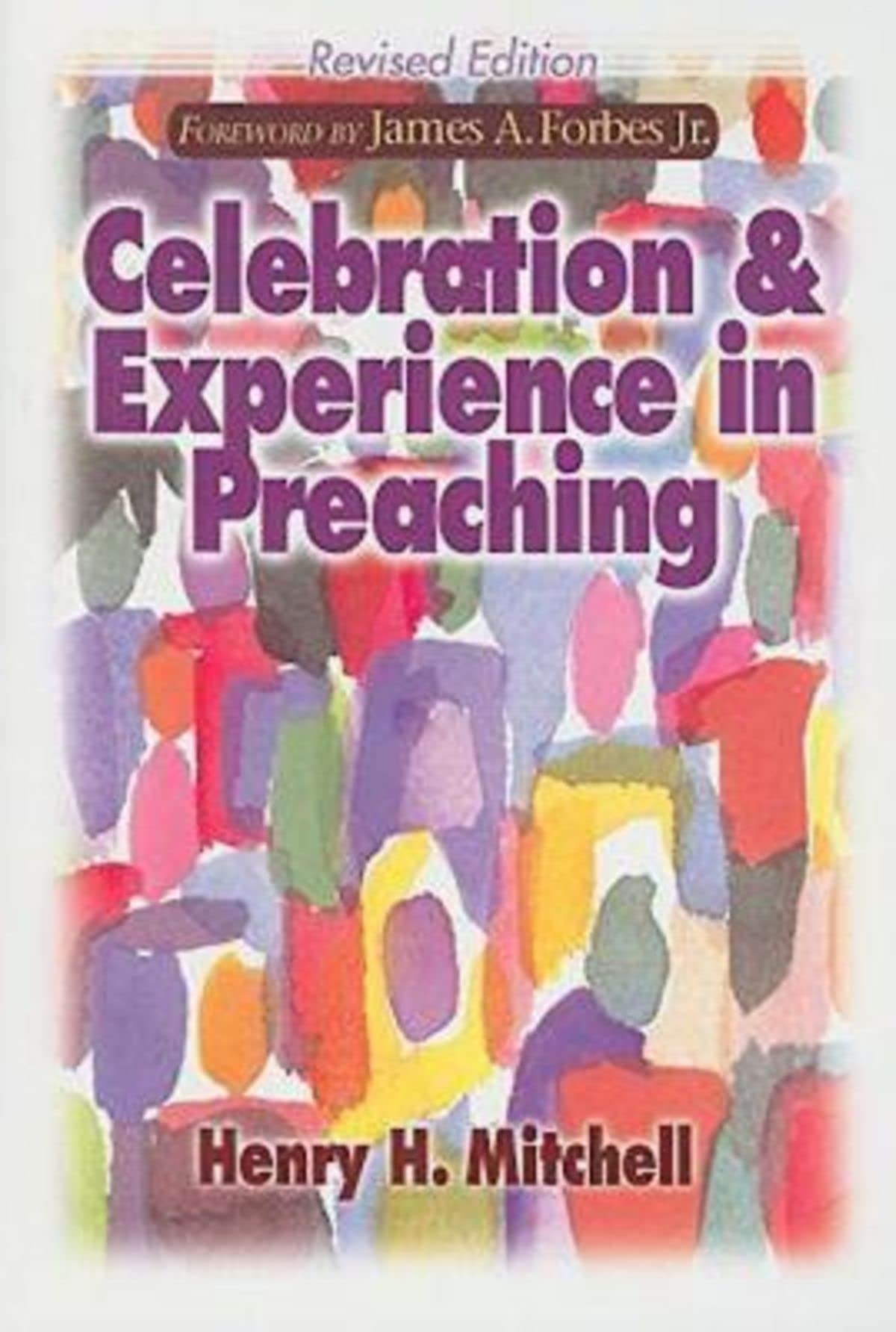



Henry H. Mitchell’s great contribution to the study of preaching has been his insistence that the homiletical practices of the Black church are gifts to the whole church. Nowhere has he made this point more forcefully than in Celebration and Experience in Preaching . In this classic text he advocates a way of preaching that genuinely engages all aspects of the congregation’s attention, especially the ability to both understand and to feel the sermon’s message. In this revised edition Mitchell builds on this groundbreaking work by examining in greater depth the multiple ways in which we experience the preached word, by defining the different kinds of claim on the behavior of the hearer that biblical texts express, and by exploring various genres of sermon to discover the concrete manifestations of celebration and experience. Henry H. Mitchell is the author of Celebration and Experience in preaching, Black Preaching, Black Belief, The Recovery of Preaching, and Soul Theology. He teaches and supervises students at the Interdenominational Theological Center in Atlanta, Georgia. He was Professor of Homiletics and History and Dean of the School of Theology at Virginia Union University. 1994 MLK Jr. Emeritus Profess of Black Church Studies, Colgate Rochester Crozer Divinity School. 411 Angier Court, NE, Atlanta, GA 30312-1082 Celebration and Experience in Preaching By Henry H. Mitchell Abingdon Press Copyright © 2008 The United Methodist Publishing House All right reserved. ISBN: 978-0-687-64919-8 Chapter One The Definition and Purpose of Experiences of the Word Actually, God gives experiential encounters in the Spirit and with the Word. Yet, quite often, these experiences occur in apparent connection with the efforts of thoughtful servants of God. It is a fact that we are commanded to go into all the earth and preach and teach and witness as if it all depended on us, while trusting that it all is in the hands of God. For the homiletical studies outlined in this work, then, preaching is defined as follows: To preach is so to be used by the Holy Spirit that the gospel is communicated, to the end that hearers are saved and then helped to grow in grace and in the knowledge of our Lord. It is the hope of every preacher that every sermon will be used by the Spirit to move Christians to grow from point A to point B, in the direction of the life modeled by Jesus Christ. And every sermon should focus on one such behavioral goal as stated or implied by the biblical text. The first element of meaningful experiential encounter is a biblical text , the basis of the authority that distinguishes the sermon from a secular essay. Texts should be chosen with careful thought, as well as divine guidance. In the thoughtful aspect, a text should be chosen for clarity of behavioral purpose and memorable brevity, as well as for helpful guidance in a specific human need. Some texts literally are behavioral purposes: "In every thing give thanks" (1 Thess. 5:18). Other texts imply or exemplify behavioral purposes (b.p.). In Romans 8:28, Paul exemplifies a b.p. of trust in all situations when he says, "We know that God works in everything for good (author's translation; emphasis mine)." Because so many texts imply trust, this b.p. should be more specific: "Regardless of fearful appearances, God works in everything! " Jesus' Parables have implied b.p.s. For instance, there is no direct admonition to "be compassionate," but the parable of the good Samaritan (Luke 10:33) says it all in a human example of compassion. This one-purpose focus is characteristic of all of Jesus' parables, and Matthew, Mark, and Luke all testify that this is how Jesus preached (Matt. 13:34; Mark 4:34; Luke 8:10). He employed concrete images that had parallels to spiritual meanings, otherwise expressible only in abstraction. To attempt more than one purpose is likely to achieve neither or none, because of lack of focus. It is a great and sufficient blessing when the gospel concerning even one needed behavior is actually received and the hearer is motivated and empowered to obey. For example, "Blessed are the meek" (Matt. 5:5) is a great challenge. One hardly dares ask the Spirit for more in a single sermon. (Notice, Jesus didn't say, "You ought to be meek.") One is not necessarily called to preach all of even one text verse if it contains more than one behavioral goal. Paul's great list of the fruits of the Spirit includes seven goals in Galatians 5:22, with two more in verse 23. I have been known to preach for two weeks, with introductory and concluding sermons and a different fruit from the text for a b.p. each night of a ten-night revival. These guidelines of brevity and clarity are often challenged in class on the grounds that all of a verse ought to be treated. A long, Paul-type sentence (Ephesians 3:15-19 is just one sentence) offers many possible b.p.s. Students feel obligated to preach all of them, exhausting all