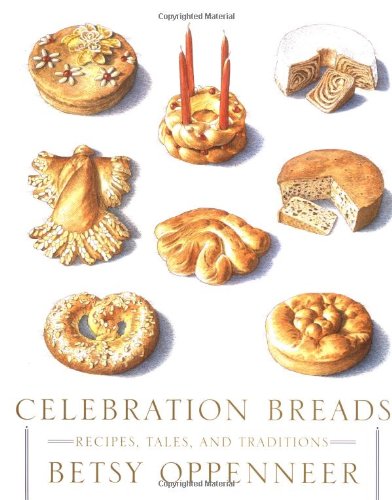



A collection of international baked bread recipes for all occasions by a respective culinary instructor presents detailed steps on how to prepare more than seventy-five sweet and savory breads, from the Passover matzoh and festive Russian kolach to the Christmas stollen and British hot cross buns. 25,000 first printing. Japan is about the only nation not represented in Betsy Oppeneer's Celebration Breads . And guess what? In Japan they don't celebrate holidays or special events with bread. Everywhere else, well, it's another story. And who better to tell that story than Betsy Oppeneer, longtime cooking teacher, author of Breads from Betsy's Kitchen , The Bread Book , and Betsy's Bread . There was a time in Europe when eggs and sugar were so costly none but the wealthy could use them for anything but special events, usually holidays like Easter or Christmas. Or there are special breads linked to events like the Hanukkah, the Festival of Lights. Oppeneer has scoured the world for breads closely linked to this spirit of celebration, of special event. And what she found, in many cases, was a disappearing world where new generations were failing to carry on traditions and old recipes were fading out of mind and history. Celebration Breads acts as something of a bridge between what has been and what can be. Always the careful, thorough teacher, Oppeneer begins her book with chapters on ingredients, special equipment, the how-tos of doing it by hand, by heavy-duty mixer, by food processor, or bread machine, and tips and techniques. She divides her recipe chapters by region: Africa, the Americas, the British Isles, Eastern Europe, the Eastern Mediterranean, the Middle East, Russia and Asia, Scandinavia, and Western Europe. You'll find flat breads like Egyptian Zalabya and yeast breads like Chelsea Buns. There are sweet breads and savory breads. Big breads and little breads. And in each of the more than 75 recipes Oppeneer is right there at your shoulder, enjoying new discoveries and old friends right along with you. --Schuyler Ingle Sharon Tyler Herbst Author of The New Food Lover's Companion Celebration Breads, with its mouthwatering recipes and wealth of information on bread- making techniques, truly gives bread lovers a reason to celebrate. Anecdotal detail about the historical and cultural origin of each bread makes this book a fascinating read. Bottom line? When you think bread, think Betsy Oppenneer -- this woman knows her breadstuff! -- Review Betsy Oppenneer is an accomplished baker, cooking teacher, and lecturer. She has studied at some of the most prestigious schools in the country, as well as with renowned chefs and teachers, including Julia Child, Nick Malgieri, Nancy Silverton, and Bernard Clayton, among others. Betsy has made regular appearances on TV Food Network's Cooking Live with Sara Moulton, CBS This Morning, and local programs across the country. She has been a consultant to Corning Incorporated, the Hay Day Bakery, and The King Arthur Flour Baker's Catalogue; developed recipes for Fleischmann's Yeast; and been a cooking contest judge. In 2002 she was nominated for the International Association of Culinary Professionals' award as Best Cooking School Teacher of the Year. She lives with her husband in New Hampshire. Chapter One: Ingredients Yeast Yeast is an amazing living fungus that hangs in suspension until warm water activates it. Once activated, like any living thing, it requires food and nourishment, such as flour and other bread ingredients. Yeast feeds on the natural sugar in the flour and creates carbon dioxide. The kneading process helps fill the gluten meshwork with gas bubbles, which in turn make the bread rise. Yeast is commercially available in three forms: Active Dry Yeast is available at the grocery store in small 1/4-ounce foil packages or in 4-ounce jars. You can also buy yeast in bulk at some specialty food stores or through mail-order catalogs. If you use bulk yeast, this conversion formula is helpful: For each package of active dry yeast called for in a recipe, use one scant tablespoon -- not quite a full spoon -- of yeast. Of the two major yeast companies in America, one specifies that a scant tablespoon equals a small packet of yeast, while the other says to use 2 1/2 teaspoons yeast for a packet. Both ways of measuring equal the same amount. Like all perishable products, yeast packages are stamped with an expiration date. Most yeast remains good past that date, but you should "proof" it to be sure. See page 22 for detailed instructions on proofing and activating yeast. Compressed or Fresh Yeast is available at some grocery and health food stores in the refrigerated section, and from some bakeries. The packages are approximately an inch square and 1/2-inch thick. Fresh yeast is becoming harder and harder to find because it is more perishable than active dry yeast. Also fresh yeast is easy to damage when defrosting it from its frozen state. How