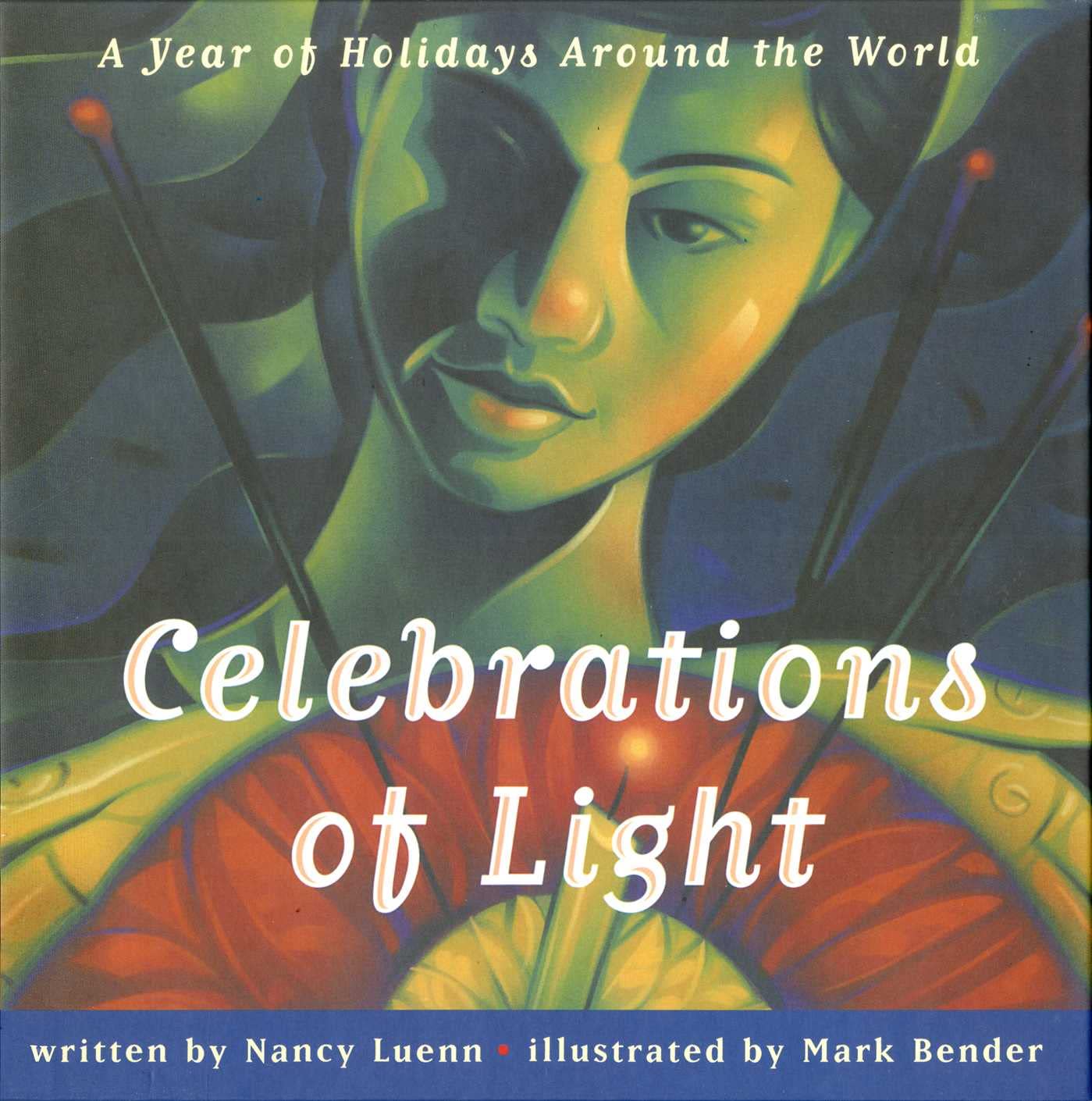



Long ago, people found a way to light the darkness. They built fires to keep warm and cook their food. They lit torches to drive away danger. To help them see at night, they learned to make candles and lanterns. Light was so important in their lives that they came to use it in worship and in celebrations. From a Brazilian New Year's celebration to the African-American holiday of Kwanzaa, Celebrations of Light circles the year and the globe. The text and paintings highlight twelve festivals, showing the diverse ways in which people around the world use light as a major part of their celebrations. In each of these holidays, light plays a significant role, marking and brightening special days. Grade 1-4-Twelve holidays from different cultures are briefly examined. The book begins with the Brazilian New Year's Eve, the Chinese New Year, Lanterns in Sierra Leone, and Lichtmesdag in Luxembourg. April through November are represented by Buddha's birthday in Korea, Bon Matsuri in Japan, Diwali in India, and Loy Krathong in Thailand. The cycle concludes with Hanukkah, Sweden's Luciadagen, Christmas/Las Posadas, and Kwanzaa. Two paragraphs describe each holiday and its significance and relate whether the light is used for celebration, remembrance, and/or worship. The theme of light is an interesting, unifying concept across cultures, but the text is too long for most teachers to read aloud in one sitting and there may be too little information to be useful as a reference for a single holiday. The stylized airbrush art has a strong geometric quality. Unnatural colors, ambiguous use of space, and unusual placement of elements give some of the paintings a cubist look. While the illustrations have a celebratory mood, they do not contribute much information. An alternative source might be Anabel Kindersley's Children Just Like Me: Celebrations! (DK, 1997). Although not dealing specifically with the light motif, it does discuss many of the same days with more detail in text and photographs. Luenn's book may be an appropriate choice for those looking specifically at light across cultural events or for those needing an additional volume on world holidays. Adele Greenlee, Bethel College, St. Paul, MN Copyright 1998 Reed Business Information, Inc. Gr. 3^-5. Luenn examines 12 celebrations around the world and throughout a year that emphasize light. She includes well-known observances, such as New Year's Day (in Brazil and China), Hanukkah (Israel), Christmas (the U.S. and Mexico), and Kwanza (U.S.), as well as lesser-known festivities such as Lichtmesday or Candlemas (Luxembourg), Buddha's Birthday (Korea), Lanterns (Sierra Leone), and Luciadagen (Sweden). Each observance is presented on a double-page spread, with Mark Bender's stylized airbrush paintings on the left and a brief description of the festival customs on the right. Although there's not enough information here for report writers and some of the illustrations may be confusing to young readers (Saint Lucia, wearing a candle-lit crown, appears to be sleeping amid cups of hot coffee and pastries), this will be useful for introducing the concept that winter holidays (10 of the 12) encompass more than Christmas. Kay Weisman Nancy Luenn is the author of fourteen books for children and teens, including Nessa's Fish, The Dragon Kite , Mother Earth , and Squish! A Wetland Walk .