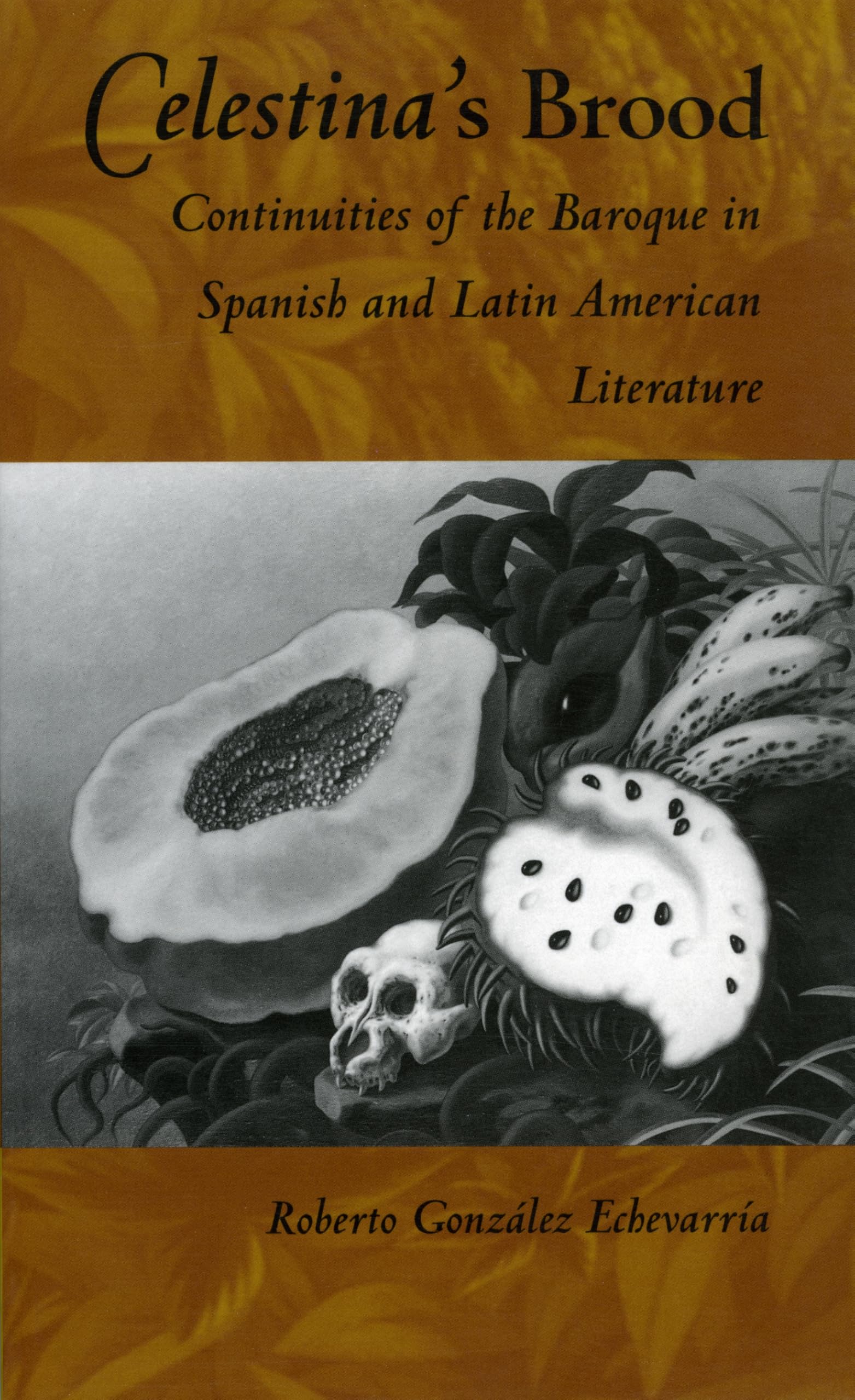
Celestina's Brood: Continuities of the Baroque in Spanish and Latin American Literature
$27.95
by Roberto González Echevarría



Published in 1499 and centered on the figure of a bawd and witch, Fernando de Rojas' dark and disturbing Celestina was destined to become the most suppressed classic in Spanish literary history. Routinely ignored in Spanish letters, the book nonetheless echoes through contemporary Spanish and Latin American literature. This is the phenomenon that Celestina's Brood explores. Roberto González Echevarría, one of the most eminent and influential critics of Hispanic literature writing today, uses Rojas' text as his starting point to offer an exploration of modernity in the Hispanic literary tradition, and of the Baroque as an expression of the modern. His analysis of Celestina reveals the relentless probing of the limits of language and morality that mark the work as the beginning of literary modernity in Spanish, and the start of a tradition distinguished by a penchant for the excesses of the Baroque. González Echevarría pursues this tradition and its meaning through the works of major figures such as Cervantes, Lope de Vega, Calderón de la Barca, Alejo Carpentier, Carlos Fuentes, Gabriel García Márquez, Nicolás Guillén, and Severo Sarduy, as well as through the works of lesser-known authors. By revealing continuities of the Baroque, Celestina's Brood cuts across conventional distinctions between Spanish and Latin American literary traditions to show their profound and previously unimagined affinity. ""Roberto González Echevarría's Celestina's Brood is a profound study of the continuity of Hispanic literature, moving as it does from the greatest writers of the Spanish Golden Age—Rojas, Cervantes, Lope de Vega, Calderón—through the transitional figures of Balboa and Medrano—and on to major Latin American imaginations of our age, Carpentier, Nicolás Guillén, and Sarduy. González Echevarría matures here from the disciple of Derrida, de Man, and Foucault into a strong critic with a vision and a method very much his own. He fuses the Baroque and the Romantic, and exemplifies the virtual identity between those two modes in Hispanic literature."—Harold Bloom, Yale University "This collection of essays is valuable not only for the excellence of the individual pieces but also as the critical itinerary of an eminent and influential Hispanist. Because Roberto González Echevarría has been at the center of critical debates in Hispanism over the last two decades, his evolution as a critic also illuminates changes in the discipline from the sixties to the present. This is a major collection of essays by one of the leading Hispanists in the world today."—Gustavo Pérez Firmat, Duke University "This collection of essays is valuable not only for the excellence of the individual pieces but also as the critical itinerary of an eminent and influential Hispanist. Because Roberto Gonzalez Echevarria has been at the center of critical debates in Hispanism over the last two decades, his evolution as a critic also illuminates changes in the discipline from the sixties to the present. This is a major collection of essays by one of the leading Hispanists in the world today."--Gustavo Perez Firmat, Duke University Roberto González Echevarría is Bass Professor of Hispanic and Comparative Literatures at Yale University. He is the author of numerous books on Latin American and Spanish literature. Celestina's Brood Continuities of the Baroque in Spanish and Latin American Literatures By Roberto González Echevarría Duke University Press Copyright © 1993 Duke University Press All rights reserved. ISBN: 978-0-8223-1371-7 Contents Acknowledgments, Preamble, 1. Celestina's Brood, 2. The Life and Adventures of Cipión: Cervantes and the Picaresque, 3. Poetry and Painting in Lope's El castigo sin venganza, 4. Calderón's La vida es sueño: Mixed-(Up) Monsters, 5. Threats in Calderón: La vida es sueño 1:303–8, 6. Reflections on the Espejo de paciencia, 7. Poetics and Modernity in Juan de Espinosa Medrano, Known as Lunarejo, 8. Socrates Among the Weeds: Blacks and History in Carpentier's El siglo de las luces, 9. Guillén as Baroque: Meaning in Motivos de son, 10. Plain Song: Sarduy's Cobra, Notes, Index, About the Author, CHAPTER 1 Celestina's Brood 1 [T]he wit with which racy words and concepts are strung together in this book is almost a national catastrophe, because it does not allow one to handle without caution one of our greatest classics. —Ramiro de Maeztu Fernando de Rojas's Celestina (1499) is the most suppressed classic in Spanish literary history, and one of the least known outside Hispanic letters. An account of the readings to which this disturbing work has not been subjected in the past hundred years could of itself constitute a monograph. A book in which perverse desire drives the characters, Celestina still awaits a Freudian analysis, as well as an interpretation according to Bataille's theories linking eros, evil, and literature. A story in which lower-class characters bring about