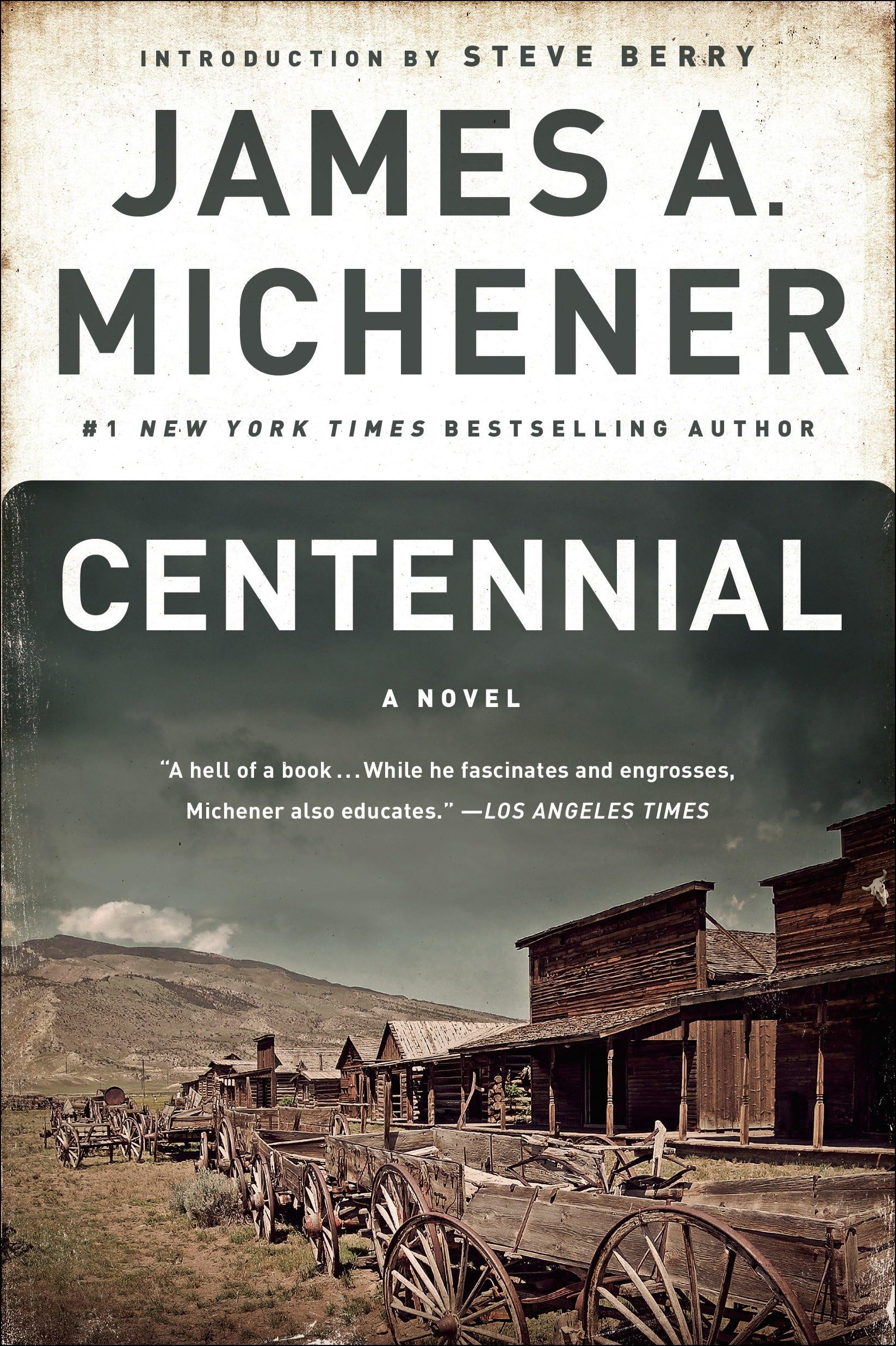



NATIONAL BESTSELLER Written to commemorate the Bicentennial in 1976, James A. Michener’s magnificent saga of the West is an enthralling celebration of the frontier. Brimming with the glory of America’s past, the story of Colorado—the Centennial State—is manifested through its people: Lame Beaver, the Arapaho chieftain and warrior, and his Comanche and Pawnee enemies; Levi Zendt, fleeing with his child bride from the Amish country; the cowboy, Jim Lloyd, who falls in love with a wealthy and cultured Englishwoman, Charlotte Seccombe. In Centennial, trappers, traders, homesteaders, gold seekers, ranchers, and hunters are brought together in the dramatic conflicts that shape the destiny of the legendary West—and the entire country. Praise for Centennial “A hell of a book . . . While he fascinates and engrosses, Michener also educates.” — Los Angeles Times “An engrossing book . . . imaginative and intricate . . . teeming with people and giving a marvelous sense of the land.” — The Plain Dealer “Michener is America’s best writer, and he proves it once again in Centennial . . . . If you’re a Michener fan, this book is a must. And if you’re not a Michener fan, Centennial will make you one.” — The Pittsburgh Press “An absorbing work . . . Michener is a superb storyteller.” — BusinessWeek “A hell of a book . . . While he fascinates and engrosses, Michener also educates.” — Los Angeles Times “An engrossing book . . . imaginative and intricate . . . teeming with people and giving a marvelous sense of the land.” — The Plain Dealer “Michener is America’s best writer, and he proves it once again in Centennial . . . . If you’re a Michener fan, this book is a must. And if you’re not a Michener fan, Centennial will make you one.” — The Pittsburgh Press “An absorbing work . . . Michener is a superb storyteller.” — BusinessWeek James A. Michener was one of the world’s most popular writers, the author of more than forty books of fiction and nonfiction, including the Pulitzer Prize–winning Tales of the South Pacific, the bestselling novels The Source, Hawaii, Alaska, Chesapeake, Centennial, Texas, Caribbean, and Caravans, and the memoir The World Is My Home . Michener served on the advisory council to NASA and the International Broadcast Board, which oversees the Voice of America. Among dozens of awards and honors, he received America’s highest civilian award, the Presidential Medal of Freedom, in 1977, and an award from the President’s Committee on the Arts and Humanities in 1983 for his commitment to art in America. Michener died in 1997 at the age of ninety. ONLY ANOTHER WRITER, SOMEONE WHO HAD WORKED HIS heart out on a good book which sold three thousand copies, could appreciate the thrill that overcame me one April morning in 1973 when Dean Rivers of our small college in Georgia appeared at my classroom door. “New York’s trying to get you,” he said with some excitement. “If I got the name right, it’s one of the editors of US.” “The magazine?” “I could be wrong. They’re holding in my office.” As we hurried along the corridor he said, with obvious good will, “This could prove quite rewarding, Lewis.” “More likely they want to verify some fact in American history.” “You mean, they’d telephone from New York?” “They pride themselves on being accurate.” I took perverse pleasure in posing as one familiar with publishing. After all, the editors of Time had called me once. Checking on the early settlements in Virginia. Any sophistication I might have felt deserted me when I reached the telephone. Indeed, my hands were starting to sweat. The years had been long and fruitless, and a telephone call from editors in New York was agitating. “This Dr. Lewis Vernor?” a no-nonsense voice asked. “Yes.” “Author of Virginia Genesis?” “Yes.” “Had to be sure. Didn’t want to embarrass either of us.” The voice dropped slightly, as if that part of the discussion were ended. Then with crisp authority it said, “Dr. Vernor, I’m James Ringold, managing editor here at US. Problem is simple. Can you catch a plane from Atlanta this afternoon and report at my office tomorrow morning at nine?” Before I could even gasp, he added, “We cover expenses, of course.” Then, when I hesitated because of my surprise, he said, “I think we may have something that would interest you … considerably.” I grew more confused, which gave him time to add, “And before you leave for the airport, will you discuss schedules with your wife and your college? We shall very probably want to preempt your time from the end of semester right through Christmas.” I placed my hand over the mouthpiece and made some meaningless gesture toward Dean Rivers. “Can I fly to New York on the late plane?” “Of course! Of course!” he whispered with an enthusiasm as great as mine. “Something big?” “I don’t know,” I whispered back. Then into the phone I said, “What was your name ag