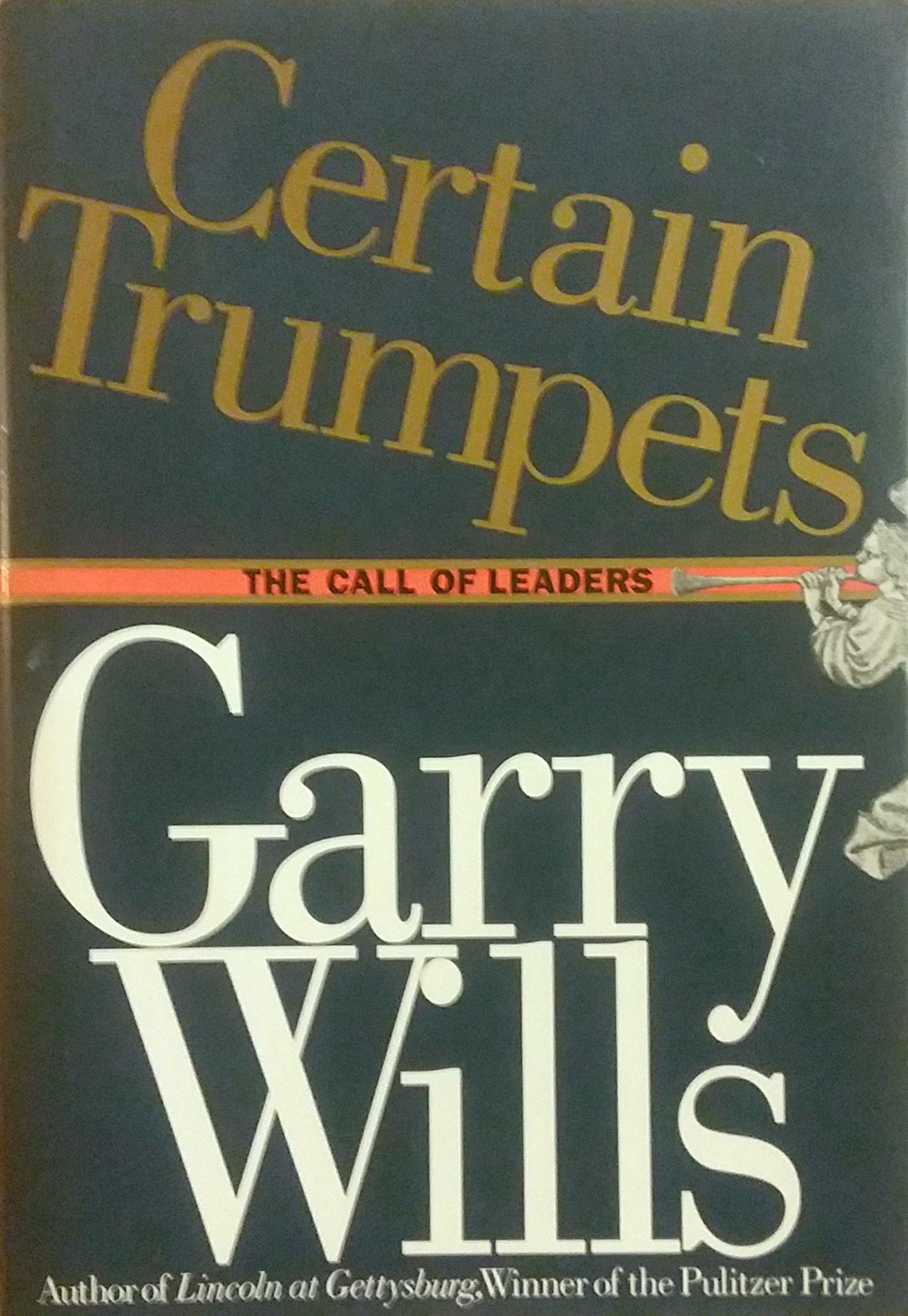



An examination of leadership that analyzes modes of leadership to better understand society offers profiles of a variety of leaders, including Harriet Tubman, Napoleon, Ross Perot, and Martha Graham. 25,000 first printing. $25,000 ad/promo. Tour. YA-Students will find food for thought in this volume of essays that attempts to compare and contrast styles of leadership by pairing successful leaders with antitypes. For instance, electoral giant Franklin Roosevelt is paired with Adlai Stevenson; Napoleon with George McClellan (military); Martin Luther King, Jr. with Robert Parris Moses (rhetorical). In every instance, consideration of the interests of followers and the ability to identify with them are deemed vital to the person's success. Roosevelt's experience with polio, for instance, allowed him to empathize with the struggles of ordinary citizens during the Depression. Stevenson, on the other hand, was aloof from the people, expecting his ideas to be enough to garner a following. In some instances, the pairs stretch the credibility of Wills's theory, and readers should be warned that the book is limited in biographical scope. Its narrow focus, however, brilliantly underscores its message. Jackie Gropman, Kings Park Library, Burke, VA Copyright 1994 Reed Business Information, Inc. Wills (Lincoln at Gettysburg, LJ 5/1/92) identifies 16 historical figures who fit his definition of a leader-one who motivates others toward a common goal shared by the followers. His subjects include high-profile leaders like Washington, Roosevelt, and Napoleon and less conspicuous individuals like Carl Stotz, Dorothy Day, and Andrew Young. His categories include some curious selections-Eleanor Roosevelt for reform leadership, Socrates for intellectual leadership, and Pope John XXIII for traditional leadership. Wills concludes the section on each type with a brief analysis of an antitype, e.g., Stephen A. Douglas is presented as the antitype to the radical leadership of Harriet Tubman. The author admits that his are not necessarily the greatest or best of leaders; rather, they illustrate distinct kinds of ability. He concludes that whom one admires as a leader is an insight into the inner self. An important book by an important author, this volume is highly recommended for all academic and public libraries. --Boyd Childress, Auburn Univ. Lib., Ala. Copyright 1994 Reed Business Information, Inc. The Pulitzer Prize-winning commentator and historian once again offers lucid, unique thinking on various sociopolitical situations from the past. What he had to say in the wise and revisionist Lincoln at Gettysburg (1992) is the perfect antecedent to what he has to say now; in the previous book Wills showed how our sixteenth president, a verbal magician, changed the way people interpreted the North's intent in the Civil War through his short speech at Gettysburg. Lincoln was a great leader, and leadership is Wills' subject here. In a series of short profiles of outstanding leaders at work, he analyzes the nature of leadership and its variations in practice within different contexts: politics, the military, business, religion, sports, the arts, etc. The format is particularly edifying in that for each of the individuals Wills presents as a good leader, he submits a counterpoint: an "antitype" (as he calls it), an individual who was bad at exactly what the superior political or religious or business leader was good at. "Mobilization toward a common good" is the sheer definition of leadership Wills tenders, and from Franklin Roosevelt to Harriet Tubman to Martha Graham, he informs us what that concept has meant in action. Beautifully written and reasoned. Brad Hooper Wills (History/Northwestern) has written a stunningly literate and thoughtful examination of what makes a leader. The 1992 Pulitzer Prize winner (Lincoln at Gettysburg) has been pondering this question publicly in much of his writing, and the essays in this volume show that his work has not been in vain. Leadership is a quality that grows out of a reciprocal engagement between two contrasting wills. One leads, often in disguised ways, while the other follows, often resisting. Consequently, Wills says, ``leadership is always a struggle, often a feud.'' In order to focus on how that struggle is won or lost, Wills has devised 16 categories of leadership, ranging from elected to saintly, from sports to military, and has chosen one exemplar per category, offering a brief biography of each. In addition, he has chosen ``anti-types'' who lack the very qualities their opposites exemplify (e.g., in business, Ross Perot is the archetype, Roger Smith the anti-type; among intellectuals, Socrates and Wittgenstein; in the performing arts, Martha Graham and Madonna). There is an excellent chapter on rhetorical leadership, in which Wills writes eloquently of Dr. Martin Luther King Jr., offering a brief but powerful analysis of the famous 1963 March on Washington speech. Along the way, Will