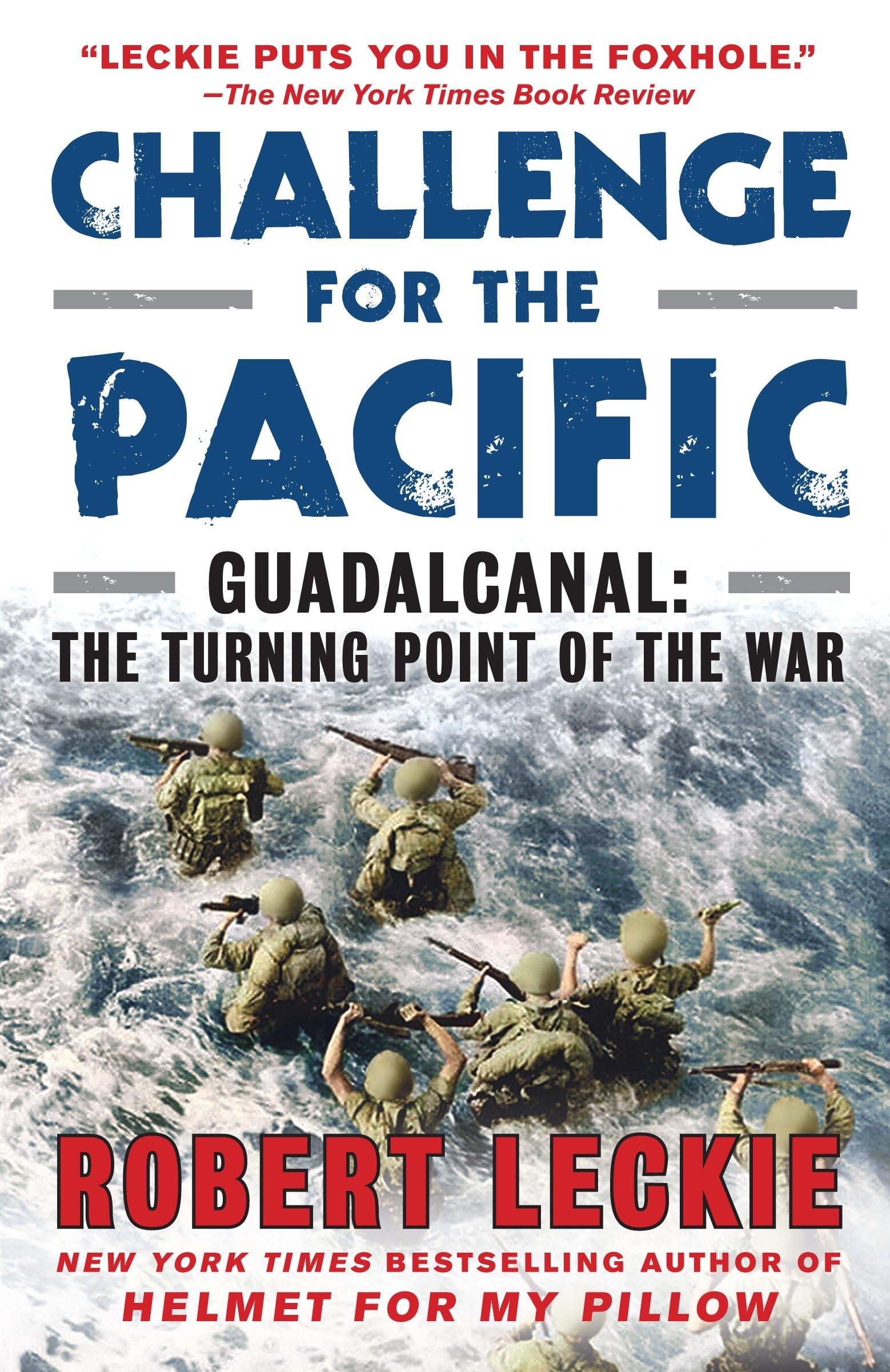
Challenge for the Pacific: Guadalcanal: The Turning Point of the War
$16.99
by Robert Leckie



From Robert Leckie, the World War II veteran and New York Times bestselling author of Helmet for My Pillow , whose experiences were featured in the HBO miniseries The Pacific , comes this vivid narrative of the astonishing six-month campaign for Guadalcanal. From the Japanese soldiers’ carefully calculated—and ultimately foiled—attempt to build a series of impregnable island forts on the ground to the tireless efforts of the Americans who struggled against a tenacious adversary and the temperature and terrain of the island itself, Robert Leckie captures the loneliness, the agony, and the heat of twenty-four-hour-a-day fighting on Guadalcanal. Combatants from both sides are brought to life: General Archer Vandegrift, who first assembled an amphibious strike force; Isoroku Yamamoto, the naval general whose innovative strategy was tested; the island-born Allied scout Jacob Vouza, who survived hideous torture to uncover the enemy’s plans; and Saburo Sakai, the ace flier who shot down American planes with astonishing ease. Propelling the Allies to eventual victory, Guadalcanal was truly the turning point of the war. Challenge for the Pacific is an unparalleled, authoritative account of this great fight that forever changed our world. “Leckie puts you in the foxhole.”— The New York Times Book Review “Fast-paced and informative . . . Characters are very much alive on the printed page.”— Navy Times “[A] stirring story of America’s survival in its grimmest hour . . . as readable and gripping as a novel.”— Patriot Ledger Robert Leckie (1920–2001) was the author of more than 30 works of military history as well as Marines! , a collection of short stories, and Lord, What a Family! , a memoir. Raised in Rutherford, New Jersey, he started writing professionally at age 16, covering sports for the Bergen Evening Record of Hackensack, New Jersey. Leckie enlisted in the United States Marine Corps on the day following the attack on Pearl Harbor, going on to serve as a machine gunner and as an intelligence scout and participating in all 1st Marine Division campaigns except Okinawa. He was awarded five battle stars, the Naval Commendation Medal with Combat V, and the Purple Heart. Helmet for My Pillow was his first book; it received the USMC Combat Correspondents Association Award upon publication. PART ONE: THE CHALLENGE CHAPTER ONE The admiral was tall, hard, and humorless. His face wasof flint and his will was of adamant. In the United States Navy which he commanded it was sometimes said, "He's so tough he shaves with a blow torch." President Roosevelt was fond of repeating this quip in the admiral's presence, hoping to produce, if there had been no reports of fresh disaster in the past twenty-four hours, that fleeting cold spasm of mirth-like an iceberg tick-which the President, the Prime Minister of England, and the admiral's colleagues on the Anglo-American Combined Chiefs of Staff were able to identify as a smile. If levity was rare in Admiral Ernest King, self-doubts or delusions were nonexistent. He was aware that he was respected rather than beloved by the Navy, and he knew that he was hated by roughly half of the chiefs of the Anglo-American alliance. Mr. Stimson, the U.S. Secretary of War, hated him; so did Winston Churchill and Field-Marshal Sir Alan Brooke and Admiral Sir Andrew Cunningham. Nevertheless, Admiral King continued to express the wish that was an athema in the ears of these men, as it was also irritating or at least unwelcome in the ears of General George Marshall, the U.S. Army Chief of Staff, and General H. H. Arnold, chief of the Army Air Force. Admiral King wanted Japan checked. He wanted this even though he was bound to adhere to the grand strategy approved by Roosevelt and Churchill: concentrate on Hitler first while containing the Japanese. But what was containment? Containing the Japanese during the three months beginning with Pearl Harbor had been as easy as cornering a tornado. The Japanese hadcrippled the U.S. Pacific Fleet and all but driven Britain from the IndianOcean by sinking Prince of Wales and Repulse. Except for scattered American carrier strikes against the Gilberts and Marshalls the vast Pacific from Formosa to Hawaii was in danger of becoming a Japanese lake. Wake had fallen; Guam as well; the Philippines were on their way. Japan's "Greater East Asia Co-Prosperity Sphere" had already absorbed the Dutch East Indies withall their vast and precious deposits of oil and minerals, it had supplanted the French in Indochina and evicted the British from Singapore. Burma, Malaya, and Thailand were also Japanese. The unbreachable Malay Barrier had been broken almost as easily as the invincible Maginot Line had been turned. Japan now looked west toward India with her hundreds of millions; and if Rommel should beat the British in North Africa, a German-Japanese juncture in the Middle Eastwould become a dreadful probability. Meanwhile, great