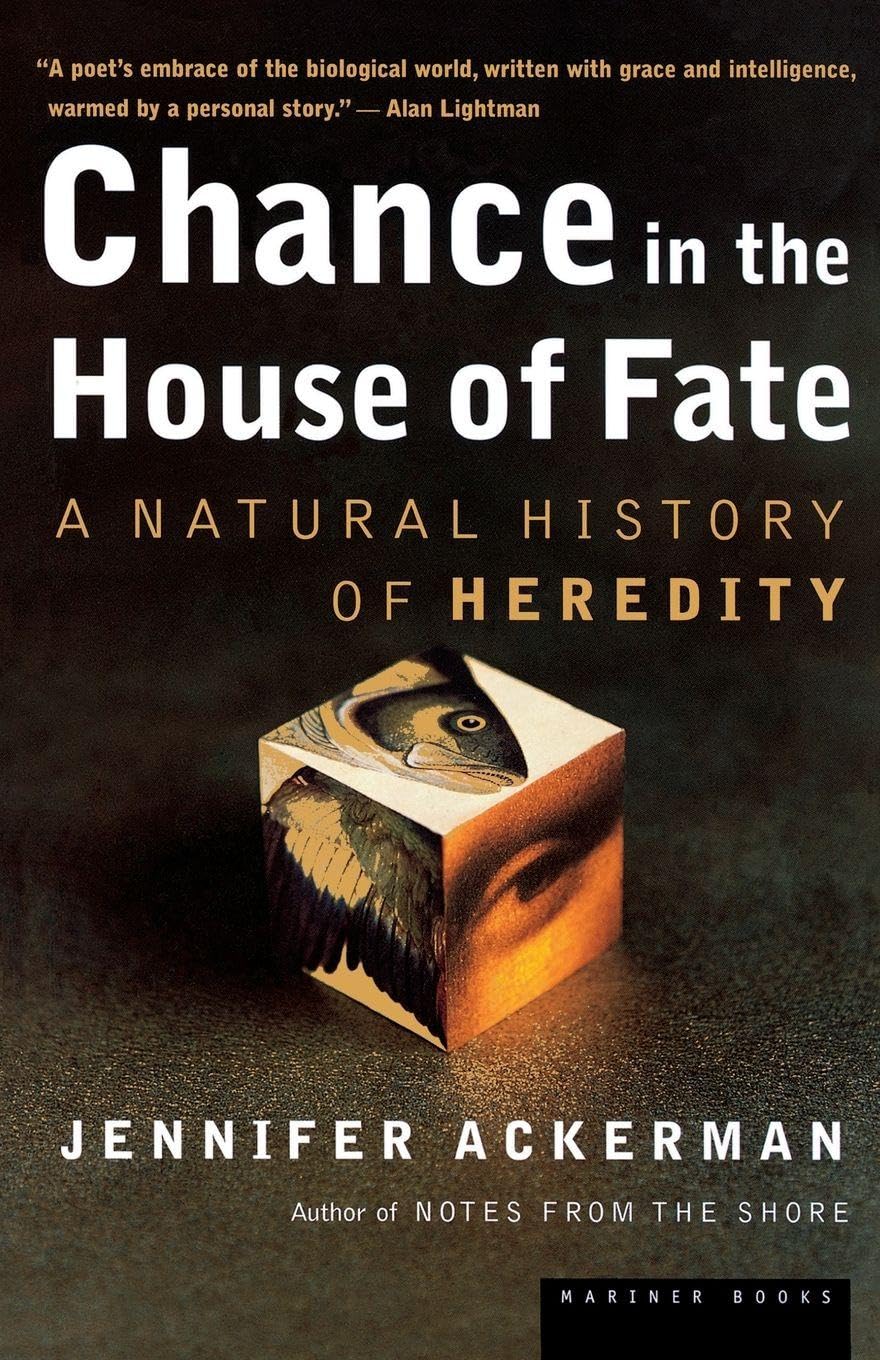



Award-winning science writer Jennifer Ackerman investigates the endless mysteries of genetics, offering an elegant natural history of humanity as seen through the lens of our genes and cells. Combining the gifts of vision and language with in-depth knowledge, Ackerman explores the ways in which, at the most fundamental level, humans are genetically linked to every part of the natural world. CHANCE IN THE HOUSE OF FATE is a rich and often personal tour through the surprising turns of heredity, informed by the ways genetic inheritance has affected Ackerman's own life. From a younger sister's profound retardation and her mother's illness to the births of her own healthy daughters, Ackerman reveals her own experiences as telling touchpoints, ultimately illuminating the the hidden biological connections among all forms of life. "...graceful, nearly lyrical at times...The way in which she focuses on the beauty of scientific language enriches her expertise." Bookpage "ponders the complexities of a common genetic inheritance among diverse organisms, from fruit flies to human beings" -Science News "...a beautiful story of the natural world that will inspire and educate without dampening wonder." The San Francisco Chronicle Jennifer Ackerman is the author of Notes from the Shore and Chance in the House of Fate. The recipient of a grant from the Alfred P. Sloan Foundation and literature fellowships from the National Endowment for the Arts and the Bunting Institute of Radcliffe College, she writes for National Geographic, the New York Times, and other publications. Chance in the House of Fate A Natural History of Heredity By Jennifer Ackerman Mariner Books Copyright © 2002 Jennifer Ackerman All right reserved. ISBN: 0618219099 Excerpt Preface There are mysteries in all families. Those that arrest me, that set me back on my heels, are the mysteries of heredity - the past whispered in bone and blood; the dozens of ancestors rolled up in one skin, to be read in "curve and voice and eye," as Thomas Hardy wrote, "the seeds of being that heed no call to die" but turn up again and again on the doorstep like a ne"er-do-well uncle. It seems astonishing that a sweep of eleven generations hardly modifies the night blindness of one family or the trembling jaw of another, that fifty or a hundred years may fail to alter a familial pattern of whorled eyebrow or "wolf"s" teeth, the musical genius of the Bach family, or the dimpled chin of my husband"s tribe. In the last decade or so, a startling new message has come out about the long hold of heredity. Members of the human family carry traits that have held on down the line not just for generations but for eons, traits that mock all boundaries of time and kind. Scientists probing the deep workings of organisms from yeast to humans have turned up news that despite our outward differences of life and limb, we are run by similar genes and proteins, similar cell parts and mechanisms, which have weathered evolution over ages, passing nearly intact through hundreds of millions of years of rising and falling forms. These shared molecules and routines affect nearly all the turnings of life, from birth and growth to perception and behavior. This book is a pilgrimage to the heart of heredity. It is a natural history not in the literal sense of a systematic inquiry, but rather in the etymological sense, a telling of stories about life, lineage, chance, and fate; about family, kin, and kind. It explores both the projecting traits of the human family - the one we"re born into and the one we create - and also the bigger, deeper inheritance that ties us to the rest of life in profound, even shocking ways. . . . I like to hang around the doorway of biological surprise. For years I have collected news of curious findings, of young spiders that eat their mothers, of a giant fungus infecting miles of Michigan forest spawned by a single spore in the last ice age, of fish with fingers, caterpillars with lungs, genes with secrets. I don"t profess to worship everything, but I do harbor strange sympathies fired by such discoveries, a kind of naturalist"s faith. This is the news that sweeps me away, the gnomic workings of the living order, nature"s inventive jack-in-the-box surprises that shift our view of life like the sudden twist of a kaleidoscope. Here is an item from my files. When scientists deciphered the intimate details of mating in yeast, that single-celled fungus that raises our bread and brews our beer, they got a shock. The molecule that draws two yeast cells into sex closely resembles one made by our own brain cells to regulate reproduction. The likeness seemed a fluke at first. But then other examples popped out of the box: genes that shape the bodies of fruit flies so like our own body-shaping Hox genes that one can put a human Hox gene into a developing fruit fly embryo, and it will carry out the job of the fly"s