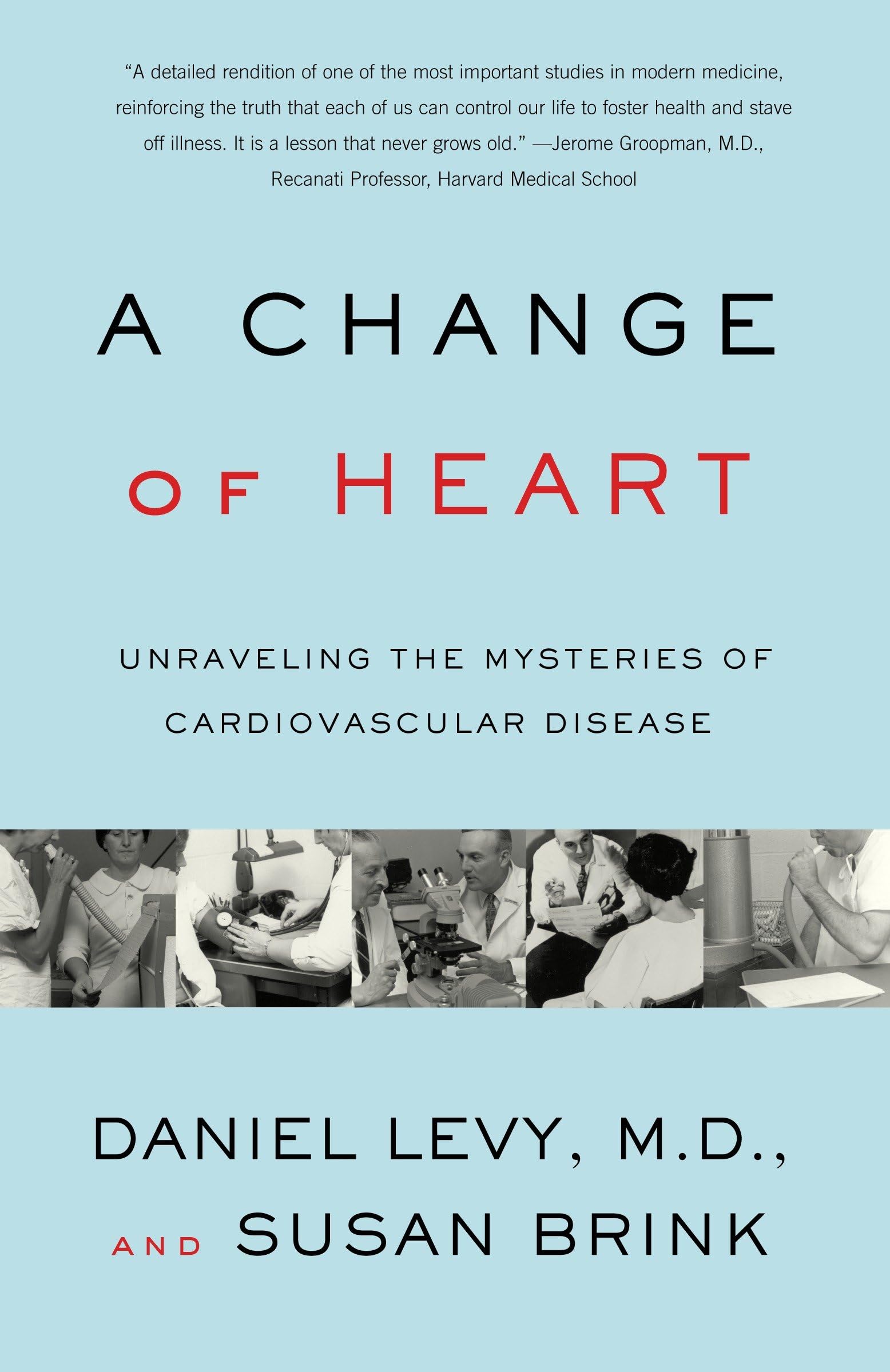
Change of Heart: Unraveling the Mysteries of Cardiovascular Disease
$14.88
by Daniel Levy M.D



A Change of Heart is a detailed account of the revolutionary Framingham Heart study — which, over the years, has provided conclusive evidence that cardiovascular disease is largely the result of measurable and modifiable risk factors. First begun in 1948, not long after Franklin Delano Roosevelt succumbed to a massive stroke, the study of over 5,000 citizens of Framingham, Massachusetts, changed the course of medical history. The lessons learned in Framingham allow each of us to control our risk of heart disease and stroke, two of the leading causes of death in the United States. Here is a clear-eyed and intriguing assessment of the achievements of this study and of its continuing importance to our health today. “A detailed rendition of one of the most important studies in modern medicine, reinforcing the truth that each of us can control our life to foster health and stave off illness. It is a lesson that never grows old.” –Jerome Groopman, M.D., Recanati Professor, Harvard Medical School “This book holds many lessons for the present. . . . A Change of Heart is an easy but exciting read. We owe a lot to Framingham.” – Nature "This account of the Framingham study . . . does justice to the courage and commitment of both the medical scientists and the patients who contributed so much to advancing the field of cardiology." – The Boston Globe “The Framingham Heart Study contributed considerable evidence about the important risk factors for cardiovascular disease, effective lifestyle adjustments, and preventative steps. . . . Scattered through the book are important lessons for the prevention of heart disease. . . . An engaging account.”– Science Daniel Levy, M.D., is the director of the Framingham Heart Study.Susan Brink is a senior writers for U.S. News & World Report . ONEA Killer of Paupers and PresidentsIt was April 12, 1945, and the country was heartbroken. Franklin D. Roosevelt, the thirty-second president of the United States, died suddenly in what had come to be known as the Little White House, a cottage in the woods of Pine Mountain near Warm Springs, Georgia. The public was unprepared for his death, though for many months his doctors knew that he was gravely ill. In keeping with the culture of the times, his personal physicians hid the grim reality of the president’s failing health from the press, from the public, from his family—even from FDR himself. Casualty of an as yet unrecognized epidemic, the leader of the free world slipped away.Roosevelt, his doctors, and the media had colluded to portray him as the picture of health. Long before he was elected president, in the summer of 1921 when he was thirty-nine years old, he fell victim to another epidemic. Polio rendered his legs nearly useless, his ability to walk nothing more than a simulation. He supported dead weight from the waist down with braces locked at the knee, and he would swing himself forward in a practiced rhythm between crutches. Throughout his life, the public saw him as strong, self-assured, and independent. No American was privy to the scene of Arthur Prettyman, FDR’s personal valet, strapping full-leg braces on the president as he lay supine in bed. The metal of each brace was painted black, and the president always wore black shoes and socks so as not to draw undue attention to the contraption. It was, like the title of Hugh Gregory Gallagher’s book, FDR’s Splendid Deception.1 His walk was seldom photographed, nor was the wheelchair on which he often depended. When a rare photographer violated the White House rule, Secret Service agents would seize the film and expose it. Only pictures of Roosevelt in a strong, erect stance or a comfortably seated position were permitted.Rumors that Roosevelt was in poor health circulated during his first run for president and were blamed on the opposition’s attempt to derail his candidacy. The country was in the throes of the Great Depression. America was mired in despair, and Roosevelt needed to prove that he was strong and steady. To still the gossip, he released his medical records in 1931. His blood pressure was 140/100—the 140 systolic only marginally hypertensive, but the 100 diastolic a bad omen. Even the most brilliant medical minds of the time possessed neither the knowledge to recognize the gravity of his disease nor the tools to treat it. The numbers did not raise questions, but periodic reports continued to emerge that he was ill. So in 1932 he took out a life insurance policy for $50,000, reassuring his supporters by passing the medical examination at the age of fifty.Shortly after assuming the presidency in 1933, in what may have been a fateful decision, Roosevelt selected Admiral Ross McIntire as his personal physician. Dr. McIntire was an ear, nose, and throat specialist whose main concern would be the president’s numerous head colds and sinus problems.Roosevelt took the helm of a nation at a time that would have taxed the hardiest of souls. America was then home to betwe