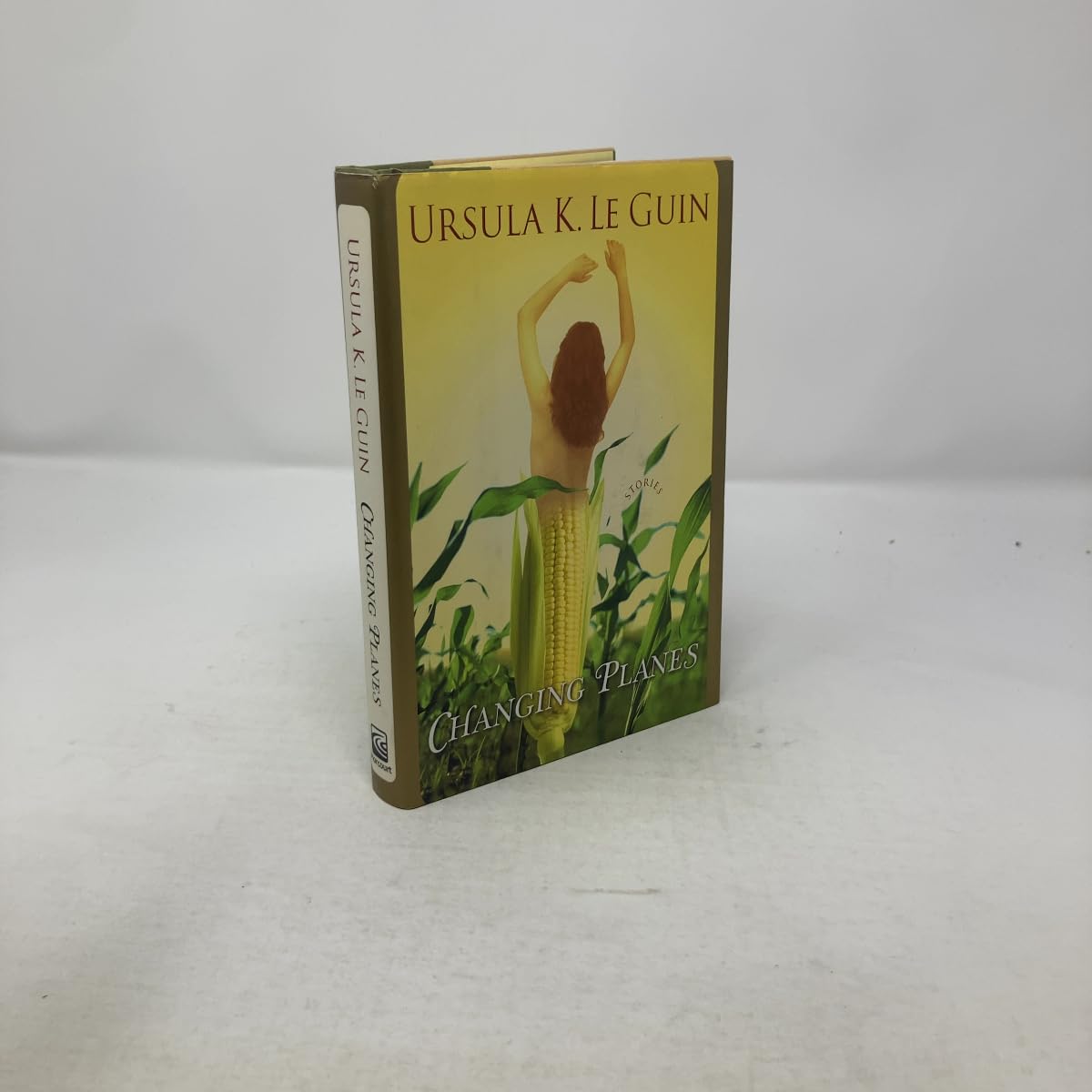



"Then came a child trotting to school with his little backpack. He trotted on all fours, neatly, his hands in leather mitts or boots that protected them from the pavement; he was pale, with small eyes, and a snout, but he was adorable." --from Changing Planes The misery of waiting for a connecting flight at an airport leads to the accidental discovery of alighting on other planes--not airplanes but planes of existence. Ursula Le Guin's deadpan premise frames a series of travel accounts by the tourist-narrator who describes bizarre societies and cultures that sometimes mirror our own, and sometimes open puzzling doors into the alien. Winner of the PEN/Malamud for Short Stories At first, readers may find Ursula K. Le Guin's collection Changing Planes rather light, if not slight. However, as the reader continues through its sixteen stories (ten of which are original to this volume), the collection achieves considerable weight and power. A punny conceit links the stories and provides the title of Changing Planes . Conceived before September 11, 2001, this conceit now, unfairly, looks odd. Trapped too many times in the misery of pre-terrorist airports, Sita Dulip discovered how to change planes: not airplanes, but planes of existence. Now the people of Sita's earth travel between alternate universes. The stories in Changing Planes are strong expressions of Le Guin's considerable anthropological and psychological insight. However, these tales don't follow traditional plot structures or character-development methods. They read more like travelogues, or socio-anthropological articles on foreign nations or tribes. They explore exotic literary planes lying somewhere between Jorge Luis Borges's ficciones and Horace Miner's anthropological satire Body Ritual Among the Nacirema . However, unlike Miner's parody, Le Guin's wise tales are rarely satirical, though "The Royals of Hegn" sharply skewers the absurdity of royalty-worship, and "Great Joy" rightly attacks the boundless corporate criminality familiar to anyone who's read a newspaper since 2001. One of America's greatest authors, Ursula K. Le Guin has received the National Book Award, the Newberry Award, the PEN/Malamud Award, five Nebula Awards, and five Hugo Awards. --Cynthia Ward "The airport offers nothing to any human being except access to the interval between planes." In Le Guin's series of 16 vivid stories, an airport-bound woman with an inquiring mind visits assorted other planes of existence. With dispassion, wry humor, and a keen eye, and aided as well by research conducted in libraries of various kinds, she describes those excursions in hopes of inducing the reader to try interplanary travel. Each story features a different society and culture, and some of these settings allow telling commentary on the foibles of our world. Hegn, for example, is a small plane on which everyone belongs to the royal family, except for one, carefully nurtured family of commoners. In Asonu, adults rarely say even one word, though the children chatter until they hit their teens, when they start becoming more and more silent. As for Hennebet, do its people experience reincarnation, or are they living again? The narrator's expectations of identity and time become very confused trying to grasp the slippery concept upon which that plane is based. And then there is unusually tenuous Zuehe, which imparts the feeling of being in a landscape created by the artist Escher. Eric Beddows' black-and-white illustrations perfectly complement Le Guin's wildly inventive array of societies and cultures. Sure to delight fans of the unusual travelogue, this is just plain good airport reading. Sally Estes Copyright © American Library Association. All rights reserved PRAISE FOR URSULA K. LE GUIN "{Le Guin] is a splendid short story writer. [Her] fiction, like Borges's, finds its life in the interstices between the borders of speculative fiction and realism."-- San Francisco Chronicle Book Review "The people, places and emotions in Le Guin's stories are typically strange, but her careful, sudden turns toward the familiar. . . seem like revelations of what's really important or fascinating about human life."-- Salon In this collection, Ursula K. Le Guin, winner of the National Book Award and the PEN/Malamud Award, presents a world where there is a better way of changing planes. Missing a flight, waiting in an airport, listening to garbled announcements-who doesn't hate that misery? But Sita Dulip from Cincinnati finds a method of bypassing the crowds at the desks, the long lines at the toilets, the nasty lunch, the whimpering children and punitive parents, the bookless bookstores, the blue plastic chairs bolted to the floor. A mere kind of twist and a slipping bend, easier to do than to describe, takes her not to Denver but Strupsirts, a picturesque region of waterspouts and volcanoes, or Djeyo, where she can stay for two nights in a small hotel with a balcony overloo