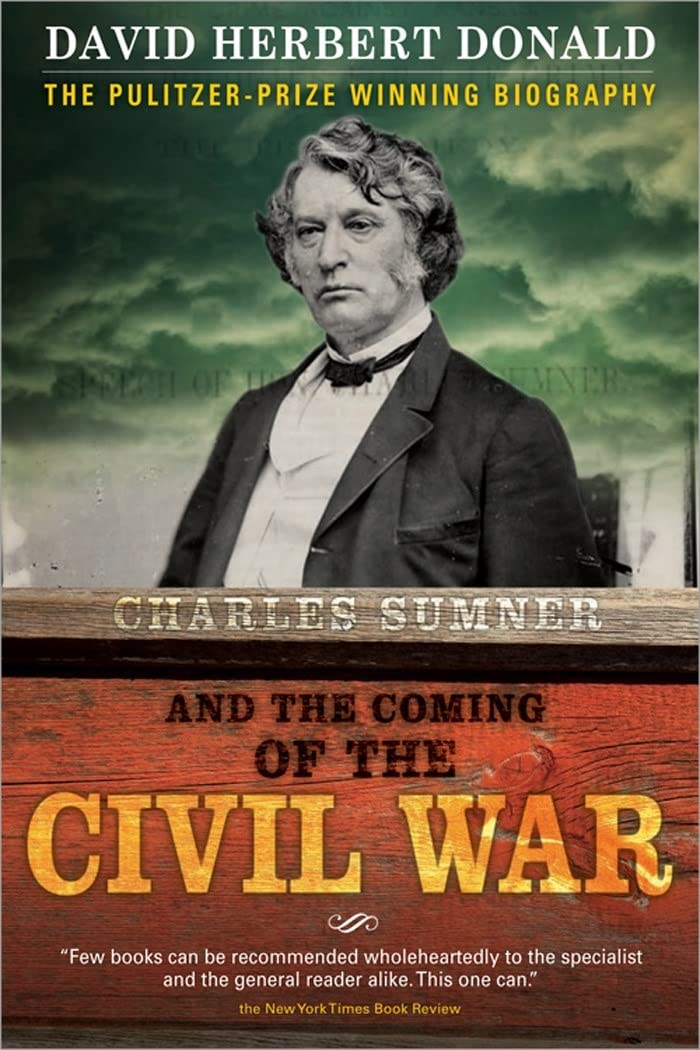



The Puliter-Prize winning classic and national bestseller returns! In this brilliant biography―a Pulitzer Prize―winning national bestseller―David Herbert Donald, Harvard professor emeritus, traces Sumner's life as the nation careens toward civil war. In a period when senators often exercised more influence than presidents, Senator Charles Sumner was one of the most powerful forces in the American government and remains one of the most controversial figures in American history. His uncompromising moral standards made him a lightning rod in an era fraught with conflict. Sumner's fight to end slavery made him a hero in the North and stirred outrage in the South. In what has been called the first blow of the Civil War, he was physically attacked by a colleague on the Senate floor. Unwavering and arrogant, Sumner refused to abandon the moral high ground, even if doing so meant the onslaught of the nation's most destructive war. He used his office and influence to transform the United States during the most contentious and violent period in the nation's history. Charles Sumner and the Coming of the Civil War presents a remarkably different view of our bloodiest war through an insightful reevaluation of the man who stood at its center. "A truly perceptive study." American Heritage "Few books can be recommended wholeheartedly to the specialist and the general reader alike. This one can." New York Times Book Review "[Full of] Donald's unparalleled knowledge and provocative interpretations." James M. McPherson, New York Times Book Review David Herbert Donald, who has twice been awarded the Pulitzer Prize for Biography, is Charles Warren Professor of American History and Professor of American Civilization Emeritus at Harvard University. His many books include Lincoln's Herndon, Lincoln Reconsidered, The Politics of Reconstruction, Charles Sumner and the Rights of Man, and Look Homeward: A Life of Thomas Wolfe. Excerpt from Chapter One THESE JOTTINGS ARE MADE FOR FRIENDLY EYES," THE NEWLY ELECTED senator from Massachusetts wrote as a postscript to his autobiography, "to be used more or less, or not at all, as shall be thought best." The senatorial contest of 1851 had been the most embittered and prolonged in Massachusetts history, and Charles Sumner wished to repel charges that he was a political nonentity, a mere rhetorician elected through an unholy and corrupt coalition. As his autobiographical notes had this practical purpose, they naturally were not modest, and Sumner's old friend and former Harvard professor, John Gorham Palfrey, to whom he entrusted them, was able to work them into a laudatory newspaper sketch of the new antislavery senator as a statesman whose name would illuminate "the historical page of the triumphs of Freedom in the nineteenth century." Touched by Palfrey's words, which, in fact, merely echoed his own, Sumner was delighted by "that beautiful sketch" of his career. "I felt a throb of gratitude to you," he wrote Palfrey, "but a deep feeling also of my own unworthiness As a composition your article is all that could be desired. As a token of friendship more than I deserve." 1 Sumner's autobiographical jottings, like Palfrey's published tribute to him, were revealingly reticent. The new Massachusetts senator stated that he had been born in Boston on January 6, 1811, but he had nothing else to say about his boyhood. Neither here nor at any other time did he look back to the good old days when Boston was a compact town of only 40,000 inhabitants, most of whom knew each other by sight. He never told anecdotes of playing in the mud flats of Back Bay, where now some of the proudest houses in Boston rise. He had no tales of wandering on the wharves, thronged with sailing ships manned by rough-voiced sailors shouting in unknown tongues. He never remembered roaming through the markets, sniffing the exotic aroma of tea from the Orient, tasting figs from Smyrna, and sampling barrels of West Indies molasses through straws adeptly inserted through the bungholes. He had no recollections of snowball fights on the Common or of sledding down Beacon Hill across the main thoroughfare of Washington Street in defiance of all traffic. Sumner never had the feeling of his contemporary, Edward Everett Hale, that Boston "was a good place in which to be born, and a good place in which to grow to manhood." Sumner's autobiography was equally silent on his genealogy. Though he knew that New Englanders had an almost Oriental reverence for their ancestors and delighted in tracing family lineages through assorted Patiences, Ashabels, and Eliphalets back to the founders of Massachusetts Bay Colony, the newly elected senator made no effort to exploit the fact that on both sides of his family he could claim industrious and God-fearing forebears who had settled in New England in the early 1630s. He did not mention that his mother's grandfather had been an extensive landholder, the surveyor of Hanover, in Plymouth County, a town