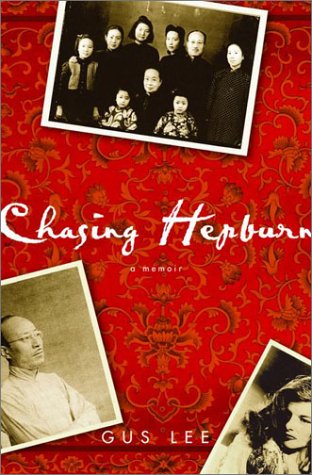



Chasing Hepburn is the story of the Lee family—a saga spanning four generations, two continents, and a century and a half of Chinese history. In the masterful hands of acclaimed author Gus Lee, his ancestors’ stories spring vividly to life in a memoir with all the richness of great fiction. From the time of her birth in 1906 it was expected that Gus Lee’s mother, Tzu Da-tsien, would become an elegant bride for a wealthy provincial man. But she was shunted onto a less certain path by age three, when her warmhearted father rescued her from her foot-binding ceremony in response to her terrified screams. This dramatic rejection of tradition was the first of many clashes that would lock the family in a constant struggle between Chinese customs and modern ways. Later, with the Chinese countryside in the grip of civil war, the Tzu family moved to Shanghai, seeking financial stability. There Da-tsien met Lee Zee Zee, the dashing son of the Tzus’ landlord, who lived across the street. With their patriarch succumbing to opium addiction, Zee Zee’s family was on the brink of ruin, and Da-tsien’s mother was working hard to secure her big-footed daughter’s marriage to a wealthy older man. But not even the protests of both families could keep the lovers apart, and these two socially displaced clans were reluctantly united. Over the course of their courtship and marriage, Zee Zee and Da-tsien would encounter the most important movements and figures of the times, including underworld gangsters, Communist students and workers, revolutionary armies, Christian missionaries, and legions of invading Japanese soldiers. Zee Zee became an ardent anti-Maoist and an ally of the highest-ranking leaders in the Chinese Nationalist movement. But his flights from tradition took him away from his young family—first into Chiang Kai-shek’s air force and later to America in search of his idol, Katharine Hepburn. Faced with this abandonment and with the chaos of the Japanese occupation, Da-tsien would rely on all of her resources, traditional and modern—faith, superstition, tremendous courage, and her strong feet—in an attempt to preserve her family. Gus Lee takes us straight into the heart of twentieth-century Chinese society, offering a clear-eyed yet compassionate view of the forces that repeatedly tore apart and reconfigured the lives of his parents and their contemporaries. He moves deftly from recounting intimate household conversations to discussing major historical events, and the resulting story is by turns comic, harrowing, heroic, and tragic. For most of her life, Da-tsien prayed for a son who would honor his family and respect his Chinese heritage. In this enthralling tribute, Gus Lee lovingly accomplishes both. In his first nonfiction book, novelist Lee (China Boy) writes a lively memoir that centers on the life of his family in Shanghai during the Chinese civil war. Lee's parents, T.C. Lee and Da-Tsien Tzu, broke with Chinese tradition and arranged their own marriage. In their courting years, watching first-run movies in Shanghai in the early 1930s, they were attracted to strong-willed actress Katharine Hepburn and recognized each other's determination to be independent. T.C. Lee, a hyperactive person who chose a mobile career in the Chinese military and befriended the wealthy T.A. Soong, met Hepburn and became romantically involved with other American actresses in Hollywood. In the meantime, while raising their children and still living with her in-laws and parents in China, Da-Tsien Tzu became devoted to Western Christianity and eventually "walked across China" during the Japanese occupation with three of her children to reunite with her husband in California in the 1940s. Lee reveals how his parents struggled to mesh American and Chinese images and values. Recommended for large public libraries. Peggy Spitzer Christoff, Library of Congress Copyright 2002 Reed Business Information, Inc. The violent opening scene is unforgettable: Da-tsien, a screaming three-year-old baby girl in Soochow, China, in 1909 is being held down to have her tiny feet broken in the traditional foot binding ceremony. Her kind, scholarly father rescues her just in time, but after that her mother viciously rejects the daughter with great big feet ("Who will marry her now?"). Da-tsien grows up in Shanghai to reject an arranged marriage when she is 14 and to choose as her husband the glamorous young rogue Zee Zee, from across the street. The couple falls in love watching American movies together, romanticizing Katharine Hepburn, who represents independence and glamour, far from the restrictions of Chinese tradition. And yet, what's most devastating is that this brave, liberated Da-tsien still feels bound by her "destiny" to produce a son, and she bitterly rejects her second daughter as viciously as her own mother rejected her. Meanwhile her restless husband wants adventure, and he continually abandons his family to the violent upheaval of China's c