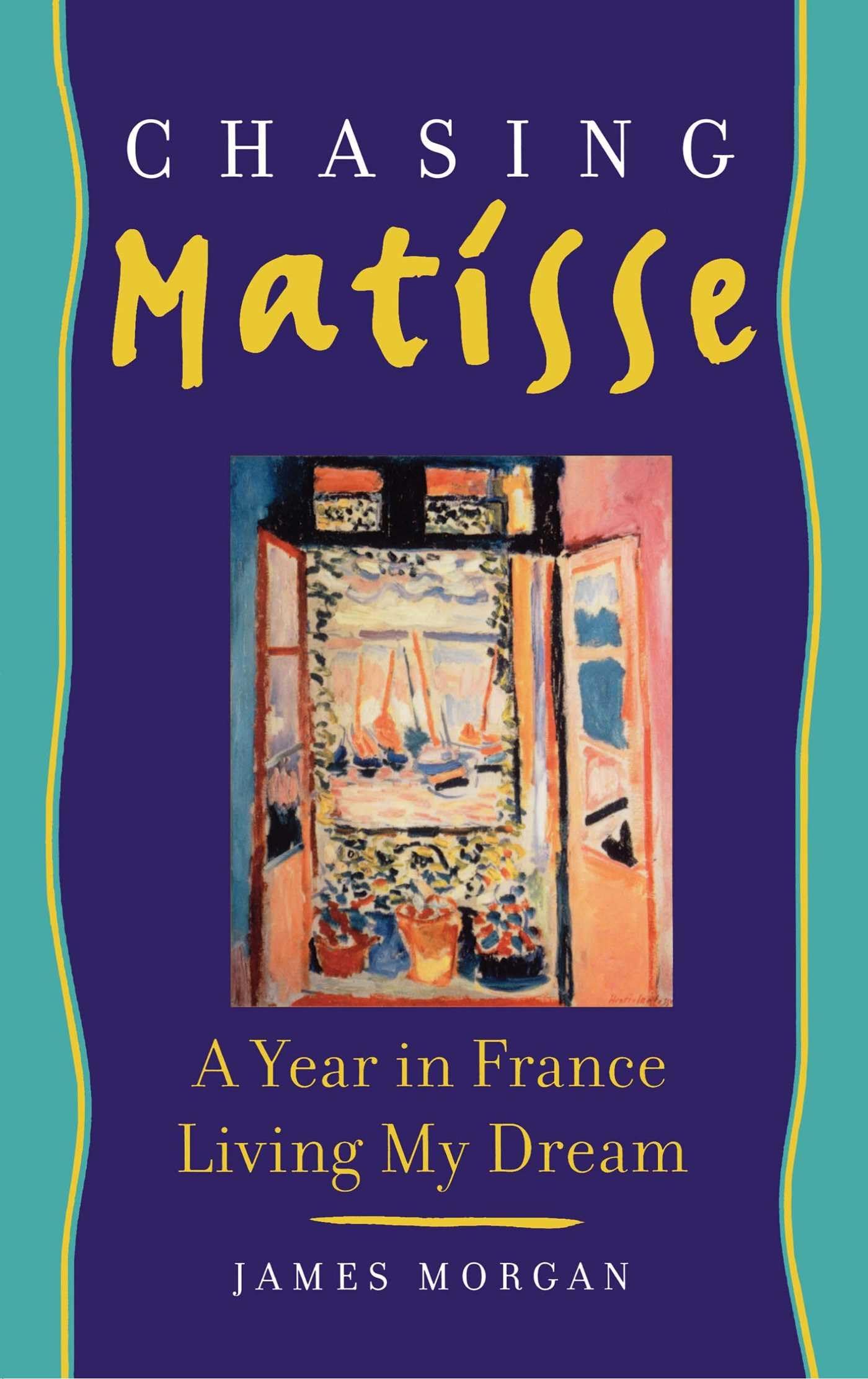



Who hasn't had the fanthasy of leaving his or her old life behind to start over? What would happen if you gave up your job, city, state, and routine to move to another part of the world? Critically acclaimed writer and aspiring painter James Morgan does just that. Risking everything, he and his wife shed their old, settled life in a lovingly restored house in Little Rock, Arkansas, to travel in the footsteps of Morgan's hero, the painter Henri Matisse, and to find inspiration in Matisse's fierce struggle to live the life he knew he had to live. Part memoir, part travelogue, and part biography of Matisse, Chasing Matisse proves that you don't have to be wealthy to live the life you want; you just have to want it enough. Morgan's riveting journey of self-discovery takes him, and us, from the earthy, brooding Picardy of Matisse's youth all the way to the luminous Nice of the painter's final years. In between, Morgan confronts, with the notebook of a journalist and the sketchpad of an artist, the places that Matisse himself saw and painted: bustling, romantic Paris; windswept Belle-île off the Brittany coast; Corsica, with its blazing southern light; the Pyrénees village of Collouire, where color became explosive in Matisse's hands; exotic Morocco, land of the secret interior life; and across the sybaritic French Riviera to spiritual Vence and the hillside Villa Le Rêve -- the Dream -- where the mature artist created so many of his masterpieces. A journey from darkness to light, Chasing Matisse shows us how we can learn to see ourselves, others, and the world with fresh eyes. We look with Morgan out of some of the same windows through which Matisse himself found his subjects and take great heart from Matisse's indomitable, life-affirming spirit. For Matisse, living was an art, and he never stopped striving, never stopped creating, never stopped growing, never stopped reinventing himself. "The artist," he said, "must look at everything as though he were seeing it for the first time." That's the inspiring message of renewal that comes through on every page of Chasing Matisse . Funny, sad, and defiantly hopeful, this is a book that restores our faith in the possibility of dreams. James Morgan is the author of the New York Times Notable Book The Distance to the Moon and the critically acclaimed If These Walls Had Ears: The Biography of a House. He also collaborated with Virginia Kelley, President Clinton's mother, on her bestselling autobiography, Leading with My Heart. Morgan's articles and essays have appeared in numerous national media, including The New Yorker, Atlantic Monthly, The Washington Post Magazine, Men's Journal, and National Geographic Traveler. He and his wife now live in Paris. Visit www.chasingmatisse.com Chasing Matisse 1. Up in Charcoal Country WHERE WE COME from is never just a place on a map. The red roads are drawn in the blood of our veins, the green hills in the faith of our earliest hopes and dreams, and sometimes the blue rivers in the wash of our tears. Topography is a fingerprint. Beth and I left Paris for Matisse’s Picardy on a cold blustery Saturday in December, our leased Peugeot 307 wagon loaded down like a gypsy’s caravan. This wasn’t the car she had wanted us to get. Convinced that a station wagon would be too small, she had pressed for a minivan. At the Arc de Triomphe, a circle of madness that felt like a metaphor, I steered the car around a swath of pavement half a football field wide jammed with cars, trucks, bicyclists, and even Rollerbladers all going as fast as they could, darting this way and that, peeling off inches in front of one another to turn at any number of the spokes that branch out sadistically from the center. All I had to do was glance in my rearview mirror to know that Beth had been right. In our car, there wasn’t even a clear sight line to the back window. Instead, I saw shifting mounds of coats, hats, suitcases, book boxes, file folders, computer bags, art supplies, and even our income tax records (we are, hilariously, a corporation). We seemed to be trying to haul our own topography with us. “We look like the Joads,” I said. “Jwahds,” said Beth, correcting my French. We traversed the usual pattern of modern office buildings, depressing apartment houses, giant discount stores, and factories. Then, in a surprisingly short time, the buildings were gone and cows were grazing. Soon we came upon a sign proclaiming “Picardie: Terre Fertile.” I had long wondered what Matisse’s boyhood world looked like, and now I was in it. Picardy approaching winter was a muddy palette, a somber and cheerless farm landscape as far as the eye could see. It didn’t strike me as the celebratory sort of fertility you find in Provence. This looked like hard-work country. Matisse was born, on December 31, 1869, in the little textile town of Le Cateau-Cambrésis. Eight days later, the family moved a few miles south to Bohain-en-Vermandois, where Monsieur Matis