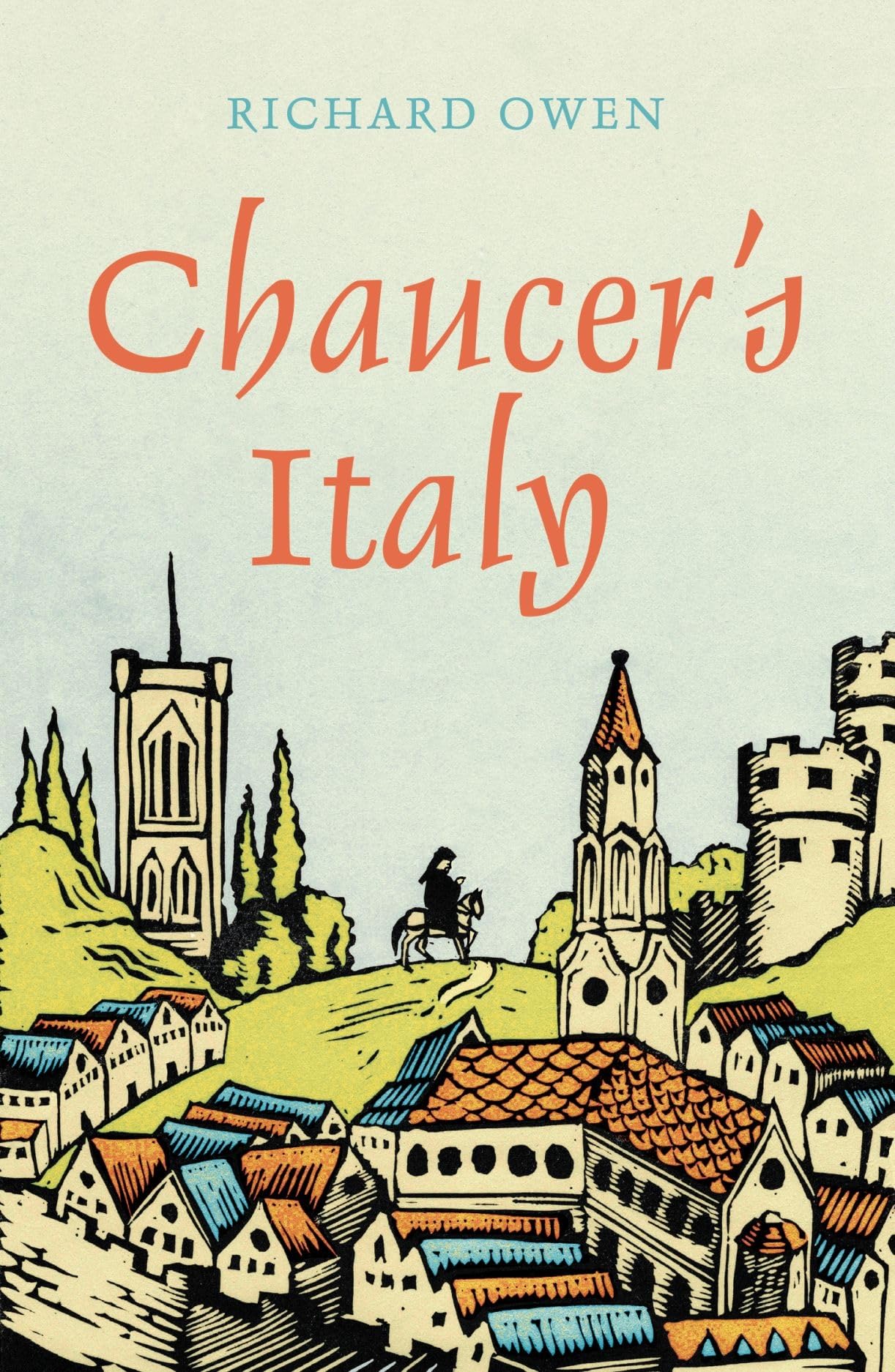



An exploration of the influence of Italy and Italians on Chaucer’s life and writing. Geoffrey Chaucer might be considered the quintessential English writer, but he drew much of his inspiration and material from Italy. In fact, without the tremendous influence of Francesco Petrarch and Giovanni Boccaccio (among others), the author of The Canterbury Tales might never have assumed his place as the “father” of English literature. Nevertheless, Richard Owen’s Chaucer’s Italy begins in London, where the poet dealt with Italian merchants in his roles as court diplomat and customs official. Next Owen takes us, via Chaucer’s capture at the siege of Rheims, to his involvement in arranging the marriage of King Edward III’s son Lionel in Milan and his missions to Genoa and Florence. By scrutinizing his encounters with Petrarch, Boccaccio, and the mercenary knight John Hawkwood—and with vividly evocative descriptions of the Arezzo, Padua, Florence, Certaldo, and Milan that Chaucer would have encountered—Owen reveals the deep influence of Italy’s people and towns on Chaucer’s poems and stories. Much writing on Chaucer depicts a misleadingly parochial figure, but as Owen’s enlightening short study of Chaucer’s Italian years makes clear, the poet’s life was internationally eventful. The consequences have made the English canon what it is today. "A fascinating insight into Chaucer’s world." -- Mary Hollingsworth, author of Princes of the Renaissance "Owen performs the remarkable feat of showing us Italy through Chaucer’s eyes. It’s a wonderful evocation of the vibrant intellectual, commercial and cross-cultural exchanges at the height of the Middle Ages—and the perfect read for a getaway break to Florence, Genoa or Milan." -- Ross King, author of The Bookseller of Florence "By scrutinizing his encounters with Petrarch, Boccaccio, and the mercenary knight John Hawkwood (and with vividly evocative descriptions of the Arezzo, Padua, Florence, Certaldo, and Milan that Chaucer would have encountered), Owen reveals the deep influence of Italy's people and towns on Chaucer's poems and stories. Much writing on Chaucer depicts a misleadingly parochial figure, but as Owen's enlightening short study of Chaucer's Italian years makes clear, the poet's life was internationally eventful... Inherently interesting, deftly written, impressively organized and presented." ― Midwest Book Review Richard Owen was The Times correspondent for fifteen years. Owen has written several works of non-fiction, including Crisis in the Kremlin: Soviet Succession and the Rise of Gorbachov , Letter from Moscow and Lady Chatterley’s Villa: DH Lawrence on the Italian Riviera . In a collection of stories called the Decameron, the Italian author Giovanni Boccaccio tells of an elderly nobleman in ancient Greece named Nicostrato, whose young and beautiful wife Lidia is ‘badly served in that one thing in which young women take most pleasure’. She falls in love with Pirro, a handsome servant; she then pretends to be ill, gets Nicostrato and Pirro to carry her into a garden, and asks Pirro to climb into a pear tree to pick some pears for her. Pirro looks down, pretends he can see the husband and wife making love, and says the pear tree must have the power of optical illusion. Old Nicostrato climbs into the tree to check this out, looks down, and sees Pirro and his wife making love on the ground. He climbs down in a fury, calling his wife a ‘wicked slut’ – but, by the time he reaches the ground, the lovers have separated. They convince him that the pear tree is bewitched and must have made him see an illusion. Some forty years later, Chaucer, writing his Canterbury Tales, sets the story in Italy, which is where he probably first read it, or perhaps heard it. In his version, called ‘The Merchant’s Tale’, an elderly bachelor knight in Pavia called January decides to marry ‘a young and pretty woman’ called May. But January goes blind and, when he takes his wife into the garden, May climbs up into a pear tree to make love to a handsome servant called Damian. January regains his sight and sees Damian ‘thrusting away’ up in the pear tree – or, as Chaucer puts it, ‘and sodeinly anon this Damian gan pullen up the smok and in he throng’. Old January is furious, calling his wife a whore, but she claims that by ‘struggling with a man up a tree’, as she had been told to do in a vision, she had cured his blindness, ‘as God is my witness’. Because of the magic pear tree, January is imagining things, May says, adding, ‘this is all the thanks I get for curing your blindness’ and bursting into histrionic tears. Chaucer never wrote an autobiography. We do not know if the Chaucer who narrates the Canterbury Tales – portly, selfeffacing, ironic, slightly detached, and sometimes naive or not very bright – is how Chaucer saw himself, how he wanted to be seen, or how he really was seen. (…) But the real Chaucer was a man of enormous diplomatic and business expe