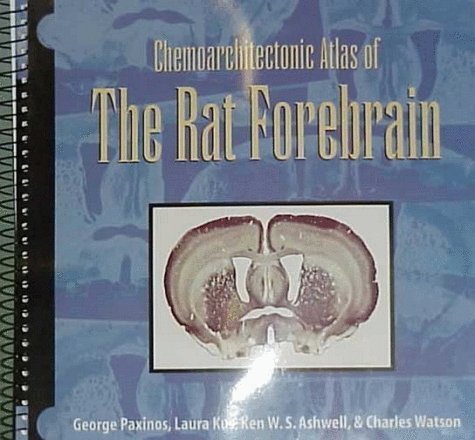



Chemoarchitectonic Atlas of the Rat Forebrain , featuring 242 fully labeled, large photographs, is the most comprehensive atlas of the rat forebrain ever published. It identifies brain structure not only on the conventional Nissl-stained sections but on additional six stains of interest to neuroscientists. This authoritative atlas provides comprehensive information about the location of chemicals in the rat forebrain, while redefining brain regions on the basis of the distribution of these substances. Key Features * 242 fully delineated photographic plates in a large 13" x 14" format * Sets new standards of accuracy in the delineations of brain regions * Based on a single brain sectioned in the coronal plane * Presents at regular intervals photographs of sections stained for parvalbumin, calbindin, calretinin, neurofilament protein (SMi32), Nissl, tyrosine hydroxylase, and NADPH/diaphorase. * An excellent companion to The Rat Brain in Stereotaxic Coordinates, Compact and Fourth Editions , and Chemoarchitectonic Atlas of the Rat Brainstem Chemoarchitectonic Atlas of the Rat Forebrain , featuring 242 fully labeled, large photographs, is the most comprehensive atlas of the rat forebrain ever published. It identifies brain structure not only on the conventional Nissl-stained sections but on additional six stains of interest to neuroscientists. This authoritative atlas provides comprehensive information about the location of chemicals in the rat forebrain, while redefining brain regions on the basis of the distribution of these substances. @introbul:Key Features @bul:* 242 fully delineated photographic plates in a large 13" x 14" format * Sets new standards of accuracy in the delineations of brain regions * Based on a single brain sectioned in the coronal plane * Presents at regular intervals photographs of sections stained for parvalbumin, calbindin, calretinin, neurofilament protein (SMi32), Nissl, tyrosine hydroxylase, and NADPH/diaphorase. * An excellent companion to The Rat Brain in Stereotaxic Coordinates, Compact and Fourth editions , and Chemoarchitectonic Atlas of the Rat Brainstem Ken Ashwell works in the School of Medical Sciences at The University of New South Wales, Sydney, Australia. George Paxinos has written 62 books on the brain of humans, monkeys, rodents and birds. His first atlas, The Rat Brain in Stereotaxic Coordinates , is the most cited neuroscience publication. His Atlas of the Human Brain received The Award for Excellence in Publishing in Medical Science (Assoc American Publishers, 1997) and The British Medical Association Illustrated Book Award (2016). His eco-fiction book A River Divided (georgepaxinos.com.au) considers the question of whether the brain in the Goldilocks Zone - the right “size for survival. Charles Watson is a neuroscientist and public health physician. His qualifications included a medical degree (MBBS) and two research doctorates (MD and DSc). He is Professor Emeritus at Curtin University, and holds adjunct professorial research positions at the University of New South Wales, the University of Queensland, and the University of Western Australia. He has published over 100 refereed journal articles and 40 book chapters, and has co-authored over 25 books on brain and spinal cord anatomy. The Paxinos Watson rat brain atlas has been cited over 80,000 times. His current research is focused on the comparative anatomy of the hippocampus and the claustrum. He was awarded the degree of Doctor of Science by the University of Sydney in 2012 and received the Distinguished Achievement Award of the Australasian Society for Neuroscience in 2018.