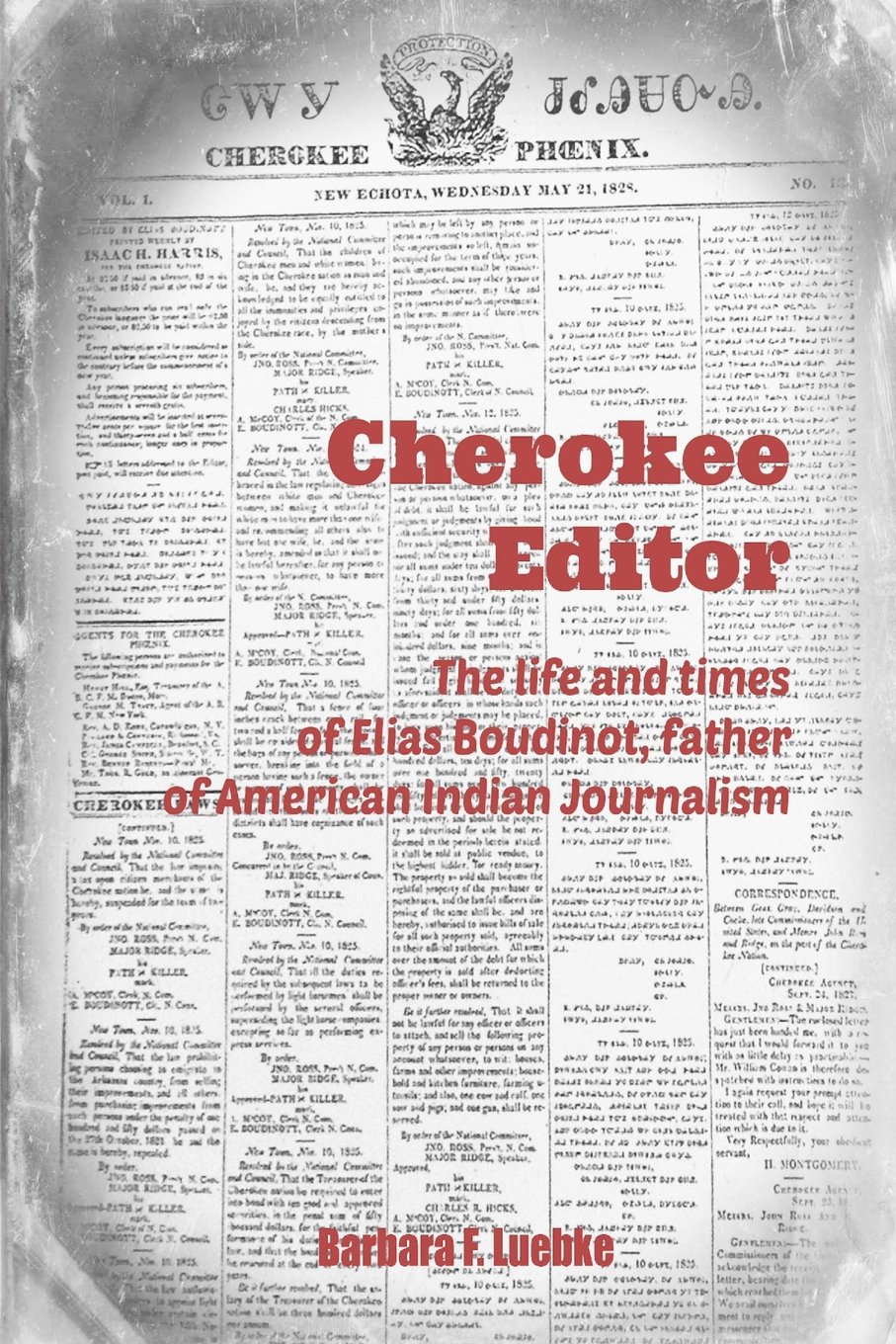
Cherokee Editor: The life and times of Elias Boudinot, father of American Indian Journalism
$8.99
by Barbara F. Luebke



The story of American journalism includes many men and women who history, for the most part, overlooks. One such man is the Cherokee who guided the development of the first Indian newspaper and edited it during its early years. Educated by missionaries in the Cherokee Nation and New England, Elias Boudinot was no ordinary Cherokee and no ordinary editor. His life story is intertwined with his people’s as they progressed into the 19th century. Part biography and part history, Cherokee Editor draws extensively on the pages of the Cherokee Phoenix to tell its story in Boudinot’s own words. Aimed at young-adult readers in particular, it is a story with 21st century themes, including racism, political feuds, government heavy-handedness, a controversial Supreme Court ruling and assassinations. Barbara F. Luebke was born in West De Pere, Wisconsin. She composed her first story at age seven and has been writing and editing ever since. She holds a B.A. degree in journalism from Wisconsin State University-Eau Claire, an M.S. in journalism from the University of Oregon and a Ph.D. in journalism from the University of Missouri. After short stints as a newspaper reporter and editor, she began her career in journalism education in 1974, at the University of Missouri School of Journalism. She subsequently taught at Eau Claire, returned to Missouri, then left again -- for the East and the University of Hartford. In 1989 she was hired as chair of the Department of Journalism at the University of Rhode Island. After 10 years, she joined Fitchburg (Mass.) State College as its first dean of undergraduate studies. She eventually returned to URI, from which she retired in 2012. In addition to academic articles on Elias Boudinot and women in the news media, she is the co-author, with Mary Ellen Reilly, of Women's Studies Graduates: The First Generation. She has published four Blurb books: Island Bark: Hilton Head Discoveries; Mayo and More: An Irish Holiday; Musings of a newly retired professor; and An Alphabet for Max.