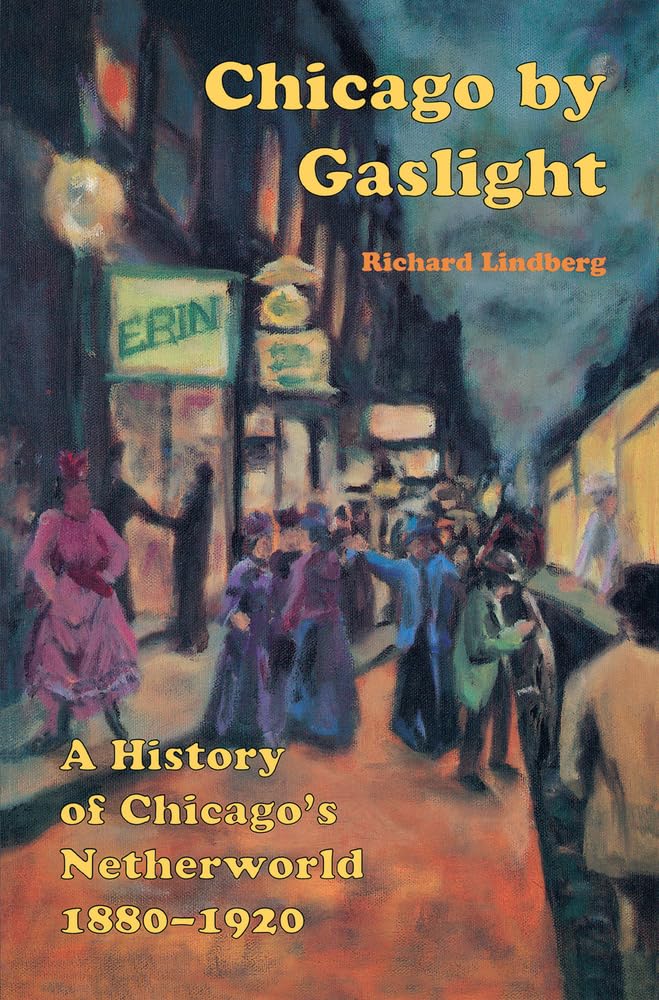
Chicago by Gaslight: A History of Chicago's Netherworld: 1880-1920
$17.95
by Richard Lindberg



This book revises the picture of the glittering Chicago of impressive mansions and museums; it exposes the city's corrupt underbelly and the realities of life in an age which is often assumed to have been simpler and more moral than ours. Includes chapters on the Haymarket riot, the gamblers' wars, the notorious levee red-light district and institutionalized graft. "... lively anecdotes of the social elite, the powerful gamblers, criminals and corrupt "boodling" politicians." — Publishers Weekly "Mr. Lindberg... has done a prodigious amount of research and has come up with a host of new and delicious details." — Chicago Sun-Times Richard C. Lindberg grew up in Chicago's Norwood Park neighborhood. His nine books include "Chicago by Gaslight: A History of the Chicago Netherworld, 1880-I 920, The White Sox Encyclopedia, "and "The Armchair Companion to chicago Sports. "He is the former editor of the "Illinois Police and Sheriff's News "and served as head writer and senior editor for the Edgar Award-winning "Encyclopedia of World Crime." Chicago by Gaslight A History of Chicago's Netherworld, 1880-1920 By Richard Lindberg Academy Chicago Publishers Copyright © 1996 Richard Lindberg All rights reserved. ISBN: 978-0-89733-421-1 Contents Acknowledgments, Preface, I. Derby Day, 1885, II. Haymarket, III. The Boodlers and the Great Escape, IV. 1896: The Summer of Silver and Gold, V. A New Century, 1901, VI. Low Life in the Levee, VII. Interlude: Love and Betrayal in the City, VIII. Bombs, Gamblers and Newspaper Wars, IX. 1919: The Summer of Lost Innocence, Appendix, Notes, Bibliography, Photographs and illustrations between pages 110–11, CHAPTER 1 Derby Day, 1885 The social event of the summer season in Chicago in 1885 was the running of the famed American Derby at the Washington Park Race Track, 61st Street and Cottage Grove Avenue. Under a radiant blue sky on June 27, the carriages left the portechochères of the stone mansions on Prairie and Michigan avenues, Grand and Drexel boulevards, the homes of the Ryersons, the Catons, the Chauncey Blairs, the Armours. A man's carriage was the measure of his worth when he travelled to Washington Park for the Derby. For weeks, the C.P. Kimball Company had been producing carriages for this day. Twenty-six hand-crafted rigs had been sold to Chicago millionaires in just twenty-one days: double suspension victorias, demi-landaus, tilburys, stanhope phaetons, Tally-ho coaches, langhams, dog carts. The true display of regal ostentation was the promenade down Grand Boulevard and across to Drexel, with its tree-lined parkways and great houses. And while some men chose to ride ahead of their family coaches on their favorite thoroughbreds, everyone wanted an English coachman and an English groom. The demand was so great that some "English" coachmen were actually Americans with fake accents and fake resumes. The drive south to the racetrack took half an hour at a leisurely pace. A brief noon shower had given way to sunshine, so the carriage tops were lowered and ladies in the conveyances could twirl their parasols as they acknowledged friends they saw along the route. The boulevards were alive with people. A social observer commented in the Chicago Inter-Ocean: "Such a gathering of thoroughbred animals, such a meeting of the highest social elements, such a display of fashion, elegance and wealth and beauty had never been seen upon any race course in the country." Washington Park had been created in the winter of 1882–83 when it was obvious that Chicago Driving Park, on the western fringe of the city, was inadequate. The new racetrack was officially chartered on February 10, 1883, "to promote good fellowship among its members by providing a clubhouse and pleasure grounds for their entertainment where at all times they may meet for social intercourse, and further, to encourage by providing the proper facilities, raising, improving, breeding, training, and exhibiting horses at meetings to be held at stated times each year." Architect Solon Beman's design of the clubhouse was financed by 174 stockholders, where access was limited to the 800 families prominent in Chicago since the days of John Kinzie and Mark Beaubien. These were in the main of English descent — the city's Swedes, Poles, Irish, Jews and Germans were excluded. It was considered a great honor to belong to the Washington Park Clubhouse. The city's elite belonged to clubs. One of the most prestigious was the Commercial Club, where the sixty members were the captains of trade and industry, who gathered on the last Saturday of each month to discuss an assigned topic over brandy and cigars. These topics, of which members were informed in advance by the club secretary through a courier, ranged from discussion of railroad rates to elegant plans for civic improvement. There were many clubs: the Union League, the Union, the Iroquois, the Calumet, with its imposing 8-by-13 foot portrai