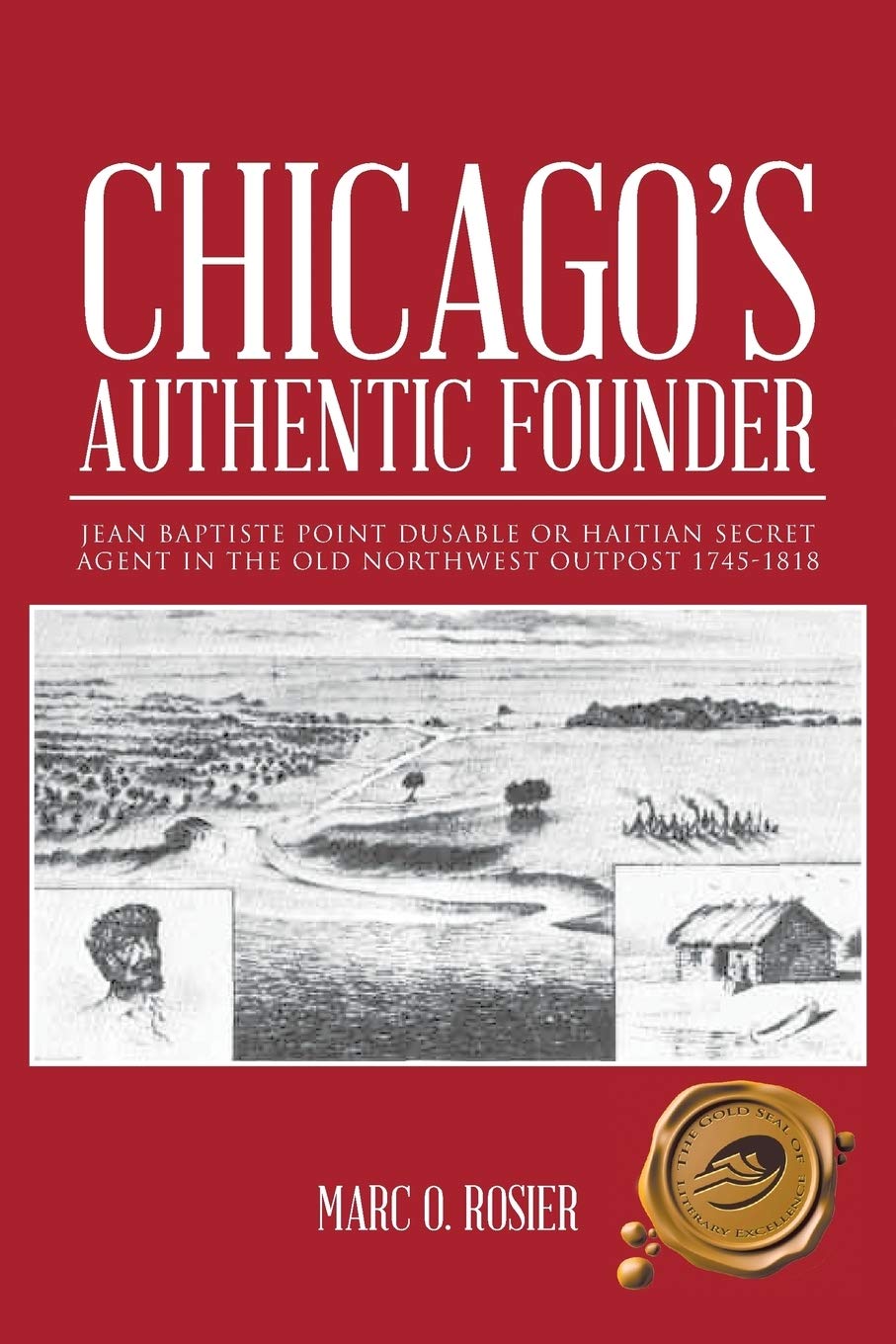
Chicago's Authentic Founder: JEAN BAPTISTE POINT DUSABLE OR HAITIAN SECRET AGENT IN THE OLD NORTHWEST OUTPOST 1745-1818
$26.97
by Marc O. Rosier



Chicago's Authentic Founder traces the life and time of Jean Baptiste Point DuSable from Haiti through Louisiana, Peoria, Chicago, and Saint-Charles, Missouri, where he died in 1818. It examines important historical events such as the foundation of Chicago, George Rogers Clark's conquest of the French villages in Illinois, and DuSable's arrest and appointment as manager of the Pinery in Michigan. The extent of DuSable's Chicago business or trading post is treated in full. DuSable's life in Saint-Charles is recounted in light of various court documents. His relationship to and leadership of the Pottawatomi tribe is explored and analyzed in ways that correct many of the inaccuracies found in the accounts publicized by the Kinsies and their allies. This volume contains many photos depicting DuSable's grave site, former places of residence, artistic representation, the cabin along the Chicago River, etc. DuSable's place of origin-Saint-Domingue, today's Haiti-as represented by Juliette Kinsie's Wau-Bun, is fully explored. The aggression of the European colonial powers and of the United States against Haiti after the successful Haitian Revolution and subsequent Haitian sponsorship of abolitionist and revolutionary activities is explored at length to show the reader possible motivation for associating DuSable with Haiti. Though widely admired by Native Americans and the older class of settlers in the contested territories of Illinois, Indiana, and Michigan, new American settlers, who arrived in Chicago after the building of Fort Dearborn, sought to discredit DuSable and to erroneously proclaim John Kinzie Chicago's founder. Chicago's Authentic Founder Jean Baptiste Point Dusable or Haitian Secret Agent in the Old Northwest Outpost 1745-1818 By Marc O. Rosier Trafford Publishing Copyright © 2015 Marc O. Rosier All rights reserved. ISBN: 978-1-4907-2653-3 Contents Introduction, xi, Chapter I: A Speck from the Columbian Storm, 1, Chapter II: Coming and Going in the Empire, 18, Chapter III: The Question of Origin, 36, Chapter IV: DuSable Emerges from the Two Lands, 59, Chapter V: Onward to Peoria, 84, Chapter VI: The Seed of Departure, 112, Chapter VII: DuSable Enters the Land of the Potawatomi, 146, Chapter VIII: DuSable Founded Modern Chicago, 177, Chapter IX: Assessing the Need, 186, Chapter X: The Northwest in the Balance, 195, Chapter XI: In the Hands of Commandants and Chiefs, 232, Chapter XII: Fleeing the Harvest, 262, Chapter XIII: St. Charles, Missouri, 307, Chapter XIV: Enemies, Friends, and Colleagues: The DuSable Circle, 339, Chapter XV: Haiti as the Continental Lighthouse, 352, Chapter XVI: Retaliation of the Colonial Powers and the Forces of Slavery, 389, Chapter XVII: The Empire Builders, 410, Chapter XVIII: The Campaign for Disinheriting DuSable, 451, Chapter XIX: Conclusion, 478, Selected Bibliography, 501, Appendix A: Aux Habitans D'haïti., 523, Index, 527, CHAPTER 1 A Speck from the Columbian Storm Christopher Columbus's audacious voyage of conquest to the New World and subsequent Spanish plunder of the continent's gold generated intense protest by the Portuguese and inflamed the jealousy of several other European countries. Many of those powers — Italian city-states, France, and England — had failed to sponsor the now very lucrative adventure, a rejection they came to regret. Indeed, since the early 1430s the Portuguese had reached the outskirts of Africa. Within less than two decades hence, the West and East African trading networks had been disrupted and taken over by Portuguese merchants. In light of Christopher Columbus' 1492 voyage to the Americas, a second papal bull became necessary. Portugal pursued the papal decree without delay in order to force Spain to respect previous agreements reached regarding Portugal's right of ownership over lands south of Cape Bojador. This avenue was to be Portugal's only hope of curtailing Spain's giant gains, as announced by Columbus. Pope Alexander, himself a Spaniard, attempted to settle the dispute between Spain and Portugal by dividing the pagan world into two spheres of occupation. Portugal was to take all lands east of the Azores and the Cape Verde Islands, and Spain all lands to the west. In the compromise that followed the pope's judicious intervention, Spain ceded Brazil to Portugal. This arbitrary division, however, was not applauded by all the other candidates who, in search of trading opportunities and raw materials, such as Spain enjoyed, had invested resources during these daring voyages of discovery. Had those been the only two contenders and coveters of the wealth of the nations and tribal lands in Asia, Africa, Australia, and the New World, the issue would probably have been resolved in the sixteenth century. Many future conflicts that were to follow, resulting in the deaths of millions of indigenous peoples, would have been averted. That was not the case. Britain, France, Holland, and R