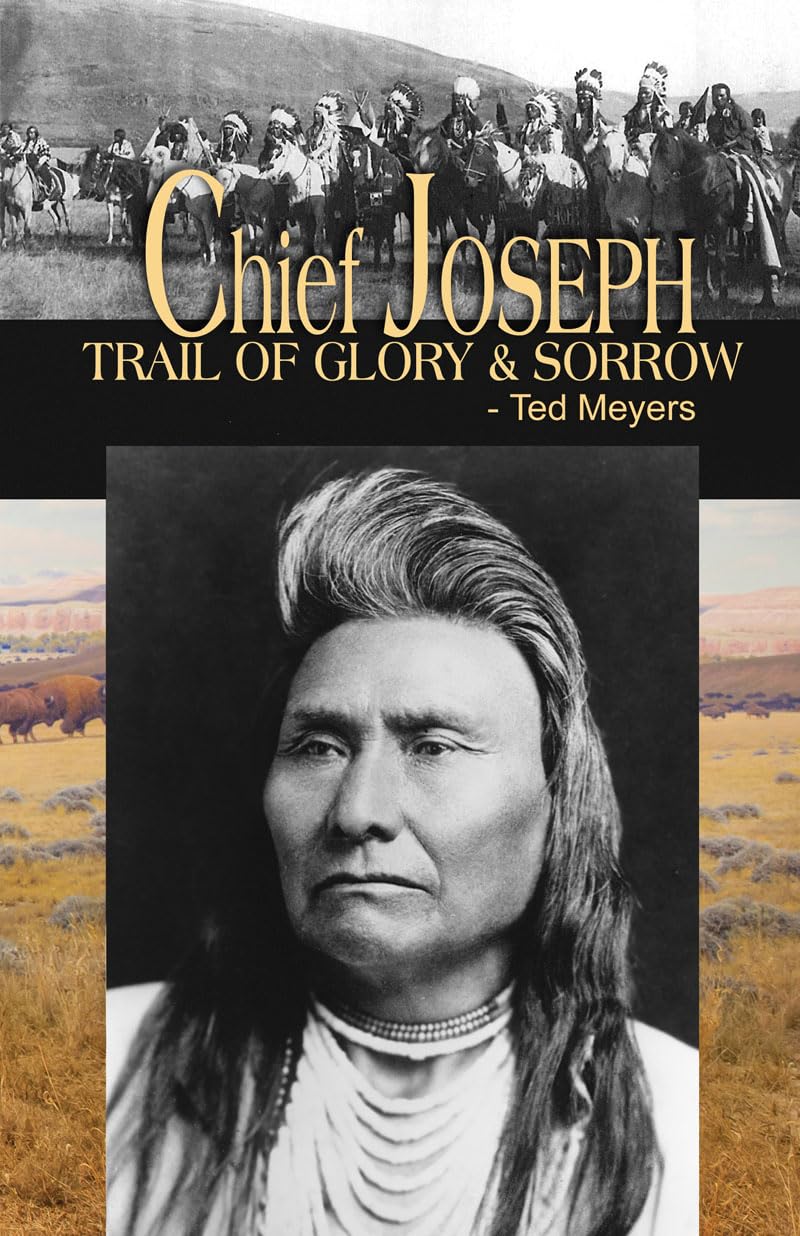



This great Chief’s Indian name Heinmot’tooyalakekt meant “Thunder Traveling to High Places Then Returning”. He received it from his Father who considered thunder he heard shortly after his son’s birth to be an omen from the Great Spirit. As an omen it had validity.Joseph, as he became known to settlers and historians, led his people in a revolt against mandatory resettlement in 1877. He was never a war chief; he was a civic chief but his diplomatic skills were ignored or swept aside by Washington bureaucrats and politicians in a series of Treaty betrayals and broken promises. By 1877 Joseph and three allied chiefs had suffered enough and he led his people on a five month trek that exceeded 1500 miles through what are now the States of Oregon, Washington, Idaho, and Montana. At every step, with less than 200 warriors, he defeated and humiliated Washington’s great Army of the Northwest until finally, with safety in Canada a mere 45 miles away his people, hungry and without adequate supplies, could resist no longer. Although more than 300 of the refugees escaped to Canada, Joseph and the remainder sued for peace. He made an honorable agreement with the two generals involved but that pact was also torn up by their political masters in Washington. The sub-title, Trail of Glory and Sorrow, tells the story in one line. he first part of his trail is The Glory and the second part is The Sorrow.Although several books about this illustrious chief have been written most cover only segments of his life. None cover the entire Trail from his birth c.1840 to his death in 1904. None explain the reasons for the revolt or the aftermath. None cast the blame upon those most responsible for the revolt – two US Presidents, several State and Territorial Governors, three ranking generals, a rogue missionary and dozens of minor federal bureaucrats. This book covers the entire Trail of Glory and Sorrow. Sandwiched between the Author's Note, Quotes, Preface, Introduction, Prologue and Appendices A through M, Timeline, Bibliography, Index, Acknowledgements and Maps, and interspersed with copious chapter endnotes and 50-some pages of glossy photos in the middle is a big book about legendary Nez Perce leader Chief Joseph. Relying on contemporary Nez Perce, military, civilian, newspaper and other published accounts, the author paints a well-written and vivid portrait of Chief Joseph, chronicling his extraordinary accomplishments while putting ot rest much of the mythology that has grown up and flourished around his memory. Rod Miller, Roundup Magazine There are far too few accounts of the Native Americans and their travails battling the U.S. Government. One group, in particular, has suffered from a lack of scrutiny. The Apache, the Sioux, Cochise and Sitting Bull have had their due. "Chief Joseph" chronicles the great Nez Perce leader who fought well and led his people on a arduous trek of 1,500 miles that traversed Oregon, Idaho and Montana to perceived safety in Canada in 1877. The journey was complicated by a pursuing U.S. Army. Ted Myers spent a decade laying out this massive tribute to Joseph, a significant and final Indian champion. His research and detail are overwhelming. Scores of previously unpublished facts are awash in "Chief Joseph." The Nez Perce story is laced with betrayals of both the U.S. and Canadian governments. Myers details the 1877 war and the many events that led to the final conclusion. Chief Joseph, at long last, receives proper historical attention. Kudos to my longtime colleague from the Western Canadian Province, British Columbia. This book is a must read for those of us who are compelled to learn the history of the West. Scott Dyke, Green Valley News This great Chief’s Indian name Heinmot’tooyalakekt meant “Thunder Traveling to High Places Then Returning”. He received it from his Father who considered thunder he heard shortly after his son’s birth to be an omen from the Great Spirit. As an omen it had validity. Joseph, as he became known to settlers and historians, led his people in a revolt against mandatory resettlement in 1877. He was never a war chief; he was a civic chief but his diplomatic skills were ignored or swept aside by Washington bureaucrats and politicians in a series of Treaty betrayals and broken promises. By 1877 Joseph and three allied chiefs had suffered enough and he led his people on a five month trek that exceeded 1500 miles through what are now the States of Oregon, Washington, Idaho, and Montana. At every step, with less than 200 warriors, he defeated and humiliated Washington’s great Army of the Northwest until finally, with safety in Canada a mere 45 miles away his people, hungry and without adequate supplies, could resist no longer. Although more than 300 of the refugees escaped to Canada, Joseph and the remainder sued for peace. He made an honorable agreement with the two generals involved but that pact was also torn up by their political masters in Washington. The sub-title,