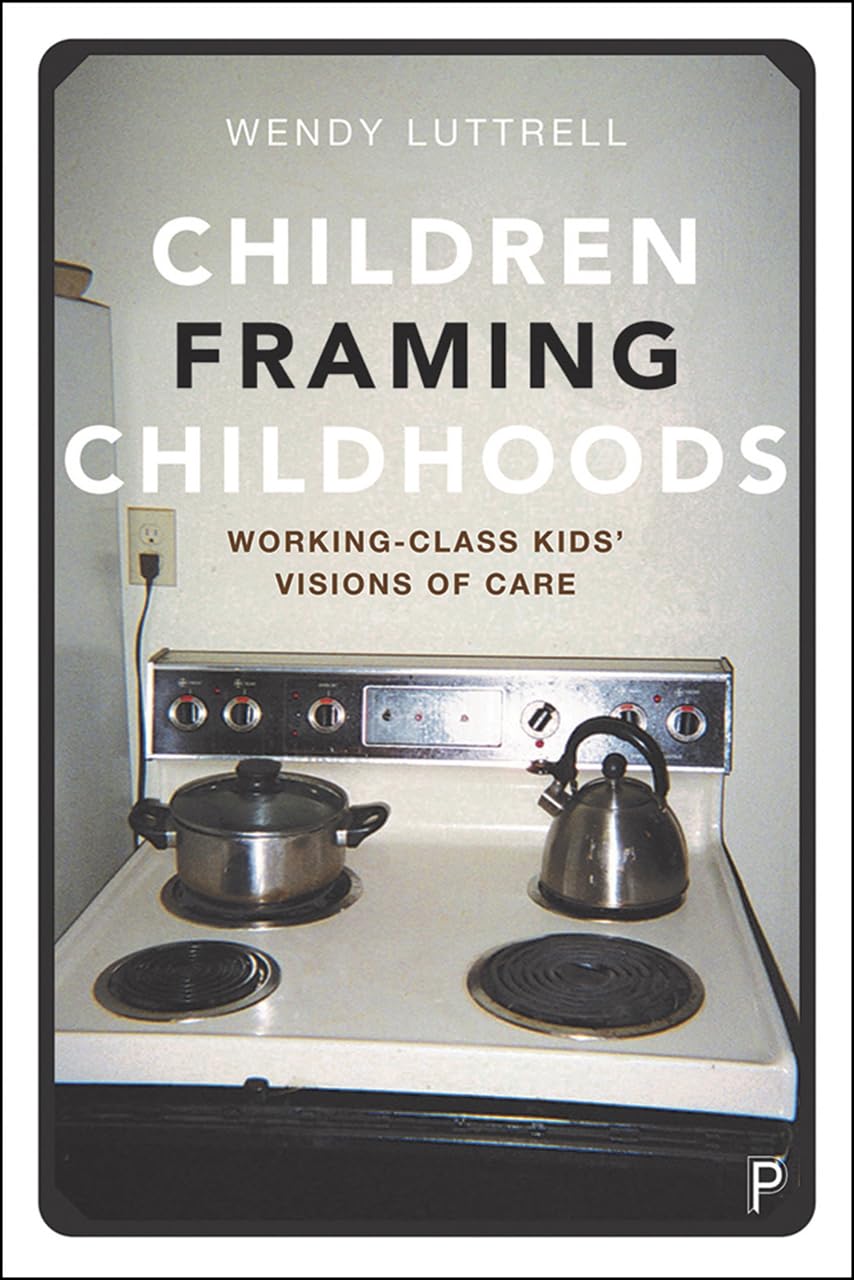



Urban educational research, practice, and policy is preoccupied with problems, brokenness, stigma, and blame. As a result, too many people are unable to recognize the capacities and desires of children and youth growing up in working-class communities. This book offers an alternative angle of vision―animated by young people’s own photographs, videos, and perspectives over time. It shows how a racially, ethnically, and linguistically diverse community of young people in Worcester, MA used cameras at different ages (10, 12, 16 and 18) to capture and value the centrality of care in their lives, homes, and classrooms. Luttrell’s immersive, creative, and layered analysis of the young people’s images and narratives boldly refutes biased assumptions about working-class childhoods and re-envisions schools as inclusive, imaginative, and care-ful spaces. With an accompanying website featuring additional digital resources (childrenframingchildhoods.com), this book challenges us to see differently and, thus, set our sights on a better future. "Children Framing Childhoods challenges the deficit models of working-class children by asking them to tell us what is important to know about school and home. Demonstrating their ways of doing care work offers adults lessons on how to create a caring environment and offers hope for the future of our country." Mary Romero, President of the American Sociological Association “A powerful book that centralizes the voices of children, specifically illuminating how working-class kids frame their childhoods―through photographs and related meanings and contexts. [It] has a strong and powerful focus on how social inequalities, especially related to class, race, and gender, shape how the children and young people learn and express what they feel entitled to, constrained by, and how they envision their future possibilities. Overall, the most powerful and crucial of the children’s stories and photographs is the depth that is manifested in their profound and basic understanding about care―that care is work, something that requires time, effort, resources, and coordination, as well as attention and investment; it is also mundane, necessary, and arduous and affectively linked with social units and spaces (in this case, family, school, friendship circles, and communities). Care, then as Luttrell argues, is the basic currency of community―indeed, in a democratic society, it is the precondition of freedom itself.” Journal of Women and Social Work “I want to thank Wendy Luttrell for her big, bold ideas because in a time of institutional structures that perpetuate inequality and undermine our attempts to care, these ideas truly dare to change the world.” Janie Victoria Ward, Professor Emerita of Critical Race, Gender, and Cultural Studies, Simmons University Wendy Luttrell is Professor of Urban Education, Sociology and Critical Social Psychology at the Graduate Center, The City University of New York.