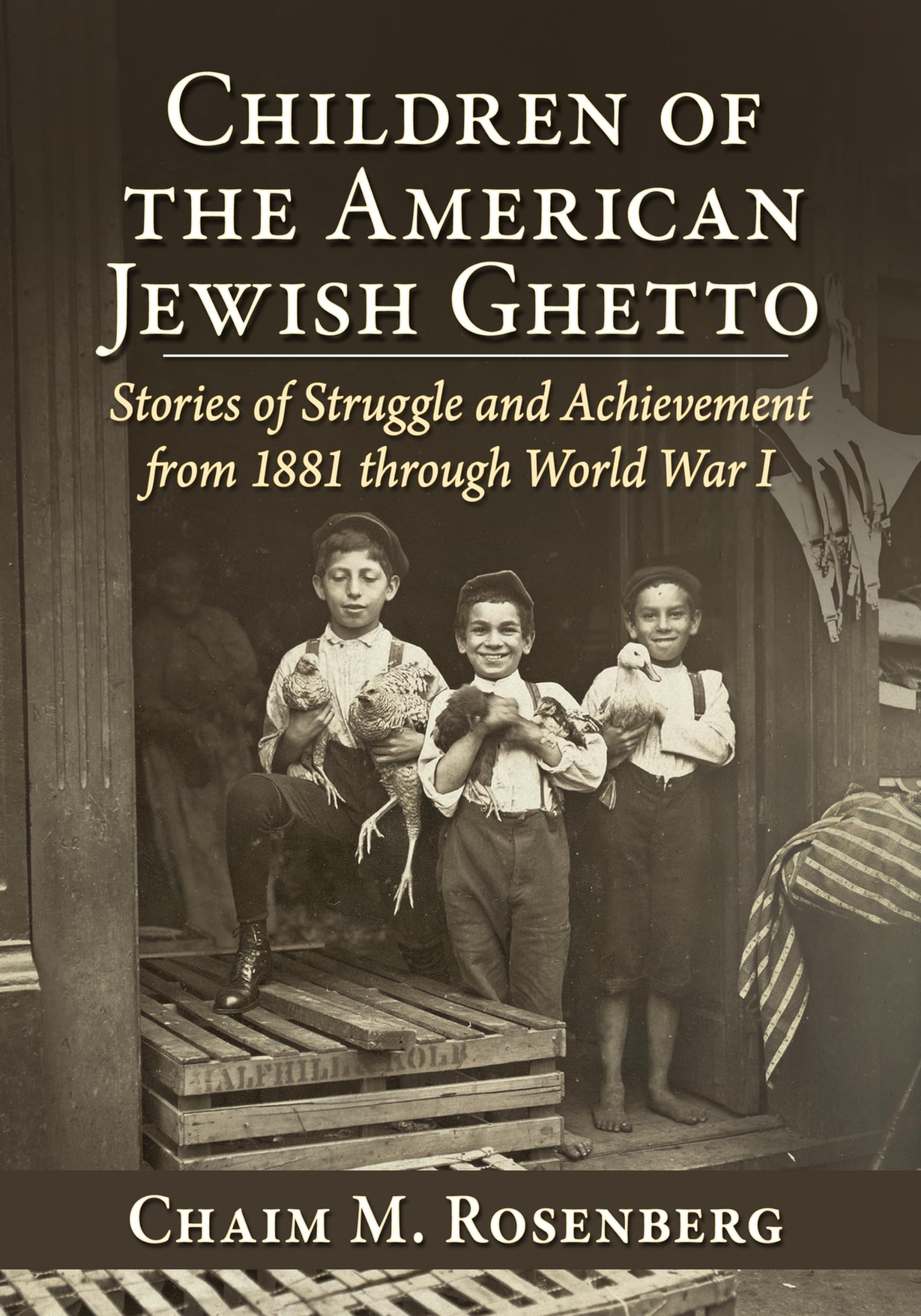
Children of the American Jewish Ghetto: Stories of Struggle and Achievement from 1881 through World War I
$39.95
by Chaim M. Rosenberg



Between 1881 and 1914, more than two million Jews came to America. Most were poor, from the stultifying shtetls of the Pale of Settlements of the Russian Empire, steeped in Jewish tradition and religion, and Yiddish-speaking. In New York, Philadelphia, Boston and Chicago they formed overcrowded Jewish ghettoes, living in cramped walk-up apartments and finding low-pay work in the clothing sweatshops or tobacco and cigarette factories. The children of the American Jewish ghetto had higher aspirations. From neighborhood elementary schools, the most academically gifted kids gained admission to elite high schools and acceptance into the nation's leading universities. Combining original thought with hard work, many reached the top levels in their chosen fields: in the sciences, the arts, academia, entertainment, Hollywood and in business. Despite anti-Semitism, more than 40 of them went on to become Nobel laureates, and many others were Pulitzer, Academy, Emmy and Tony award winners. This book shares the stories of many American-educated children of Jewish immigrants who emerged from American Jewish ghettoes. “A thorough and uplifting look at the learning, courage, and skill that took twentieth-century Jews from European shtetls and American ghettoes to the tops of their fields―from selling newspapers on the corner and working in sweat shops to winning the Pulitzer Prize, Academy Award, World Series, Olympic gold medals, and more! A brilliant compendium of relentless spirit and remarkable Jewish achievement.”―Michael Benson, author of Gangsters vs. Nazis “An outstanding social history of the trials, tribulations, triumphs, and tenacity of East European first- and second-generation Jewish immigrants to the United States. Building upon scholarly literature in both American Jewish history and immigration history, Rosenberg offers a textured and synthetic portrait of American Jewish life, especially the aspirations of children, between 1881–1914, when two-million Jews arrived in the United States seeking economic opportunity, religious freedom, and security.”―Jonathan Zisook, PhD, Department of Religious Studies, University of Pittsburgh, Area Editor (Modern Judaism), Religious Studies Review Psychiatrist Chaim M. Rosenberg is also an American history researcher and writer. He lives in Chicago, Illinois.