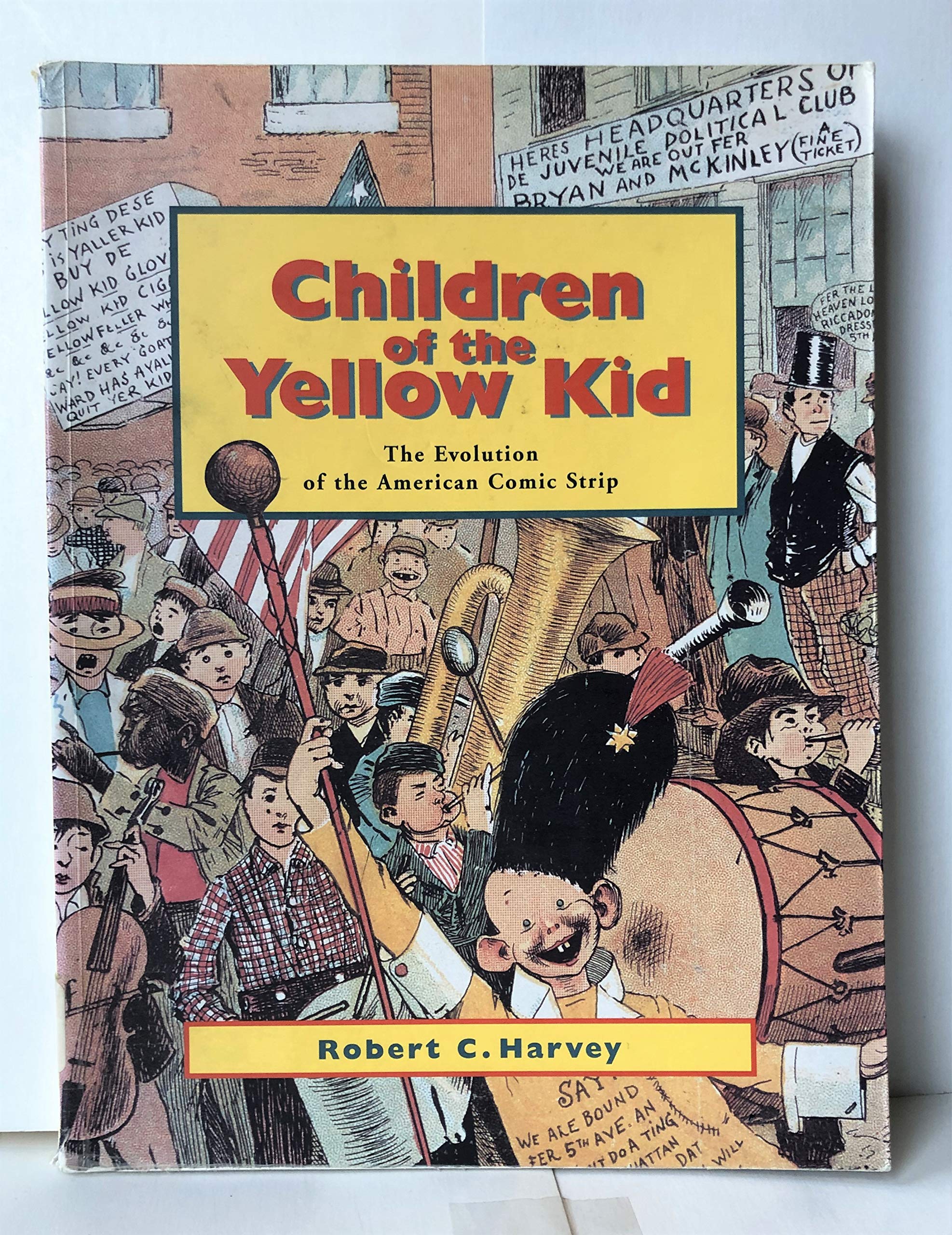
Children of the Yellow Kid: The Evolution of the American Comic Strip
$33.20
by Robert C. Harvey



Traces the development of the comic strip since its birth at the turn of the century. The reproductions of vintage strips are strikingly pristine, due to the use of original artwork rather than published versions in the production of the volume. The author, a seasoned writer and scholar of the subject is good at historical and aesthetic discussion, less so at discussing the sociological context of various strips. Two other experts in the field, Brian Walker and Richard V. West, contribute a foreword and afterword. An attractive and enjoyable volume. 9x12<"> Annotation c. Book News, Inc., Portland, OR (booknews.com) Harvey, a comics historian (The Art of the Comic Book) and a regular columnist for the Comics Journal, briskly recounts the history of the American comic strip, just over a century old. He ably discusses the major stylists, from Alex Raymond (Flash Gordon) to Brian Bassett (Adam), and notes in passing how comics have reflected both the newspaper wars and reigning social mores. Harvey is aided in his discussion by fellow comics scholar Brian Walker, the son of Mort (Beetle Bailey) Walker. Harvey's most interesting subject is cartoonist Walt Kelly, and the discussion of the satirical uses of the comic strip Pogo is sharp. Most of the rest of the history presented here is not new, but this reviewer can't recall when it has been presented between two covers before. The selection of illustrations is inviting, and although the information presented is a bit sketchy, it does give the reader a feel for American comics of the last century.AStephen Weiner, Maynard P.L., MA Copyright 1999 Reed Business Information, Inc. The catalog of a 1998 exhibition at Seattle's Frye Art Museum traces the 100-year evolution of American newspaper comics through 130 examples of vintage and recent strips. What distinguishes it from other historical collections of comic art is that nearly all its illustrations are reproductions of artists' original drawings--a few of them at full size--that reveal the pencil sketches underneath, corrections, and artists' notations. These examples show how the art form developed, from primitive efforts like The Yellow Kid and Happy Hooligan to Dick Tracy , Terry and the Pirates , and other adventure strips of the 1930s to the visually simple but otherwise sophisticated efforts that dominate the medium today, such as Dilbert and FoxTrot . An out-of-chronology chapter documents "socially conscious" strips ranging from Little Orphan Annie and Pogo to Doonesbury . Although the illustrations are, appropriately, the main attraction, comics scholar Harvey's informative text could stand alone as perhaps the most knowledgeable succinct history of the medium ever written. Gordon Flagg The catalogue of a 1998 exhibition at Seattle's Frye Art Museum traces the 100-year evolution of American newspaper comics through 130 examples of vintage and recent strips. What distinguishes it from other historical collections of comic art is that nearly all its illustrations are reproductions of artists' original drawings-a few of them at full size-that reveal the pencil sketches underneath, corrections, and artists' notations . . . . Although the illustrations are, appropriately, the main~ validation-form-field.review1_0001: ~ attraction, comics scholar Harvey's informative text could stand alone as perhaps the most knowledgeable succinct history of the medium ever written. -- Booklist, September 1, 1999 Robert C. Harvey has been writing about cartooning for well over a quarter of a century. He is a former associate member of the National Cartoonist Society, an associate member of the American Association of Editorial Cartoonists, and a member of the Comic Art Professionals Society (CAPS). He is the author of numerous columns and articles for comics-related publications. His books include ART OF THE FUNNIES: AN AESTHETIC HISTORY and THE ART OF THE COMIC BOOK. Brian Walker is a founder and director of the Museum of Cartoon Art (now the International Museum of Cartoon Art in Boca Raton, Florida). He is currently part of the creative team that produces the BEETLE BAILEY and HI AND LOIS comic strips and is chairman of the Connecticut Chapter of the National Cartoonists Society and editor-in-chief of COLLECTORS' SHOWCASE magazine. Richard V. West is an art historian and director of the Frye Art Museum in Seattle, Washington.