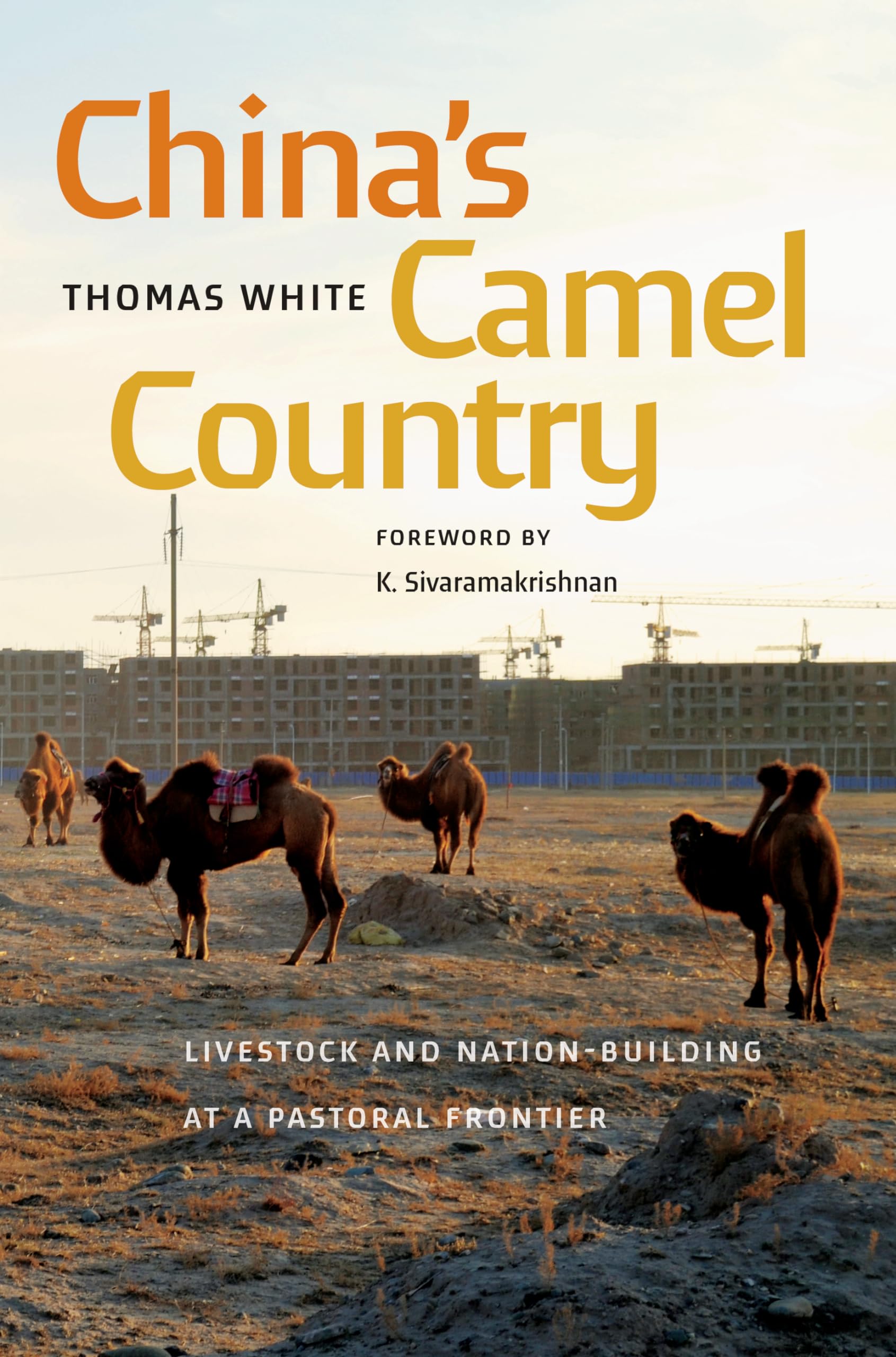
China's Camel Country: Livestock and Nation-Building at a Pastoral Frontier (Culture, Place, and Nature)
$32.00
by Thomas White



How animal conservation became a defense against cultural erasure China today positions itself as a model of state-led environmentalism. On the country’s arid rangelands, grassland conservation policies have targeted pastoralists and their animals, blamed for causing desertification. State environmentalism―in the form of grazing bans, enclosure, and resettlement―has transformed the lives of many ethnic minority herders in China’s western borderlands. However, this book shows how such policies have been contested and negotiated on the ground, in the context of the state’s intensifying nation-building project. Drawing on ethnographic fieldwork in Alasha, in the far west of China’s Inner Mongolia Autonomous Region, Thomas White describes how ethnic Mongols have foregrounded the local breed of Bactrian camel, mobilizing ideas of heritage and resource conservation to defend pastoralism. In exploring how the greening of the Chinese state affects the entangled lives of humans and animals at the margins of the nation-state, this study is both a political biography of the Bactrian camel and an innovative work of political ecology addressing critical questions of rural livelihoods, conservation, and state power. "There has been no shortage of critical scholarship on ‘authoritarian environmentalism’ in China. China’s Camel Country offers a fresh perspective by telling a story that takes into account not simply top-down imposition of rangeland privatization, conservation, and forced nomad settlement measures, but also the important role that cultural heritage recognition is also playing along China’s ethnic peripheries. What happens, White asks, when pastoralism is reimagined as heritage? His rich exploration of the tensions and contradictions that result from this reimagining reveal the ways our thinking about ‘authoritarian environmentalism’ has been far too simplistic and binary."―Tim Oakes, University of Colorado Boulder "Thomas White has written an interesting and insightful book on the position of the Bactrian camel in China’s Camel Country by providing a varied set of discussions about pastoralism and modernization, about invented, maintained, and abandoned traditions versus folklore, marketing, and agrotechnology, and about people’s perceptions in coping with top-down inspired socioeconomic transformations in the guise of modernization."―Hermann Kreutzmann, author of Hunza Matters: Ordering and Bordering between Ancient and New Silk Roads "A fantastically rich account of pastoralism in a frontier region that opens out powerful new ways of looking at heritage, the complexities of ‘camel culture’, nation-making, and state-minority relations in China. Through this deeply rooted research we come to better understand not just ecological degradation and visions for development and conservation, but also how to write robust environmental anthropologies of the contemporary."―Nayanika Mathur, author of Crooked Cats: Beastly Encounters in the Anthropocene " China's Camel Country is a rich exploration of how people in rural Alasha are using China's development discourse and political economy to negotiate their future. Again and again, White shows how Chinese state and market policies and pressures work at cross-purposes, creating opportunities but also stymieing success in any one direction. His sensitive portrait of Alasha in contemporary transition will draw comparison not just with other areas in China, but also with Inner Mongolia's past. . . . [A]n invaluable portrait of rural Mongolia life in modern China."― China Quarterly "[P]resents a fascinating look at an understudied and difficult-to-access region of Inner Mongolia. The book greatly advances not only the study of China's Inner Asian regions but also presents a solid foundation on which anthropologists can explore how China's new outward facing narrative is affecting other frontier and minority cultures throughout the nation."― China Journal " China's Camel Country offers a unique insight into three decades of complex developments in China's pastoral economy, highlighting issues of ethnicity within China's nation-building endeavour. . . . Fascinating and appealing to a wide range of audiences, this book is a must read for anyone trying to understand the complexity of pastoral life at China's margin and beyond."― Asian Affairs "[A] welcome addition and unique contribution to the growing literature about people the state has categorized as ethnic minority groups in modern and contemporary China. . . . The book immerses the reader in the physical and social space of Alasha League."― Journal of Asian Studies How animal conservation became a defense against cultural erasure Thomas White is lecturer in China and sustainable development at King’s College London.