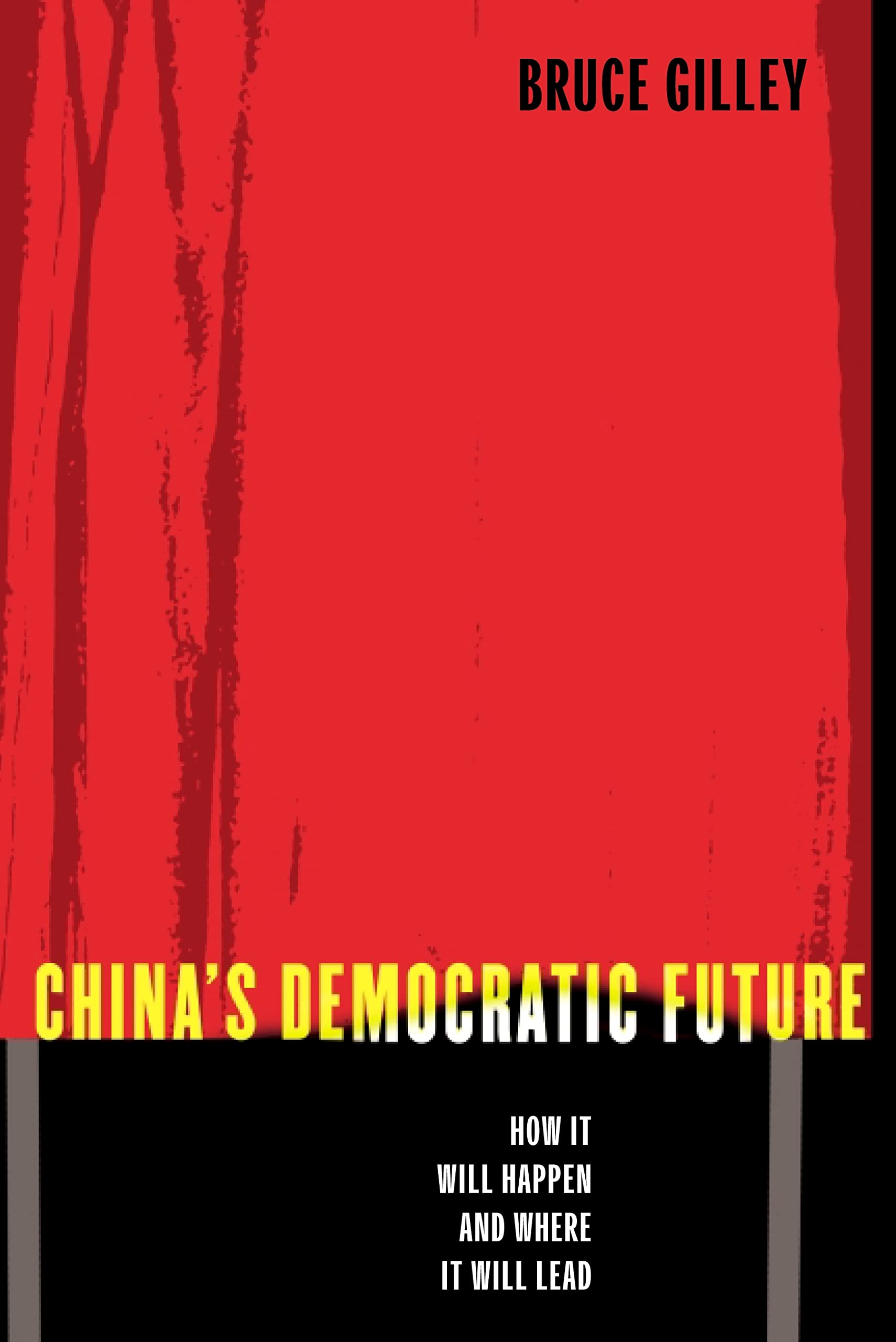
China's Democratic Future: How It Will Happen and Where It Will Lead
$94.87
by Bruce Gilley



The end of communist rule in China will be one of the most momentous events of the twenty-first century, sounding the death knell for the Marxist-Leninist experiment and changing the lives of a fifth of humanity. This book provides a likely blow-by-blow account of how the Chinese Communist Party will be removed from power and how a new democracy will be born. In more than half a century of rule, the Chinese Communist Party has turned a poor and benighted China into a moderately well-off and increasingly influential nation. Yet the Party has failed to keep pace with change since stepping aside from daily life in the late-1970s. After nearly a hundred years of frustrating attempts to create a workable political system following the overthrow of the last dynasty, the prospects for democracy in China are better than ever, according to Bruce Gilley. Gilley predicts an elite-led transformation rather than a popular-led overthrow. He profiles the key actors and looks at the response of excluded elites, such as the military, as well as interested parties such as Taiwan and Tibet. He explains how democracy in China will be very "Chinese," even as it will also embody fundamental universal liberal features. He deals with competing interests―regional, sectoral, and class―of China's economy and society under democracy, addressing the pressing concerns of world business. Finally he considers the implications for Asia as well as for the United States. The end of communist rule in China will be one of the most momentous events of the twenty-first century, sounding the death knell for the Marxist-Leninist experiment and changing the lives of a fifth of humanity. This book provides a likely blow-by-blow account of how the Chinese Communist Party will be removed from power and how a new democracy will be born. In more than half a century of rule, the Chinese Communist Party has turned a poor and benighted China into a moderately well-off and increasingly influential nation. Yet the Party has failed to keep pace with change since stepping aside from daily life in the late-1970s. After nearly a hundred years of frustrating attempts to create a workable political system following the overthrow of the last dynasty, the prospects for democracy in China are better than ever, according to Bruce Gilley. Gilley predicts an elite-led transformation rather than a popular-led overthrow. He profiles the key actors and looks at the response of excluded elites, such as the military, as well as interested parties such as Taiwan and Tibet. He explains how democracy in China will be very "Chinese," even as it will also embody fundamental universal liberal features. He deals with competing interests―regional, sectoral, and class―of China's economy and society under democracy, addressing the pressing concerns of world business. Finally he considers the implications for Asia as well as for the United States. Presently a doctoral candidate in politics at Princeton University, Gilley has also reported on China for the Far Eastern Economic Review and coauthored China's New Rulers (2002). Here he elaborates on a political prediction: by approximately 2020, the ruling Chinese Communist Party (CCP) will leave and democracy will arrive. He is confident in this forecast because recent transitions from dictatorships, both right and left, to democracy mean that the CCP will not be immune to the global trend. Sensitively observant of China's sociopolitical scene, Gilley discourses on the balance of reforming and reactionary forces in the CCP, and speculates whether the party's exit from power will be violent or peaceful. Expecting the latter, Gilley proceeds to detailed analysis of possible structures for a post-CCP constitution and, possibly, a federal rather than a unitary China. Although the author speaks to his immediate audience of China specialists such as himself, his prose is accessible to anyone wishing to study contemporary China in a serious way. Gilbert Taylor Copyright © American Library Association. All rights reserved China's Democratic Future is a very smart and provocative book, as well as a tour of ancien regime China before it becomes ancien . -- Nicholas D. Kristof ― New York Review of Books This book is an optimistic prediction from a journalist with more than a decade's experience reporting for the Far Eastern Economic Review ... this book is an important contribution to the debate about China's future. ― Publishers Weekly Although the author speaks to his immediate audience of China specialists such as himself, his prose is accessible to anyone wishing to study contemporary China in a serious way. ― Booklist Bruce Gilley, a China hand for more than a decade, puts forward the provocative hypothesis in China's Democratic Future: How It Will Happen and Where It Will Lead that within the next few decades, perhaps as early as 2010, China will become a democracy. He is in good company. Deng Xiaoping promised a d