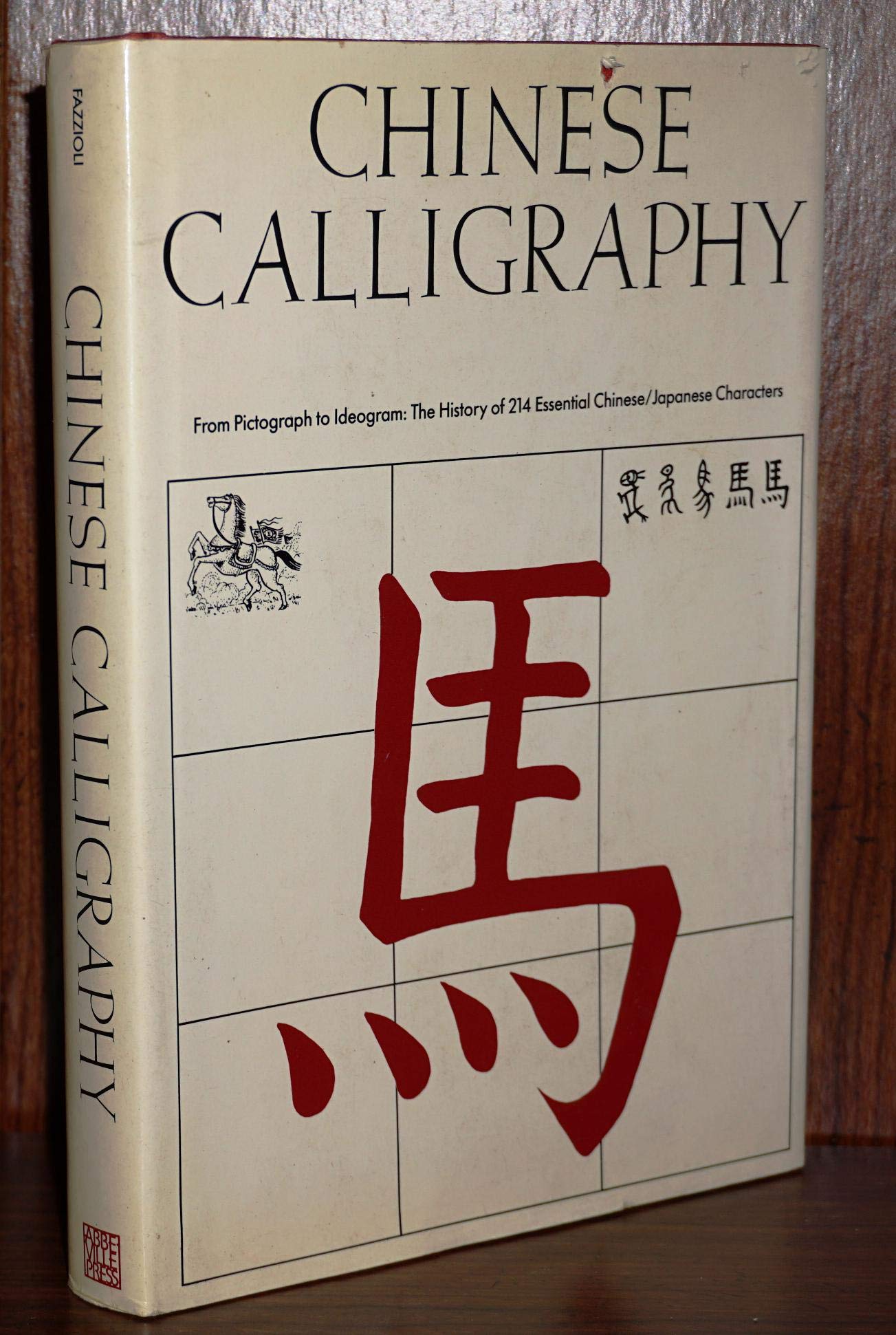
Chinese Calligraphy: From Pictograph to Ideogram: The History of 214 Essential Chinese/Japanese Characters
$31.96
by Edoardo Fazzioli



An illuminating history of the 214 Chinese symbols or radicals and how they provide a unique way to penetrate a rich, mysterious world and can reflect the history and philosophy of an entire culture. Written Chinese can call upon some 40,000 characters, many of which originated about 6,000 years ago as little pictures of everyday objects used by the ancients to communicate with each other. This book, which introduces the Westerner to a rich and mysterious world, is based on a classic compilation of the Chinese language done in the 18th century, which determined that all the characters then in use were devised from 214 root pictographs or symbols. Each of these 214 key characters, called radicals is charmingly explored by the author, both for its etymology and for what it reveals about Chinese history and culture. Chinese characters are marvels of graphic design, and this book shows, stroke by stroke, how each radical is written and gives examples of how radicals are combined with other radicals and character elements to form new characters. "
Chinese Calligraphy, is a fascinating etymological compliment to the drier task of language learning. Through illustration and a two or three paragraph explanation, the evolution of pictographs to characters is simply presented
this book is as informative as it is interesting, far moreso than a typical Chinese dictionary or language textbook." — Asian New Yorker Edoardo Fazzioli, who has studied Chinese language and culture at Hong Kong University and is a member of the ItaloChinese Institute for Economic and Cultural Exchange, has written newspaper articles and scholarly pieces on Chinese life and civilization. Excerpt from Chinese Calligraphy: A Living Language, Six Thousand Years Old Many great civilizations have punctuated man’s presence on earth, but only the Chinese civilization has survived into modern times with its principal characteristics intact. Alsoand this makes it uniqueit retains a language more than 6,000 years old. This is undoubtedly the outcome of a series of happy coincidences but, first and foremost, it results from the Chinese system of writing: those fascinating, mysterious characters, each of which hides a snatch of history, literature, art and popular wisdom. Never has the word calligraphy been so aptly used as here, even though it is still difficult for the Western eye to appreciate the full beauty and depth of this writing or to understand the aesthetic message contained in its lines. The nature of the written language and the use of the same instruments, brush and ink, has ensured that the writing of characters has formed an integral part of the history of Chinese painting. Wáng Xi Zhi (321-379), the "calligrapher sage" who lived under the Eastern Jin (317-420), is regarded as the greatest master of all time and the model for all those wishing to become engaged in the art of characterwriting. His rich poetical and imaginative style is conveyed in his portrayal of writing as a real battle. In his work The Calligraphic Strategy of the Lady Wèi, he writes: "The sheet of paper is a battleground; the brush: the lances and swords; the ink: the mind, the commander-in-chief; ability and dexterity: the deputies; the composition: the strategy. By grasping the brush the outcome of the battle is decided: the strokes and lines are the commanders orders; the curves and returns are the mortal blows." An exciting battle, but fortunately a bloodless one: one of the few that mankind can enjoy and be proud of. The first characters were incised, using wooden sticks, pointed stones, jade knives or bronze styli. These are the marks we find on ceramics, on bones, inside vases and on bronze artefacts. The graphic transformation of characters was caused by changes in the implements used for writing or the introduction of new writing surfaces such as wood, silk and paper. On a Shang bronze (16th-11th century B.C.) we find a design for a pen with a reservoir; it takes the form of a cupshaped container attached to one end of a hollow straw which deposited the colouring liquid on strips of bamboo. The result was a thick, uniform line. Around 213 B.C. widespread use appears to have been made of brushes with a fibrous tip suitable for writing on silk: these worked faster, but were still too rigid and gave a thick, square line. During the same period a further advance was made by replacing the fibrous tip with one made of leather, which was softer and more flexible. It is to a general in the imperial army of the Qín dynasty (229-206 B.C.), however, that we owe a marked improvement in the quality of writing instruments. Méng Tián, who wielded the sword as skillfully as the brush, replaced the leather tip with a tuft of soft animal hairs. His intuitive innovation was linked to the discovery of a new writing material: paper. This quickly absorbed the water, making it possible to create lines of varying intensity. He maintained that the