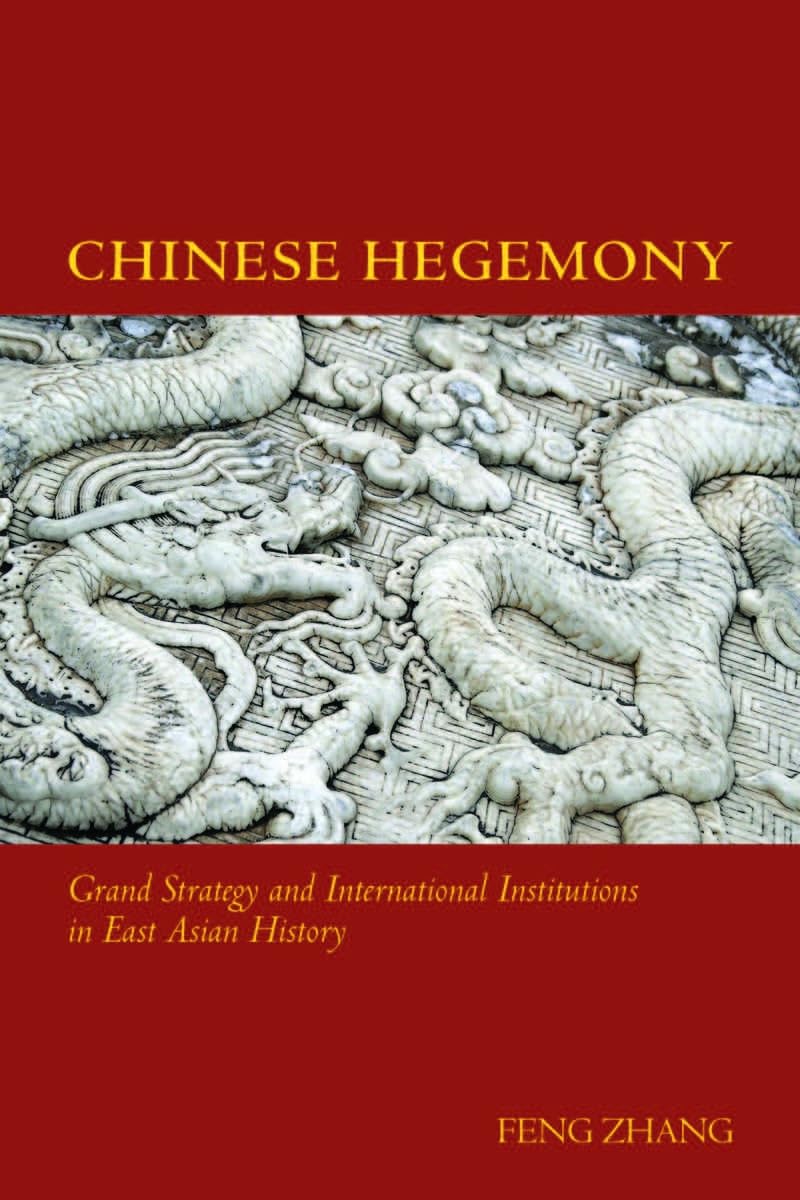
Chinese Hegemony: Grand Strategy and International Institutions in East Asian History
$46.91
by Feng Zhang



Chinese Hegemony: Grand Strategy and International Institutions in East Asian History joins a rapidly growing body of important literature that combines history and International Relations theory to create new perspectives on East Asian political and strategic behavior. The book explores the strategic and institutional dynamics of international relations in East Asian history when imperial China was the undisputed regional hegemon, focusing in depth on two central aspects of Chinese hegemony at the time: the grand strategies China and its neighbors adopted in their strategic interactions, and the international institutions they engaged in to maintain regional order—including but not limited to the tribute system. Feng Zhang draws on both Chinese and Western intellectual traditions to develop a relational theory of grand strategy and fundamental institutions in regional relations. The theory is evaluated with three case studies of Sino-Korean, Sino-Japanese, and Sino-Mongol relations during China's early Ming dynasty—when a type of Confucian expressive strategy was an essential feature of regional relations. He then explores the policy implications of this relational model for understanding and analyzing contemporary China's rise and the changing East Asian order. The book suggests some historical lessons for understanding contemporary Chinese foreign policy and considers the possibility of a more relational and cooperative Chinese strategy in the future. "This is an ambitious book that speaks to important theoretical debates and has an empirical contribution that moves beyond the existing literature on pre-modern East Asian international relations. It will be debated and discussed at length in the field." -- David C. Kang, Professor of International Relations and Business ― University of Southern California "Ambitious and innovative, this book proposes a 'relational approach' to the study of the early Ming's foreign relations and introduces into the debate the Confucian ethics of mutual affection and obligation in inter-polity relations. This is a much-needed move in a business dominated by Eurocentric ideas, perspectives and theories...It might well galvanize historians of East Asia and lead to renewed dialogue with IR scholars in the years to come."––Yangwen Zheng, Journal of Chinese Overseas " Chinese Hegemony is a fascinating, well-written, carefully constructed and researched book. I am impressed by its intellectual sweep and the diverse audiences to which it should appeal." -- Richard Ned Lebow, Professor of International Political Theory, Department of War Studies ― King's College London Feng Zhang is a Fellow in the Department of International Relations in the Australian National University's College of Asia and the Pacific. Chinese Hegemony Grand Strategy and International Institutions in East Asian History By Feng Zhang STANFORD UNIVERSITY PRESS Copyright © 2015 Board of Trustees of the Leland Stanford Junior University All rights reserved. ISBN: 978-0-8047-9389-6 Contents List of Illustrations, Notes on Transliterations, Acknowledgments, List of Abbreviations, 1. Introduction, 2. A Relational Theory of Grand Strategy, 3. Sino-Korean Relations, 4. Sino-Japanese Relations, 5. Sino-Mongol Relations, 6. Fundamental Institutions of Chinese Hegemony, 7. The Value of Relationalism, Appendix I. Major Periods in Ancient and Imperial China, Appendix II. Translation of Key Chinese Terms and Expressions, Notes, References, Index, CHAPTER 1 Introduction China's rise is one of the most significant developments in contemporary international relations. As the result of more than three decades of phenomenal economic growth, since the initiation of economic reform in 1978, a strong China now stands before the world for the first time in over a century. As China may rival the United States in material capabilities, recent discussions on China's role in world politics have been gradually shifting from a focus on the material characteristics of China's rise to a growing concern with the impact of Chinese power on regional and international order. The central question is no longer "Can China rise?" or "How great will its capabilities be?" but "What will China do with its new power?" and "What will China want?" As Paul Evans puts it, "The great strategic issue of our times is not just China's rising power but whether its worldview and applied theory will reproduce, converge with, or take a separate path from the world order and ideas produced in the era of trans-Atlantic dominance." Indeed, such an analytical shift is apparent in an emerging academic and policy discourse, inside and outside China, on possible Chinese hegemony in East Asia. Inside China, an important group of scholars, albeit still a minority in the Chinese intellectual community, has begun to promote China's world leadership on the basis of a distinctive type of Chinese hegemony, "humane authorit