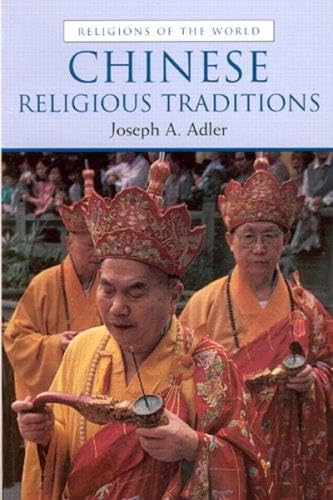



This book provides an introduction to the history of religion in China and its contours in China and Taiwan today, focusing on four religious traditions: Confucianism, Taoism, Buddhism, and popular religion. It covers not only religious and ethical ideas but also the practices of each tradition. Readers will become familiar with common themes that weave themselves through the history of Chinese religion to the present day—such as ancestor worship, sacrifice, and divination—and gain an understanding of the ways in which religion has responded to and influenced political and cultural change in China. For individuals interested in the history of China and its religions. This series provides succinct and balanced overviews of the religions of the world. Written in an accessible and informative style, and assuming little or no prior knowledge on the part of the reader, each book gives a basic introduction to the faithits history, beliefs, and practicesand emphasizes modern developments and the role and impact of the religion in today's world. Chinese Religious Traditions provides a concise introduction to the history of religion in China and its ramifications in China today. Focusing on the four major religious traditions of Confucianism, Daoism, Buddhism, and popular religion, this book covers the religious and ethical ideas as well as the practices within each tradition. The book traces themes that are common to Chinese society from earliest times to the present day. It also highlights the ways in which each tradition has responded to and influenced political and cultural change. Joseph A. Adler is Associate Professor of Religious Studies, Kenyon College, Gambier, Ohio. Ninian Smart was J. F. Rowny Professor of Comparative Religions at the University of California, Santa Barbara. China has been the major cultural center of East Asia for about 2000 years, and our knowledge of its religious traditions extends back at least another 1500 years before that. Over that span of 3500 years, China has produced two major systems of religious thought and practice (Confucianism and Daoism) and has thoroughly transformed a third (Buddhism), while its popular, unsystematized religious practices have simultaneously developed as a fourth, semi-independent tradition. All four of these religious traditions have not only shaped Chinese culture but have also influenced the neighboring cultures of Korea, Japan, and parts of Southeast Asia. Today they are becoming much better-known in the `'Vest, through scholarship and through the presence of Chinese communities outside of Asia. In our increasingly interconnected world, in which political and geographic boundaries are becoming less and less significant and scholarship is continually advancing, new perspectives in cross-cultural studies are constantly being generated. The late Ninian Smart, under whom I was very fortunate to study at the University of California at Santa Barbara, was keenly aware that religions are products of particular cultures, and that the continuing life of those cultures prevents us from closing the books on their religious traditions. Hence the need periodically to reexamine the religions of the world. Tracing the development of four religious traditions over 3500 years in a book as short as this has not been an easy task. I am grateful to the staff at Laurence King Publishing in London, especially Richard Mason and Christine Davis, for helping me to meet the requirements of this series. I would also like to acknowledge the stimulation and insights I have gained from my students at Kenyon College, where I have taught the course on which this book is based for fifteen years. That course was powerfully influenced by my graduate studies with Robert Gimello and Tu Weiming, who may recognize some of their insights in these pages. Finally, I owe a great deal to Ninian Smart, whose clarity of thinking, sensitivity of interpretation, and boundless goodwill and good cheer were models I will always treasure. This book is dedicated to him. Joseph A. Adler November 2001 China has been the major cultural center of East Asia for about 2000 years, and our knowledge of its religious traditions extends back at least another 1500 years before that. Over that span of 3500 years, China has produced two major systems of religious thought and practice (Confucianism and Daoism) and has thoroughly transformed a third (Buddhism), while its popular, unsystematized religious practices have simultaneously developed as a fourth, semi-independent tradition. All four of these religious traditions have not only shaped Chinese culture but have also influenced the neighboring cultures of Korea, Japan, and parts of Southeast Asia. Today they are becoming much better-known in the `'Vest, through scholarship and through the presence of Chinese communities outside of Asia. In our increasingly interconnected world, in which political and geographic boundaries ar