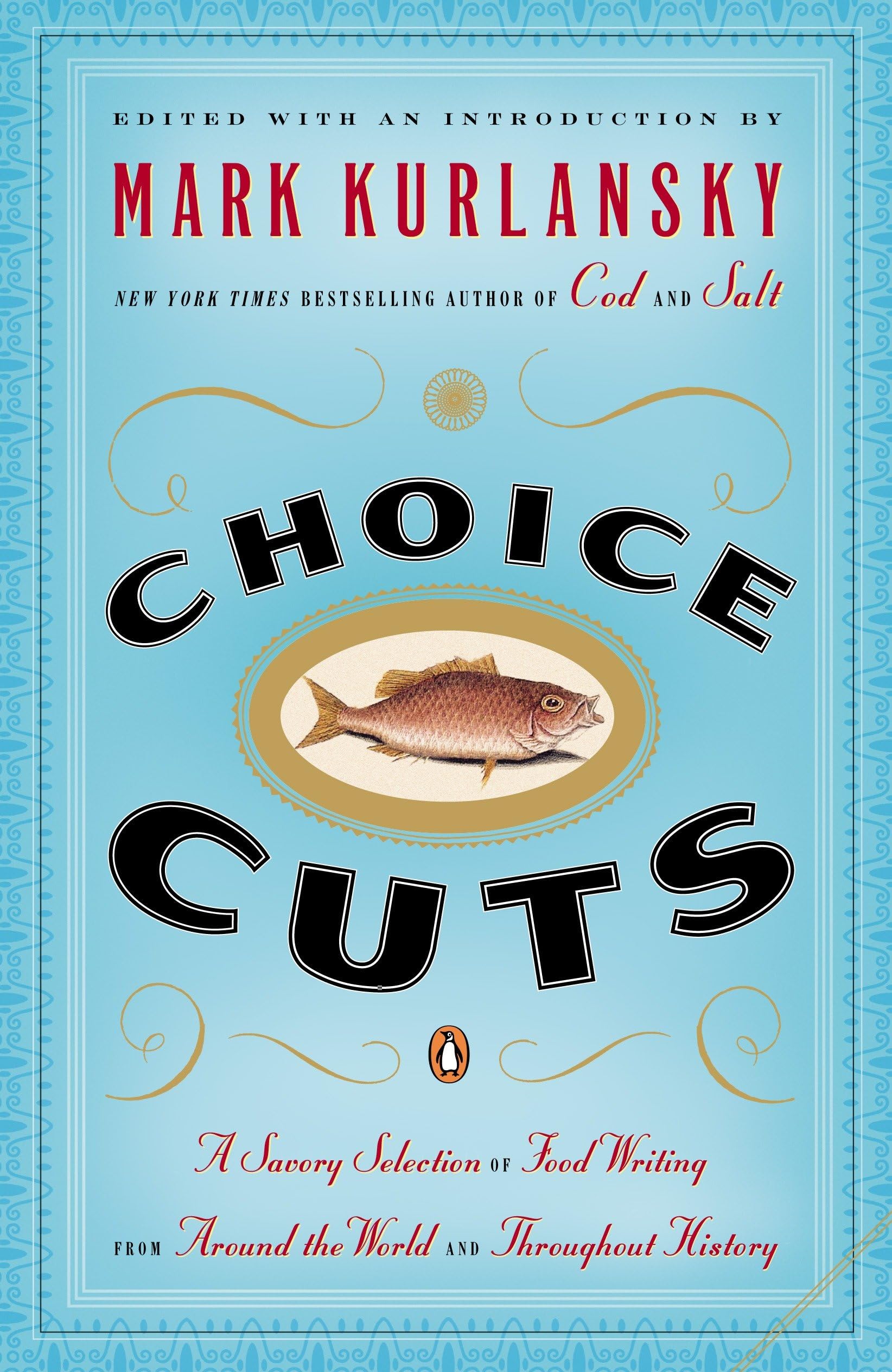
Choice Cuts: A Savory Selection of Food Writing from Around the World and Throughout History
$16.82
by Mark Kurlansky



Mark Kurlansky, bestselling author of Salt and Cod, serves up a smorgasbord of food writing through the ages, from Plato to Louis Prima Choice Cuts offers more than two hundred mouth-watering selections, including Brillat-Savarin on chocolate; Waverley Root on truffles; M. F. K. Fish on gingerbread; Pablo Neruda on French fries; Alexandre Dumas on coffee; and a vast variety by Escoffier, Elizabeth David, A. J. Liebling, Ernest Hemingway, Virginia Woolf, Dickens, Balzac, Chekhov, Orwell, and Alice B. Toklas, among others. Filled throughout with recipes, menus, classic photographs, and Kurlansky’s own original drawings, this food anthology is a must-have for any serious lover of food. “ The most outrageously broad, gregarious food writing anthology. ” – Saveur Mark Kurlansky is the New York Times bestselling author of many books, including Cheesecake , The Food of a Younger Land , Cod: A Biography of the Fish That Changed the World ; Salt: A World History ; 1968: The Year That Rocked the World ; and The Big Oyster: History on the Half Shell . He has received the Dayton Literary Peace Prize, Bon Appetit’s Food Writer of the Year Award, the James Beard Award, and the Glenfiddich Award. He lives in New York City. chapter one Gourmets and Gourmands Mark Kurlansky on Gourmets No one ever knows when he is well-off. Whenever I was called a gourmet, I suspected I was being accused of something at least slightly unpleasant. But that was before I heard the term "foodie." I am still not sure that a gourmet is a good thing to be, but it must be better than a foodie. Although I cannot say exactly what a gourmet is, like Justice Stewart said of pornography, I know it when I see it, and I am slipping into contemplation of the meaning of the word "gourmet" because I am clearly in the company of a couple of them. The two gourmets who have invited me to lunch in a rural Basque restaurant in the green mountains of Vizcaya province are a small, red-faced, and energetic author of a popular Spanish food guide and an enormously round and well-fed man of unclear profession whose business card labels him as "gastronomic adviser." The enthusiastic author rates all his food from one to ten. He wants all of us to do the same. He gives the lomo, the thinly sliced burgundy-colored prime cut of cured pork, only an eight. The gastronomic adviser had ventured a nine, and so they turned to me, the indecisive Hamlet of the group, who requested clearer definitions of both eight and nine. A gourmet, according to Webster's dictionary, is "a judge of choice foods." It comes from an old French word for a wine-tasting servant and is generally confused with the word "gourmand"--an old French word meaning glutton. From this it appears that medieval Frenchmen knew the difference between a judge--someone guided by intellect--and a glutton--someone guided by appetite. But contemporary Americans are somehow getting the two notions confused. In French, by the way, the two words are still distinct. When I wrote for the International Herald Tribune in Paris, the French accountant who processed my expenses used to delight in pointedly calling me "Monsieur Gourmand." Is it a lingering Puritanism that causes Americans to suspect the analysis of a physical pleasure? In 1901, Picasso depicted in blue paint a little girl reaching up to a table to scrape a bowl. It is usually labeled by its French title, le gourmet. But at a recent show in New York it was translated into English as The Greedy Child. Is a gourmet greedy? In truth, most people who are labeled gourmets, like my two lunch companions, go beyond the act of judging and analyzing. They are arriving at their judgments by eating a lot of food. Is the discussion an excuse for the real act, which is eating? Picasso's little girl did eat all the contents of the bowl. My gourmets are discussing the lobster. The red-faced author has given it a ten and is trying to get me to concede that these tough little clawed creatures shipped from northern Europe are far better than the lobster that come from what he does not realize is my native New England, which in fact they are not. Plato would not have thought much of these two. He mistrusted any interest in the preparation or presentation of food. In The Republic he states that the enjoyment of food is not a true pleasure because the purpose of eating is to relieve pain--hunger. To turn it into more than that through culinary skills, to him, was the use of artifice to disguise the true nature of food and eating. In Gorgias he states that cooking "is a form of flattery . . . a mischievous, deceitful, mean and ignoble activity, which cheats us by shapes and colors, by smoothing and draping. . . ." Was Plato right that gourmetism is morally and intellectually suspect or was he simply one of those unfortunates with a rubber palate incapable of appreciating food's pleasures? Or both? Gourmet is a word with dangerous boundaries. In itself it may be a wo