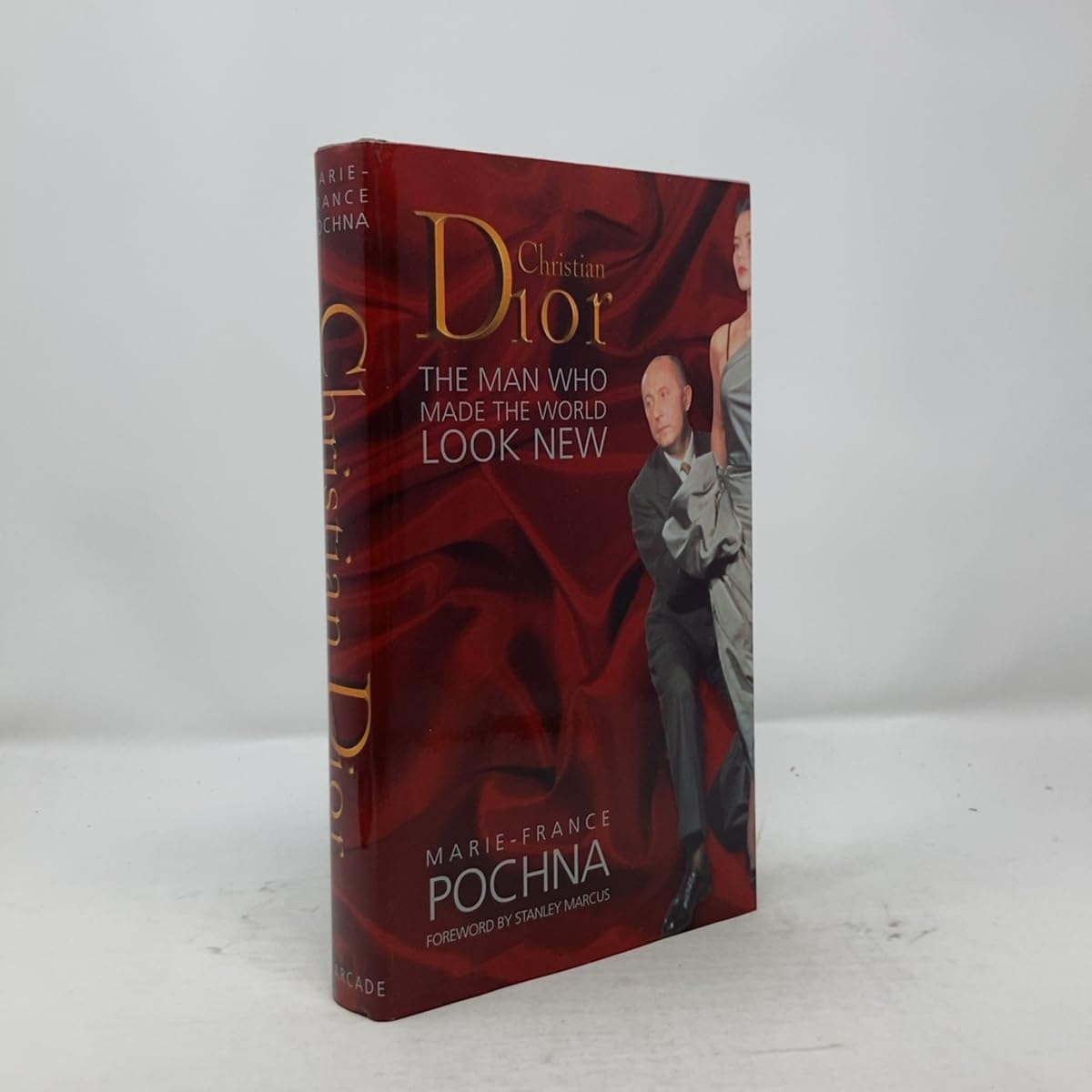



Dior's career, a veritable fairy tale, is set in a rich tapestry of Paris cultural life before, during, and after the war. Much of Dior's daily inspiration emanated from the world of the intellectual and artistic elite, in which be moved with such people as Erik Satie, Francis Poulenc, Henry Sauguet, Jean Cocteau, and Raoul Dufy. Born at the end of an era in which luxury seemed reserved only for the happy few, Dior again revolutionized the world of fashion by introducing, in the early 1950s, "ready-to-wear" in his Dior Boutique. Until then, couturiers had worked essentially if not exclusively for the very rich and famous. With his boutique, Dior brought high fashion to the world at large. Marie-France Pochna guides us skillfully through the constellation of Paris high-fashion luminaries: Lanvin, Balenciaga, Lelong, Hermes, Givenchy, and Jacques Fath. Rivalries and gossip might have divided the fiefdoms, but absolute perfection in design and high standards of fashion united the Paris "family" of haute couture. From 1947, when the House of Dior was established on Avenue Montaigne near the Champs Elysees and burst upon the scene following its first collection, we follow the Duchess of Windsor, Olivia de Havilland, Greta Garbo, Marlene Dietrich, Ingrid Bergman, and many more society celebrities and film stars - all Dior clients - to their fitting rooms. First published in 1993 in France, this English translation of Marie-France Pochna's biography of Christian Dior appears in time for the 50th anniversary of Dior's debut in the world of fashion and coincides with a retrospective of Dior's design work at the Metropolitan Museum of Art. As a biography of the designer, Pochna's book is complete and telling, perhaps not swept up high enough in the airy realms of fashion to please devoted couture mavens but highly informative and interesting for general readers interested in Dior and his impact on the fashion industry. The business of fashion rather than the artistry of Dior's designs is where Pochna directs much of her attention. After all, the marketing and branding that Dior helped initiate was innovative, so discussions of licensing agreements and the development of designer accessories, along with Dior's youthful development and inspirations, blend into a provocative profile of this fashion great. Gone are the days when a single fashion designer's dictate could evoke as much adulation?and condemnation?as did Dior's tiny-waisted, bouffant-skirted New Look in 1947. Almost single-handedly, Dior revived the postwar French fashion industry, and he was the first fashion designer to be accepted by high society. Pochna interviewed over 90 people who recalled the sensational popularity of the plain, shy, bourgeois boy who only discovered his life's work when he was 40. "Dior was a gentle, kind man who had concern about the aesthetics of the world in which he lived," notes Stanley Marcus. This book deals more frankly?though still reverently?with Dior's personal life than either the autobiographical Christian Dior and I (LJ 8/57) or Francoise Giroud's sumptuous Dior (LJ 1/88), both out of print. Although only 32 pages of black and white photographs are planned, this is highly recommended for all fashion and biography collections.?Therese Duzinkiewicz Baker, Western Kentucky Univ. Libs., Bowling Green Copyright 1997 Reed Business Information, Inc. Although somewhat diluted by time, competition, and a proliferation of both good and bad licensees, the name Christian Dior still manages to retain its cachet of high couturier-dom. Journalist Pochna, who has biographies of Nina Ricci and Gianni Agnelli also in her portfolio, documents with almost a fictional style Dior's all-too-brief tenure (10 years) as the head of the House of Dior. Much interior gazing extends beyond the details of his life: the attachment to his mother; the discreet liaisons with young men who turn into friends, not lovers; and the mercurial temperament yet shy demeanor that made him fashion's (and the press') darling. A bohemian life in Paris after World War I led initially to a stint as an art gallery owner and finally to his lifelong dream of fashion design. A preface from famed retailer Stanley Marcus simply underscores Dior's charisma as the "merchant of ideas." Just translated from the French in time for New York City's Metropolitan Museum's 50-year retrospective. Barbara Jacobs European-celeb biographer Pochna writes a serviceable history of Christian Dior on the 50th anniversary of the ``New Look.'' In February 1947 Dior launched a postwar fashion revolution, dubbed the New Look by Harper's Bazaar. Dior, 42 when the first collection was shown, was a late bloomer. Not fashionable-looking at all, he was a chubby, bald man (he once escaped a Chicago train station filled with angry demonstrators awaiting his arrival because he didn't resemble anyone's idea of a fashion arbiter). He was born in Normandy to upper-middle-class parents who made their fortun