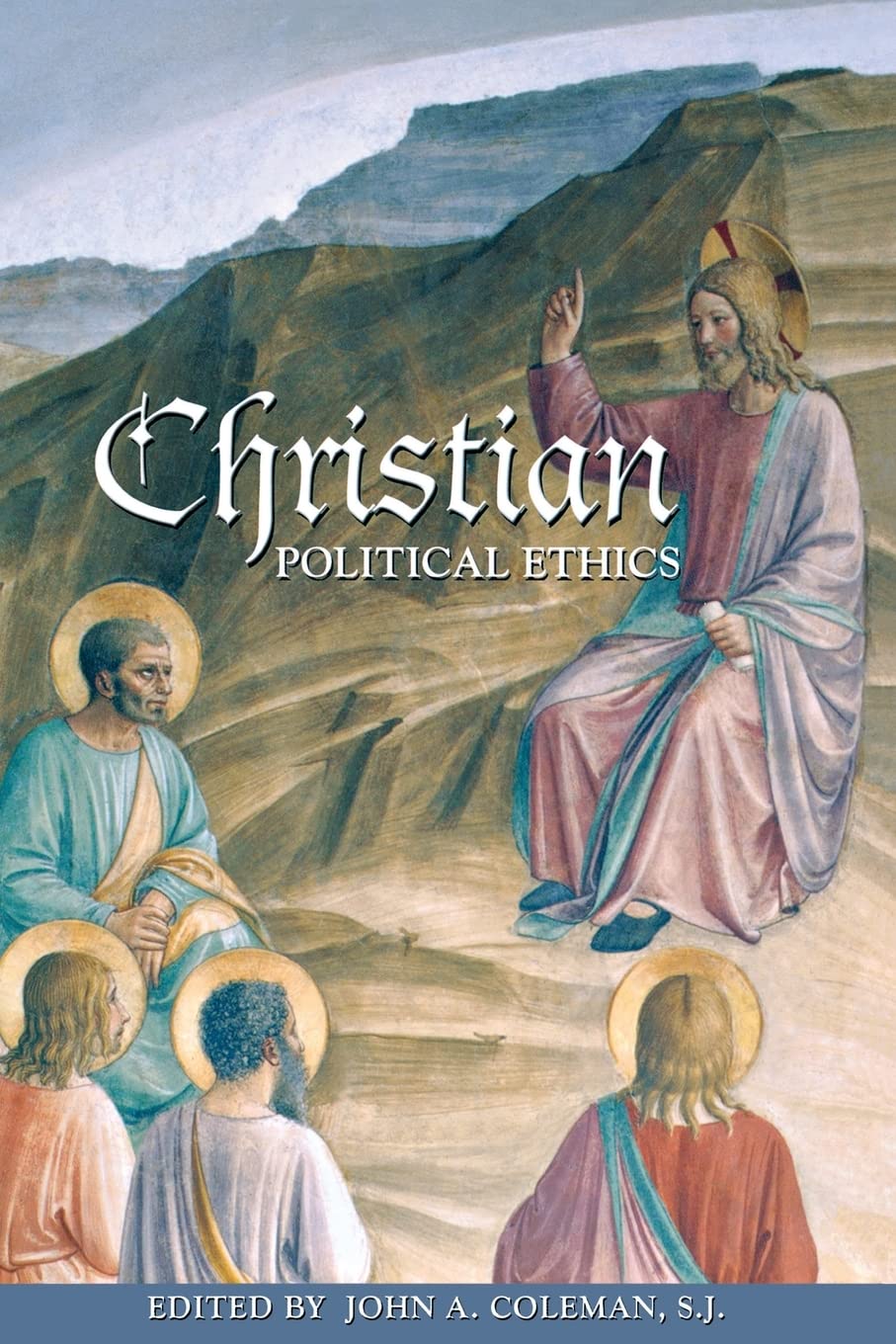
Christian Political Ethics (Ethikon Series in Comparative Ethics)
$31.64
by John A. Coleman



Christian Political Ethics brings together leading Christian scholars of diverse theological and ethical perspectives--Catholic, Lutheran, Calvinist, and Anabaptist--to address fundamental questions of state and civil society, international law and relations, the role of the nation, and issues of violence and its containment. Representing a unique fusion of faith-centered ethics and social science, the contributors bring into dialogue their own varying Christian understandings with a range of both secular ethical thought and other religious viewpoints from Judaism, Islam, and Confucianism. They explore divergent Christian views of state and society--and the limits of each. They grapple with the tensions that can arise within Christianity over questions of patriotism, civic duty, and loyalty to one's nation, and they examine Christian responses to pluralism and relativism, globalization, and war and peace. Revealing the striking pluralism inherent to Christianity itself, this pioneering volume recasts the meanings of Christian citizenship and civic responsibility, and raises compelling new questions about civil disobedience, global justice, and Christian justifications for waging war as well as spreading world peace. It brings Christian political ethics out of the churches and seminaries to engage with today's most vexing and complex social issues. The contributors are Michael Banner, Nigel Biggar, Joseph Boyle, Michael G. Cartwright, John A. Coleman, S.J., John Finnis, Theodore J. Koontz, David Little, Richard B. Miller, James W. Skillen, and Max L. Stackhouse. "A first-rate collection of essays." ---D. A. Brown, CHOICE "Obviously Christianity is a rich and diverse tradition, and this book helps to shed light on the moral and political ideals that animate Christian activists on the political left. I would strongly recommend it for anybody who wants to learn more on the topic." ---Daniel A. Bell, Politics and Religion John A. Coleman, S.J. , is the Charles Casassa Professor of Social Values at Loyola Marymount University. His many books include Globalization and Catholic Social Thought: Present Crisis, Future Hope . Christian Political Ethics Princeton University Press Copyright © 2007 Princeton University Press All right reserved. ISBN: 978-0-691-13481-9 Chapter One Christianity and Civil Society MICHAEL BANNER In its contemporary usage the term civil society typically refers to the totality of structured associations, relationships, and forms of cooperation between persons that exist in the realm between the family and the state. Where such patterns of association, cooperation, and structured relationships are thought to be weak or inconsequential, as in the corporatist East of yesteryear (where individuals are said to have related chiefly to the State) or as in the capitalist and individualistic West (where personal relationships may arguably occur only within the family, and perhaps not even there), it has become commonplace to lament the nonexistence of civil society. Christianity, it is usually supposed, will be prominent among the mourners on whichever side of the globe the wake is observed. I shall suggest in this chapter, however, that the relationship of Christian thought to the question of civil society is a matter of some complexity. This complexity is not a matter of the simple muddle that occurs where the ambiguities of the term civil society are not recognized and addressed, but has to do with the history and variety of Christian social thought. Obviously enough, the tradition of Christian thought about society and community predates questions concerning the existence, character, and qualities of civil society, without thereby having nothing to say in answer to them. Thus, though one might, in delineating a Christian conception of civil society, chart only the reactions of Christian thought to the rise of civil society under the patronage of modern liberalism, the intellectual roots of any such reactions would not necessarily emerge clearly into view, and thus the reactions might seem somewhat thinner than they really is. Such an approach might also conceal the stimulus that Christianity itself gave to the emergence of civil society in its modern form. The tradition of Christian social thought is, however, not just lengthy but also varied. Even if its different strands possess, naturally, a certain family resemblance, it is not monolithic. There is, then, nothing that can be identified as the Christian answer to the question of civil society. Rather, there is a tradition of social thought that, in its different versions, is relevant to the questions posed by the modern debate about the existence, character, and qualities of civil society. In the light of these considerations, this chapter approaches the task of answering some of these questions by attempting to outline particular and important moments in this tradition, taking as a point of departure