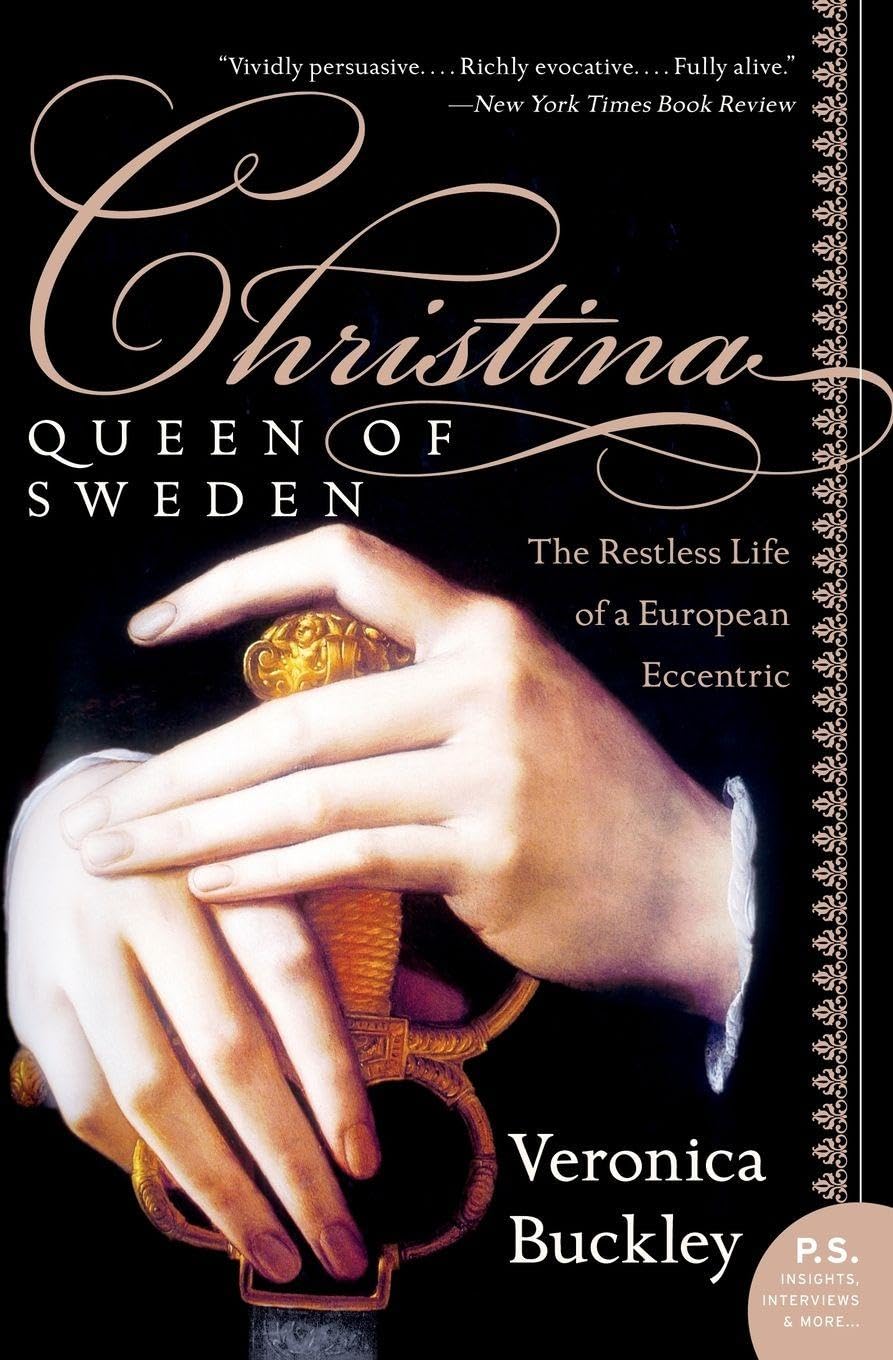
Christina, Queen of Sweden: The Restless Life of a European Eccentric – A Dazzling Biography of the Ambitious and Flamboyant Monarch Who Set the World
$10.29
by Veronica Buckley



Not unlike the elusive figure played by Greta Garbo, the real Queen Christina stood among the most flamboyant and controversial figures of the seventeenth century. All of Sweden could not contain her ambition or quench her thirst for adventure. Freed from her crown, she cut a breathtaking path across Europe -- spending madly, seeking out a more majestic throne, and stirring up trouble wherever she went. With a dazzling narrative voice and unerring sense of the period, Veronica Buckley goes beyond historical myth to breathe life into an extraordinary woman who set the world on fire and became an icon of her age -- a time of enormous change when Europe stood at the crossroads of religion and science, antiquity and modernity, war and peace. This P.S. edition features an extra 16 pages of insights into the book, including author interviews, recommended reading, and more. “Sparkling . . . the highly polished work of a writer who has been thinking about and loving her subject for years.” - London Times “Vividly persuasive . . . richly evocative . . . you find yourself thinking of Christina as a prematurely modern spirit who couldn’t manage to fit into a not-yet-modern world ―one of those historical figures who make the past feel less distant and, in the hands of a sensitive writer like Veronica Buckley, fully alive.” - New York Times Book Review Not unlike the elusive figure played by Greta Garbo, the real Queen Christina stood among the most flamboyant and controversial figures of the seventeenth century. All of Sweden could not contain her ambition or quench her thirst for adventure. Freed from her crown, she cut a breathtaking path across Europe -- spending madly, seeking out a more majestic throne, and stirring up trouble wherever she went. With a dazzling narrative voice and unerring sense of the period, Veronica Buckley goes beyond historical myth to breathe life into an extraordinary woman who set the world on fire and became an icon of her age -- a time of enormous change when Europe stood at the crossroads of religion and science, antiquity and modernity, war and peace. This P.S. edition features an extra 16 pages of insights into the book, including author interviews, recommended reading, and more. Veronica Buckley was born in New Zealand. She studied in London and Oxford, where she did her postgraduate work on Christina Alexandra. She now lives in Paris with her husband, writer Philipp Blom. This is her first book. Christina, Queen of Sweden The Restless Life of a European Eccentric By Veronica Buckley HarperCollins Publishers, Inc. Copyright ©2005 Veronica Buckley All right reserved. ISBN: 0060736186 Chapter One Birth of a Prince In the spring of 1620, a delegation of German nobles made their way along the river Spree toward the town of Berlin. The town wasnot what it had been; years of plague had depleted its people, and its oncethriving trade had dwindled to the narrow service of luxury goods to its residentcourt. Now, among the low wooden buildings, only the vast old castleimpressed upon the visitor that Berlin was still a place of power, the residenceof the Hohenzollern family of Brandenburg, electors of the Holy Roman Empire.To them, together with six other princes, fell the privilege and the dutyof electing the empire's ruler. In Berlin, a new elector, the young Georg Wilhelm,had held his stately office for just a year. Now, toward the castle, the nobles rode, down the bridle path under thelinden trees that would one day give their name to the town's most lovelythoroughfare. The delegation was led by Johann Kasimir, the Count of Pfalz-Zweibrücken, and in his train were two young gentlemen who had joinedhim from the homeland of his wife, the Princess Katarina of Sweden. One ofthese was "Adolf Karlsson," a strongly built and handsome man with theblond hair and keen blue eyes of the north. The other, his friend, was JohanHand, an eager observer of all that passed and who kept a lively record of thejourney in the pages of his personal diary. The count was related to the elector's wife, Elisabeth, and it was ostensiblyto see this princess that he had made his present journey. The visit had beentimed strategically, for the Elector Georg Wilhelm himself was not at home,nor did the count regret his absence. A matter of importance was now at hand,in which the elector's mother, the Electress Dowager Anna, would cast the decidingvote. The count had hopes of persuading her to his own views, and heknew that Anna would hear him more readily if her son was not there to speak against him. The matter at hand was no less than the marriage of Anna'sdaughter, Maria Eleonora, and the proposed bridegroom was the count's ownbrother-in-law, Gustav Adolf, King of Sweden. He had made the journey himself,just to have a look at the lady, for "Adolf Karlsson" was in fact the king. A marriage between Maria Eleonora, now age twenty, and Gustav Adolf,five years her senior, had been under consideration for