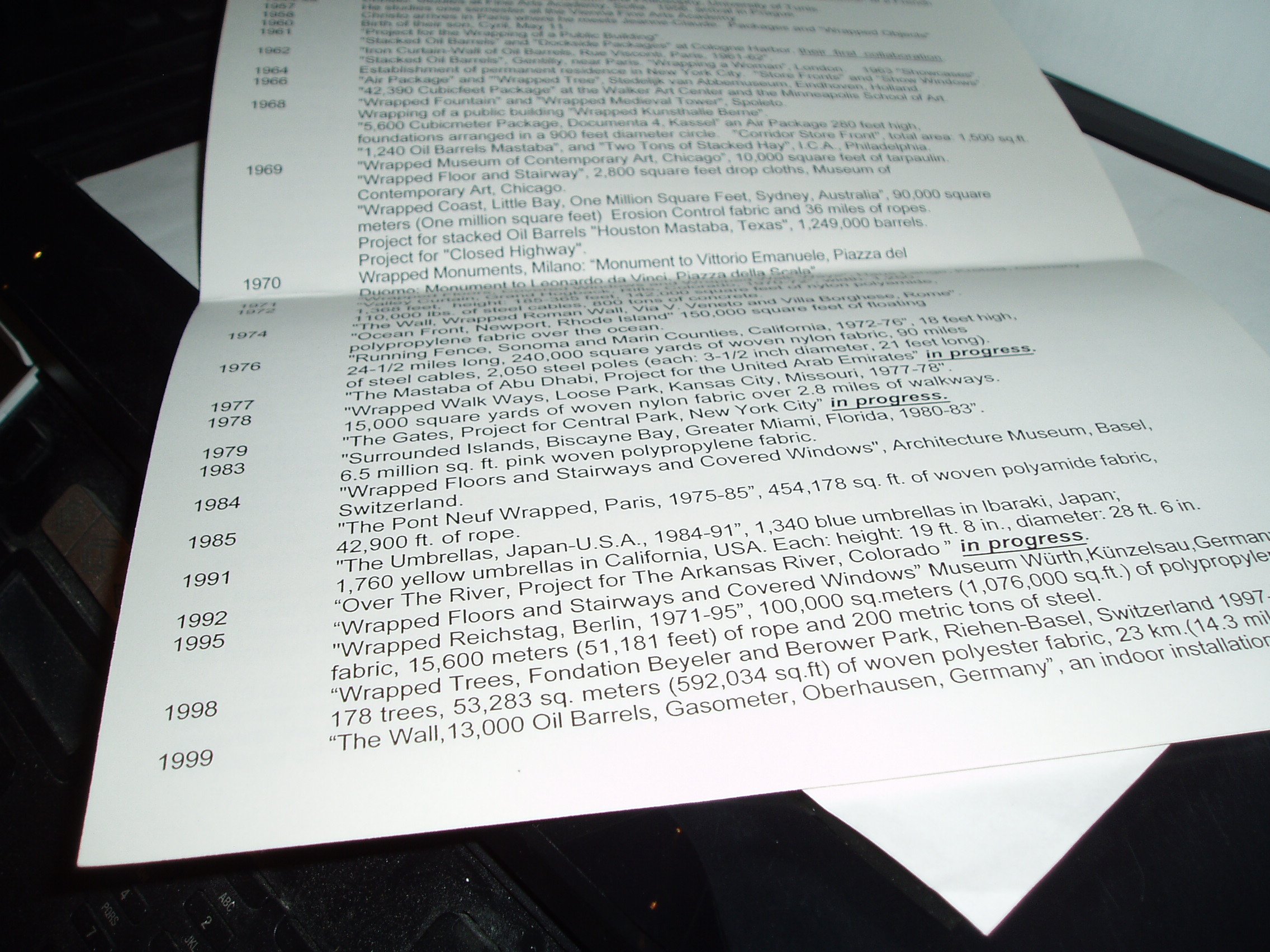



For their sheer scale and breathtaking audacity, their works have made them among the most celebrated and controversial artists in the world. Valley Curtain stretched 1,250 feet across a valley in Rifle, Colorado; Wrapped Coast covered a mile and a half of Australian coastline with a million square feet of fabric; The Umbrellas deployed 3,100 umbrellas set in Japan and California, each nearly twenty feet tall; Surrounded Islands encircled eleven islands in Biscayne Bay, Florida with six and a half million square feet of bright pink fabric; and Wrapped Reichstag enveloped the entire German parliament in shimmering silver fabric. For more than forty years, these and many other works by Christo and Jeanne-Claude have reconceived the art of the possible, turned natural and human monuments-streets, bridges, hills, trees, buildings, parks, and islands-into sculptures and paintings, and created dazzling new landscapes and startling new vistas. Often requiring years, even decades, of preparation and planning, these works-not merely feats of aesthetic daring but engineering and organizational marvels-exist for only a few weeks or less. Yet what makes these transient creations linger forever in the mind is their overwhelming and magisterial beauty. They are, in every sense, transformative, and, for the millions who have experienced them in person, unforgettable. Christo and Jeanne-Claude have been the frequent subjects of films, videos, catalogues, cartoons, monographs, exhibitions, and editorials. Until this biography by Burt Chernow, however, written with the full cooperation of the artists, nothing has connected the intimate details of their lives and the spectacular dimensions of their projects. Christo, the penniless Bulgarian refugee who made his way to Paris during the 1950s, and Jeanne-Claude, the socialite daughter of a prominent French general, seemed an unlikely couple, yet together they forged one of the most enduring partnerships in contemporary art. When they arrived in New York in 1964, Christo was already becoming well known in avant-garde circles for his wrappings of everyday objects; Jeanne-Claude acted as manager, dealer, and accountant. Over time, as Chernow reveals, the fusion of their prodigious gifts-his drawings and her ability to draw things together-produced the works for which today they are known the world over. Chernow recounts their rise from relative obscurity to international renown, revealing both the sources of their art and the heights to which it has quite literally aspired. An epilogue by Wolfgang Volz, a longtime and close collaborator of the artists, as well as their exclusive photographer, provides a fascinating insider's view of what it is like to work, and dream, with them. Christo and Jeanne-Claude is an indelible portrait of the artists and their work, and a moving account of an extraordinary couple. Take two intertwined lives marked by childhood turmoil, geographic displacement, fierce ambition, and total dedication to a quixotic form of art, add a lively narrative style and you have Christo and Jeanne-Claude by Burt Chernow. In 1959, French socialite Jeanne-Claude fell in love with a penniless Bulgarian portrait artist just beginning to wrap small objects in canvas. She had no way of knowing that her life would one day involve a constant round of negotiations with politicians, government agencies, fabricators, factory owners, truckers, laborers, farmers, and everyone else whose good will, expertise, or elbow grease were needed to make Christo's gigantic projects happen. Chernow seasons this cheerfully uncritical authorized biography of the masterminds of such projects as "Running Fence" and the "Wrapped Reichstag" with evocative sketches of the '60s art world. An epilogue by Wolfgang Volz, a photographer close to the couple, engrossingly recounts their struggles and triumphs in the '80s and '90s. --Cathy Curtis Though Christo (Christo Javacheff) was born in Bulgaria and Jeanne-Claude (Jeanne-Claude de Guillebon) in French-controlled Casablanca, the curious coincidence of their shared birthday (June 13, 1935) is just one more tie in their joint personal and professional lives. In his exemplary dual biography, the first full-length treatment of these artists, Chernow (founder of the Housatonic Museum of Art in Connecticut) traces their wildly differing early years (he was a penniless exile from Bulgarian communism, while she was the beautiful daughter of a wealthy French military family) through their meeting in Paris in the early 1960s, the slow rise to fame as Christo's avant-garde minimalism caught on with critics and collectors, their early success in New York, and on to the creation of the seminal monumental "wrapped" works that define Christo to the world at large. Chernow clarifies the couple's lifelong collaboration and justifies the artists' recent self-billing as cocreators of their major works. Chernow's narrative ends in 1983, owing to his death, leavi