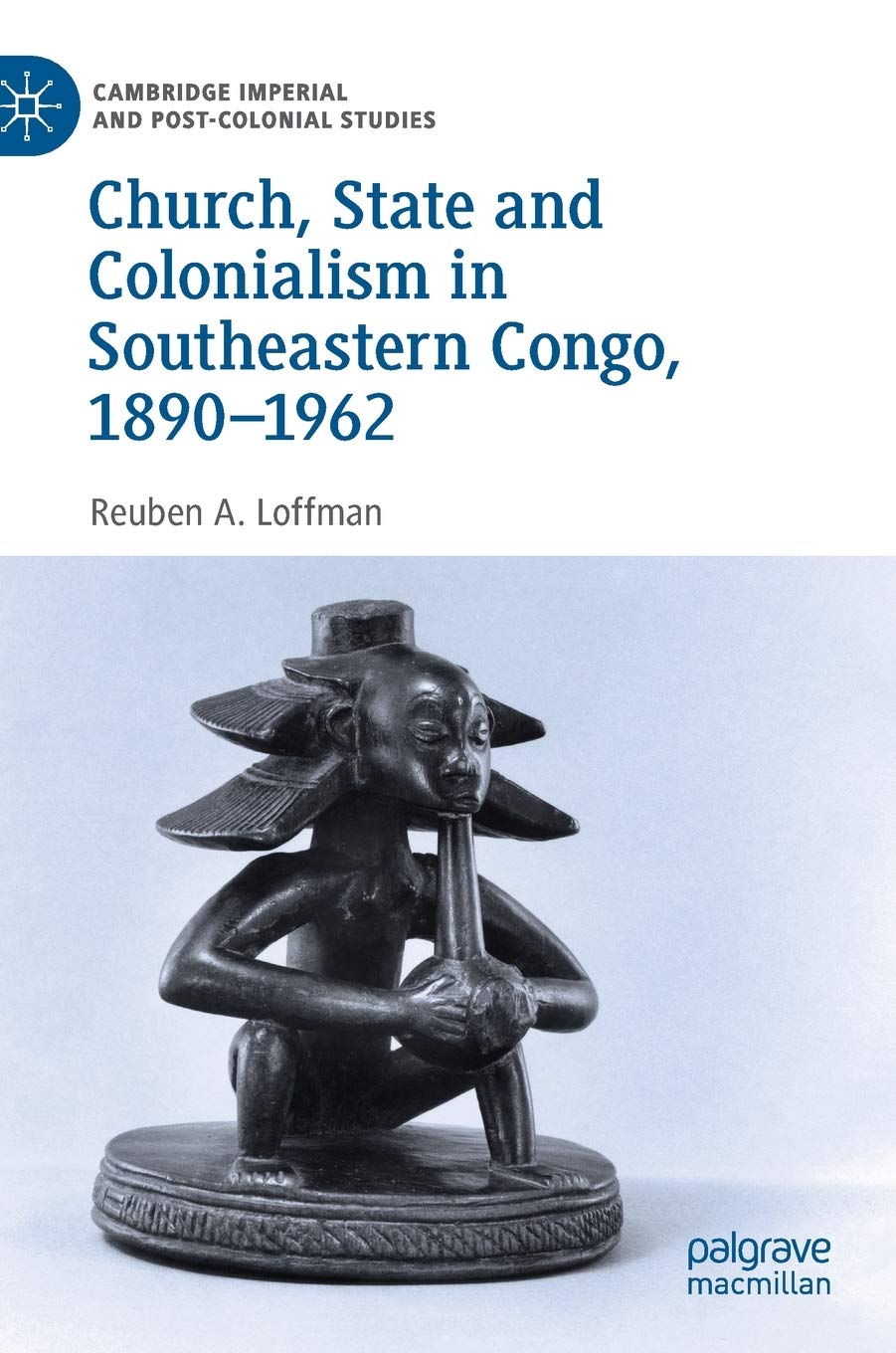
Church, State and Colonialism in Southeastern Congo, 1890–1962 (Cambridge Imperial and Post-Colonial Studies)
$82.88
by Reuben A. Loffman



This book examines the relationship between Catholic missionaries and the colonial administration in southeastern Belgian Congo. It challenges the perception that the Church and the state worked seamlessly together. Instead, using the territory of Kongolo as a case study, the book reconfigures their relationship as one of competitive co-dependency. Based on extensive archival research and oral histories, the book argues that both institutions retained distinct agendas that, while coinciding during certain periods, clashed on many occasions. The study begins by outlining the pre-colonial history of southeastern Congo. The second chapter examines how the Church began its encounters with the peoples in Kongolo and the Tanganyika province of the Democratic Republic of the Congo. Subsequent chapters highlight how missionaries exerted significant influence over the colonial construction of chieftainship and the politics of Congolese decolonization. The book ends in 1962, with the massacre ofa number of Holy Ghost Fathers in an event that signaled the beginning of a more Africanized Church in Kongolo. ‘The author gratefully acknowledges support from the Economic and Social Research Council in the completion of this project.’ “Loffman’s first monograph is a welcome addition to the history of Church and state relations in colonial Congo. This book contributes to ongoing academic debates on the region’s pasts while shedding much-needed light on some of its neglected historiographic corners. ... Loffman’s thoroughly documented monograph is a precious contribution to its field and will certainly stimulate future intellectual debates on colonial Central Africa. ... this monograph promises to stimulate, enrich and further our knowledge of Central Africa’s recent political history.” (Benoît Henriet, BMGN - Low Countries Historical Review, Vol. 135, 2020) “Loffman’s and Morier-Genoud’s monographs offer impressive and much-needed contributions to historiography on the Catholic Church and religious politics in twentieth-century Africa, moving us beyond simplistic tropes of Church-State collaboration or resistance.” (J. J. Carney, Journal of Ecclesiastical History, Vol. 71 (4), October, 2020) “Drawing upon painstaking research and a deep knowledge of the scholarship, Loffman revises one of the central historiographical narratives of Belgian colonial history, namely the supposed strong reliance between the Catholic Church and State. His rich mix of archival study and committed fieldwork produces a nuanced model of the imbrication of religion and politics, mediated by chiefs, nobles and Christian catechists alongside the more familiar figures of missionaries and administrators. And in the place of stale institutional histories of missionary societies, his study of religious encounter from below shows how Christianity was never imposed from the outside but was the product of complex cultural negotiation. A vindication of the microstudy, Loffman’s book offers fresh insight into important processes such as state formation, Christian conversion and identity formation. It comes as an important addition to the exciting new scholarship on the history of Congo.” (David Maxwell, Dixie Chair of Ecclesiastical History, University of Cambridge, UK) “In this important, thoroughly researched contribution Reuben Loffman offers a wealth of new insights into the history of the Katanga. Especially valuable is his re-examination of the relationship of the Church to the colonial state, and the quality of the evidence collected at the local level. No one interested in the history of the Katanga, or for that matter of the Congo, can afford to ignore this path-breaking addition to the extant literature.” (Rene Lemarchand, Emeritus Professor, University of Florida, USA) “Reuben Loffman’s exemplary analysis of church-state relations in colonial and post-colonial DR Congo provides considerable insight into both the autonomy of missionaries and the significant influence upon them of African converts and religious movements alike. Drawing on his painstaking local research, Loffman sheds new light on how one Congolese community experienced a tumultuousperiod of social, political and religious change in a study that will be of lasting value to scholars of Central Africa.” (Miles Larmer, Professor of African History, University of Oxford, UK) “Scholars of central Africa have every reason to be grateful to Reuben Loffman for his well-researched study of Roman Catholic missionaries in northern Katanga. By prompting us to rethink patterns of state hegemony and Church-state relations in the Belgian Congo, Loffman demonstrates that even in an age of global history, there is still much to be gained from painstaking monographs informed by a deep understanding of local dynamics and ethno-historical contexts. This is an impressive debut.” (Giacomo Macola, University of Kent, UK) ‘‘In this important, thoroughly researched contribution Reuben Loffman offers a weal