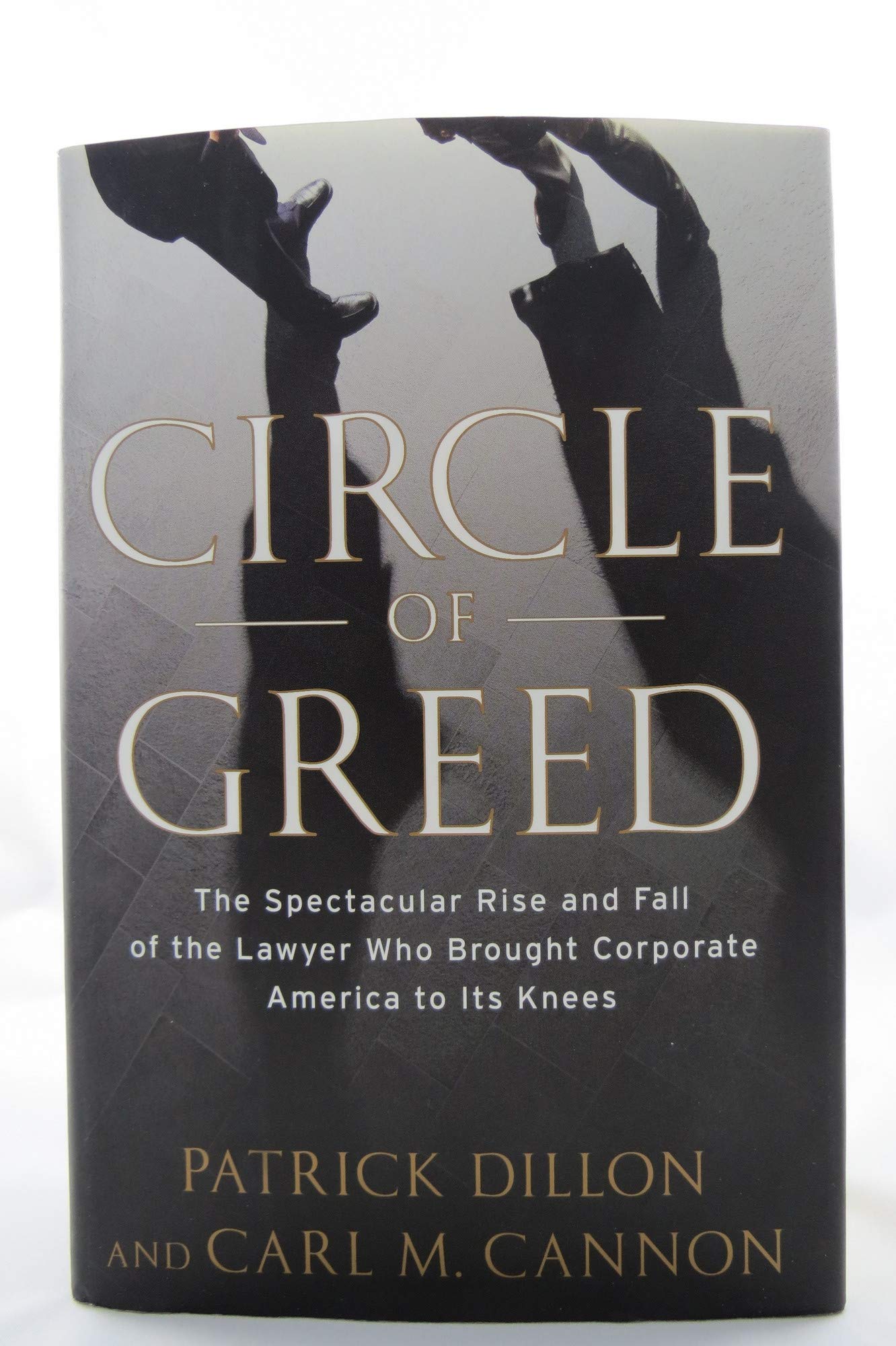
Circle of Greed: The Spectacular Rise and Fall of the Lawyer Who Brought Corporate America to it's Knees
$37.63
by Patrick Dillon



Circle Of Greed: The Spectacular Rise And Fall Of The Lawyer Who Brought Corporate Am, by Dillon, Patrick And Carl M. Cannon “John Grisham would have to struggle to invent a character as brilliant and unethical as Bill Lerach. It is a credit to the reporting talents of Patrick Dillon and Carl M. Cannon that, in “Circle of Greed,” they capture the felon-lawyer in all his charm and ruthlessness. Along the way they show how the plaintiffs' bar has transformed the process of class actions into big business.” — Wall Street Journal “[A] revelatory yarn . . . In “Circle of Greed,” the authors do justice to their subject and have produced a book that proves the adage that truth can be stranger than fiction.” — Washington Times “Mr. Dillon and Mr. Cannon have written the type of book that, like “Den of Thieves” and “Smartest Guys in the Room,” helps to explain an era.” — NYTimes.com/DealBook “In Circle of Greed , this compelling narrative becomes an irresistible metaphor for the hubris at the heart of capitalism . . . Lerach is lucky to have Pulitzer Prize-winning journalists Patrick Dillon and Carl Cannon as his chroniclers. They tell his tale with an authority and depth that comes from having followed his career since the late 1970s. . . Amid the entertaining knockabout and big personalities, the authors raise important questions about how the rule of law should work in a capitalist democracy.” — Financial Times “[R]iveting . . . Telling this complex story is a tricky business, but Circle of Greed is up to the task: it is impressively researched and well paced, and offers reporting, not editorializing, leaving the reader to form his or her own judgments.” — Washington Monthly "A well-reported, densely written saga" -- Kirkus Reviews "In modern corporate America, the swashbuckling captains of industry have long been the primary characters exposed in the public storytelling. But now, Patrick Dillon and Carl Cannon have stripped away the veneer of a lawyer who made his name as the business world’s chief adversary, Bill Lerach. In Circle of Greed , Dillon and Cannon present a painstakingly researched and entertaining tale of a legal dynamo who seemed able to root out any corporate crime, but then became enmeshed in frauds of his own. Lerach had it all, then lost it all because of his own greed and arrogance. In this thrilling book, Dillon and Cannon have unwound the character of this perplexing man, presenting a cautionary tale that is must-reading for anyone interested in business or the law." --Kurt Eichenwald , author of The Informant and Conspiracy of Fools Patrick Dillon has won many journalism awards including a share of the Pulitzer Prize- and is the author of the acclaimed Lost at Sea. The executive editor of California magazine, he was formerly editor in chief of Forbes ASAP , a writer for the Christian Science Monitor , and an editor and columnist at the San Jose Mercury News . He lives in San Francisco, California. Carl M. Cannon is the deputy editor of politicsdaily.com and coauthor of Reagan's Disciple: George W. Bush's Troubled Quest for a Presidential Legacy . He has won numerous awards, including a share of the Pulitzer Prize in 1989, and the prestigious Gerald R. Ford Prize for Distinguished Reporting of the Presidency. He lives in Arlington, Virginia. 1 DRAGON SLAYER William S. Lerach first heralded himself to the elite circles in America's legal community in 1977, from the sterile downtown county courthouse on Front Street, a few blocks from the old waterfront in San Diego. The setting was Superior Court Judge JamesL. Focht's nondescript courtroom; the case, Barr v. United Methodist Church. By the time it ended, class action litigation (a single legal action on behalf of many plaintiffs against common defendants) would never be the same in California. And ultimately thevictorious lawyer would see to it that no corporate entity within the United States would be invulnerable to outside scrutiny. No U.S. church denomination had ever been the subject of a successful class action lawsuit. The unfolding case owed its drama not only to the legal precedents at stake, or to the conflicted feelings among the litigants themselves (pious Methodists andretired ministers who found themselves suing their own denomination) but also to the intensely personal competition between the rival attorneys. The Methodists' lead lawyer was Samuel W. Witwer, Sr., a barrel-chested eminence whose regal presence and mane of silver hair all but announced his wealth of experience. The son of a steelworker, Witwer was born in 1908, the year William Jennings Bryanran for president the third and last time. Like Bryan, Witwer came out of the Midwest, his reputation proceeding him like a billowy cloud: Harvard Law, class of 1933; lay leader in the Methodist Church; and then lawyer, who after five decades of futile effortsby others succeeded in reforming Illinois'