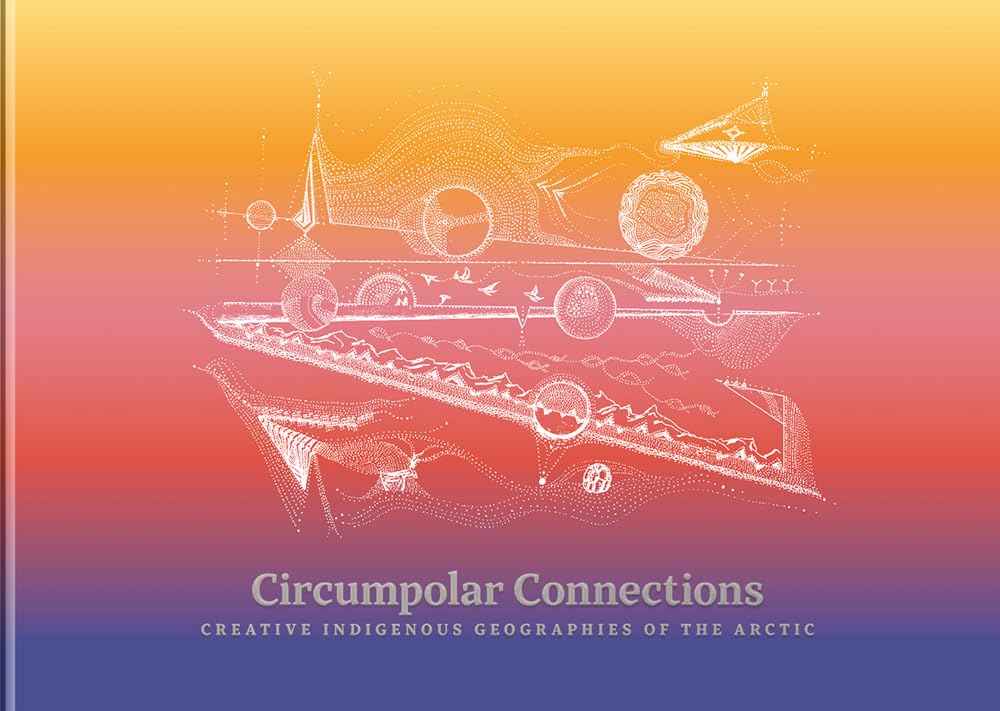
Circumpolar Connections: Creative Indigenous Geographies of the Arctic
$27.90
by Liisa-Rávná Finbog



Creative visions of Arctic geography from Indigenous perspectives Grounded in the spatiality of Indigenous existence, Circumpolar Connections: Creative Indigenous Geographies of the Arctic is an innovatively foundational book about experiences and conceptions of geography in the circumpolar world. The book centers Arctic writers and artists as creators of space and disseminators of geographical knowledge emerging from Indigenous epistemologies. It collects newly commissioned poems, short stories, and essays that are accompanied by responses in the form of visual art―including paintings, photographs, and mixed media artworks―as well as brief academic reflections. Containing multiple languages―from English and Russian to North Sámi, Kalaallisut, and Sakha―as well as translations, the book is grounded in dialogues and conversations between creative practitioners from across the circumpolar North. Among others, they include Alutiiq, Eyak, Gwich'in, Innu, Inupiaq, Inuvialuk, Lingit, and Yup'ik writers and visual artists, alongside Indigenous and non-Indigenous scholars. Extending "geo-" beyond earth and "-graphy" beyond writing, the creative geographies of Circumpolar Connections powerfully expand the Arctic into manifold spaces imagined by a multiplicity of Indigenous stories and aesthetic forms. In doing so, they offer circumpolar conversations that speak to Arctic communities while reaching out to global audiences. [Sample Text] English language assimilation as a bite of sashimi it is like I am eating my own tongue cut precisely, a flesh triangle cool red bloodless and placed in my mouth I cannot speak it tastes like my own tongue salt and flesh I am eating my own tongue the weight of it "How lovely to encounter maps that acknowledge that the Indigenous people of the Arctic and their art are 'inextricable from the lands and waters of the circumpolar North.' (92)... Circumpolar Connections encourages the reader to imagine how each image and section of text resonates with the material surrounding it. What emerges is a layered mapping of how language and image manifest the relationship between circumpolar Indigenous communities and place."―Annie Wenstrup, author of The Museum of Unnatural Histories , Inuit Art Quarterly "This stunning and revelatory book speaks collectively of maps and compasses, but not the assumed ones. taktugziun in ugiuvak―fog―is both its compass and its form of navigation. taktugziun―its wetness, its density―envelops the contours of the land, it reveals an intimacy and depth of knowledge that requires no invented tools or outside technologies. In Circumpolar Connections , maps are embodied―indeed they are the body―as well as radical kinship that is held in story, song, poems, in hand drawn marks, in sewn stitches, and in tattoos inscribed like scores. Circumpolar Connections is a book like no other. It is a collection of impressions, of ideas, of images, of narratives refigured as non- and anti- colonial maps by some of the most radical Indigenous thinkers and makers working today. And their maps aren't the usual ones, theirs are centered around the sun standing in as the North Pole, such in as in elle-hánsa/hans ragnar Mathisen/Keviselie's 1990 circumpolar map davviálbmogat that forms an apt cartography for this collection. davviálbmogat doesn't create a hierarchy between land and water, between human and animal, between colonial languages and Indigenous mother tongues, between the secular and spiritual planes. davviálbmogat uses the sámi goaddis (the drum) as its methodology, a reminder that songs are maps, too, and that they sing other worlds into being."―Candice Hopkins, curator and scholar, citizen of Carcross/Tagish First Nation " Circumpolar Connections conveys the richness, diversity, and power of Indigenous cultural expressions of the Arctic. As these works bespeak deep ties between Native peoples and their lands, they demonstrate the role of creative practices in place-making. Beautifully illustrated and designed, this remarkable book is itself a work of art."―Shari M. Huhndorf, Professor of Native American Studies, University of California, Berkeley LIISA-RÁVNÁ FINBOG is a Sámi scholar based in Oslo, Norway. She is currently curator of Indigenous Art at MUNCH. JOAN NAVIYUK KANE is Inupiaq and the author of many collections of poetry and prose. She is currently an associate professor at Reed College. JOHANNES RIQUET is a professor of English literature at Tampere University and the Principal Investigator of the Mediated Arctic Geographies project.