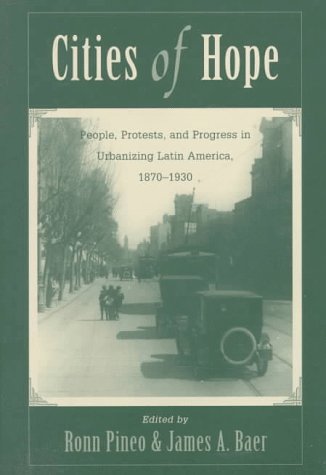



This groundbreaking book explores the relationship between the impact of urbanization on the working class in Latin American cities and the variety of responses by that group in the years between 1870 and 1930. Unlike urban geographies or political histories, the chapters of this collaborative volume focus on the people of these cities, especially the working women and men who were faced with the ramifications of the transformations taking place around them.Each contributor provides original research and analysis on a selected city and addresses three core questions. First, what were the circumstances for working women and men in the growing cities in early twentieth-century Latin America? Second, how did this population respond to the problems they faced and act to improve the quality of their lives? And, third, what circumstances and what strategies were most likely to have a lasting impact? The case studies demonstrate how exploring the patterns of working class' response provides the key to understanding the political process of the urban social reform.Filling significant gaps in the literature on Latin American social history, working class history, and the history of urbanization, Cities of Hope is written in a clear, accessible style, making it an excellent choice for course adoption in classes on urban studies, sociology, or Latin American history as well as a vital reference for scholars. Editors Ronn Pineo and James Baer have done a great service in putting together this collection of nine case studies of the politics of urban reform in turn-of-the-century Latin America. Their well-planned volume includes coverage not only of the most visible primate cities of the era (Buenos Aires, Rio de Janeiro, Mexico City and Montevideo), but also less-studied capitals (Bogota, Lima, and Panama City) and two secondary cities (Valparaiso, Chile and Veracruz, Mexico). Introductory and concluding chapters by the editors place these case studies of urbanization, working-class mobilization, housing, and public health in comparative perspective, and should make this volume an accessible resource for students of cities in other places and times. -- Lara Elizabeth Putnam, Department of History, University of Michigan. H-URBAN on-line book review, March, 1999 Overall, this is a useful and informative collection. While the essays often draw on other works of the respective authors, they are original, well researched, written in a generally jargon-free and engaging manner, and designed especially for this volume. The coverage is good, providing information on a range of cities of various types, sizes, and locations. While there is a considerable variety, there is also enough of an emphasis on basic issues to allow useful comparisons. The emphasis on the popular classes, the ordinary citizens of these cities, may occasionally overstate their influence, and relatively little is said about the nuts and bolts of municipal governance. Nonetheless, the editors and contributors are to be commended for producing a volume that makes a valuable addition to our understanding of Latin America's urban growth and of the social history of the region. -- Richard J. Walter of Washington University, St. Louis HISPANIC AMERICAN HISTORICAL REVIEW, February 1999 [Vol. 79, no. 1] 145-147 Ronn Pineo is associate professor of history at Towson State University in Baltimore, Maryland. James A. Baer is professor of history at Northern Virginia Community College in Alexandria, Virginia. Ronn Pineo is associate professor of history at Towson State University in Baltimore, Maryland. James A. Baer is professor of history at Northern Virginia Community College in Alexandria, Virginia.