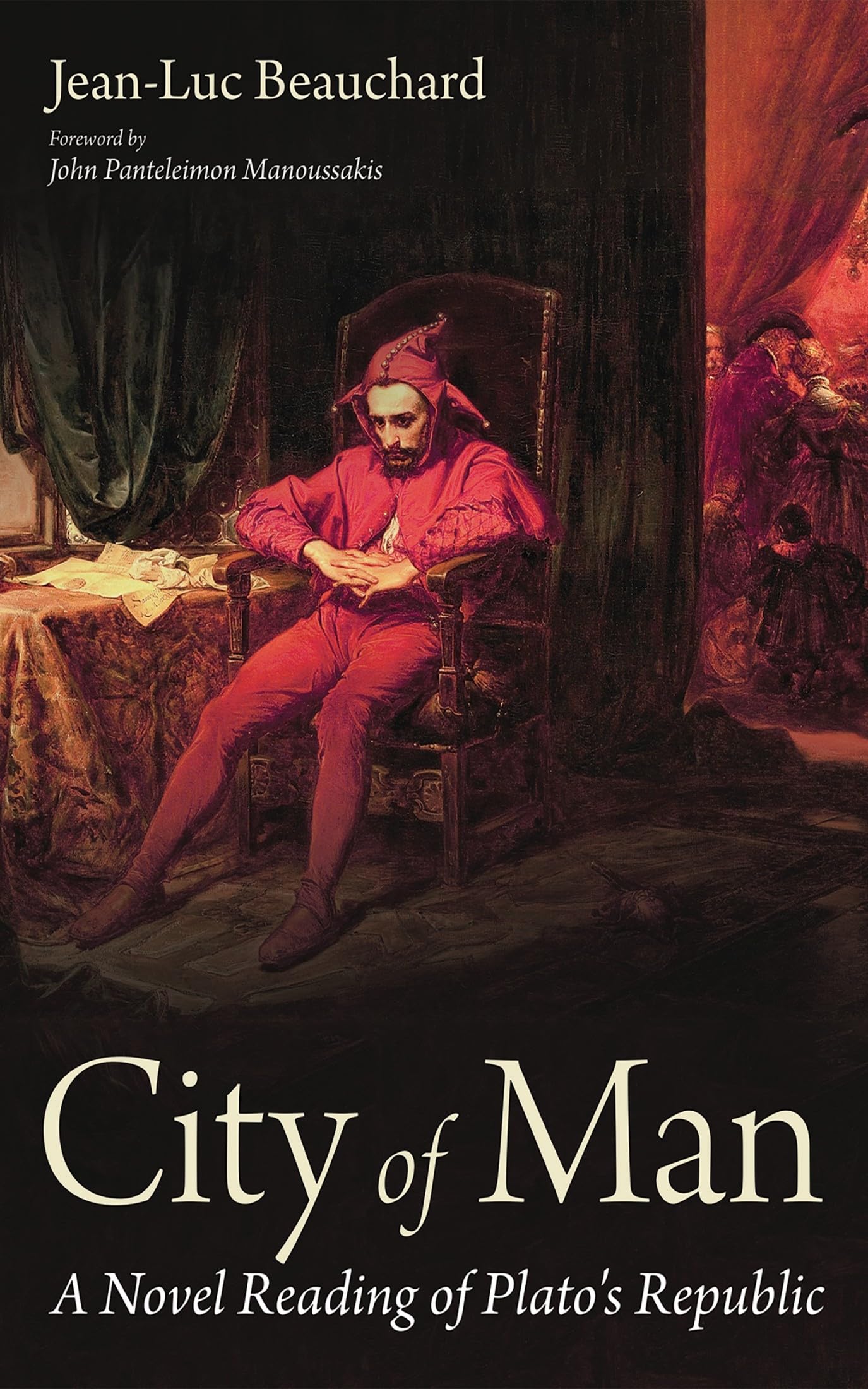



Why does life in society make us so unhappy? Why has civilization always been marked with social unrest? From the time of Plato, our greatest thinkers have understood that in order to confront the ills of the city, one must first look to the individual, to the maladies and discontents of the human soul. In this novel reading of Plato’s Republic, the insights of Nietzsche and Freud are brought to bear on one of western civilization’s most important texts. But what is at stake is far more than our interpretation of the Republic. City of Man will leave readers better equipped to face the crises that confront us today by reintroducing the import of that oft-quoted but rarely practiced Delphic maxim: know thyself. "On its face, this text presents an undertaking that many would find laughable. Yet, the end result is nothing short of an incisive and wholly new reading of what is arguably the backbone of the Western canon. It is a true rarity to find scholarship like this today, almost to the point that it makes one wonder how a thinker like Jean-Luc Beauchard exists at all." --Bryan Cocchiara, instructor of philosophy, Brookdale Community College "If this book accomplishes nothing else than to stand as a reminder of the right and wrong way to approach Plato (and, perhaps, every other text as well), it would still deserve to be called a masterpiece. For it stands, like Socrates in Athens, as a memorial of our ignorance." --John Manoussakis, associate professor of philosophy, College of the Holy Cross "In City of Man , Jean-Luc Beauchard leads us through the labyrinth of the dialogues, using his pen as a sword to slay the monsters hidden within and weaving an incredibly subtle thread to guide us back to safety. The gods will no doubt smile on this modern-day son of Theseus and reward him justly for his exceedingly fine achievement." --Joaquim Maria Nivola, translator of Les problèmes d'un problème Jean-Luc Beauchard is a philosopher and Catholic priest. He has taught courses in philosophy, theology, and literature at multiple colleges and universities in New England. John Panteleimon Manoussakis is Associate Professor of Philosophy at the College of the Holy Cross, and an Honorary Fellow at the Faculty of Theology and Philosophy of the Australian Catholic University. He was born in Athens, Greece, and educated in the United States (PhD, Boston College). He is also a monastic ordained to the diaconate in 1995 and into the priesthood in 2011 (Archdiocese of Athens). His publications focus on philosophy of religion, phenomenology (in particular post-subjective anthropology in Heidegger and Marion), Plato and the Neo-Platonic tradition, and Patristics (Gregory of Nyssa, Dionysius and Maximus). He is the author of two books, editor of five volumes and he has published over thirty articles in English, Greek, Russian, Serbian, and Ukrainian.