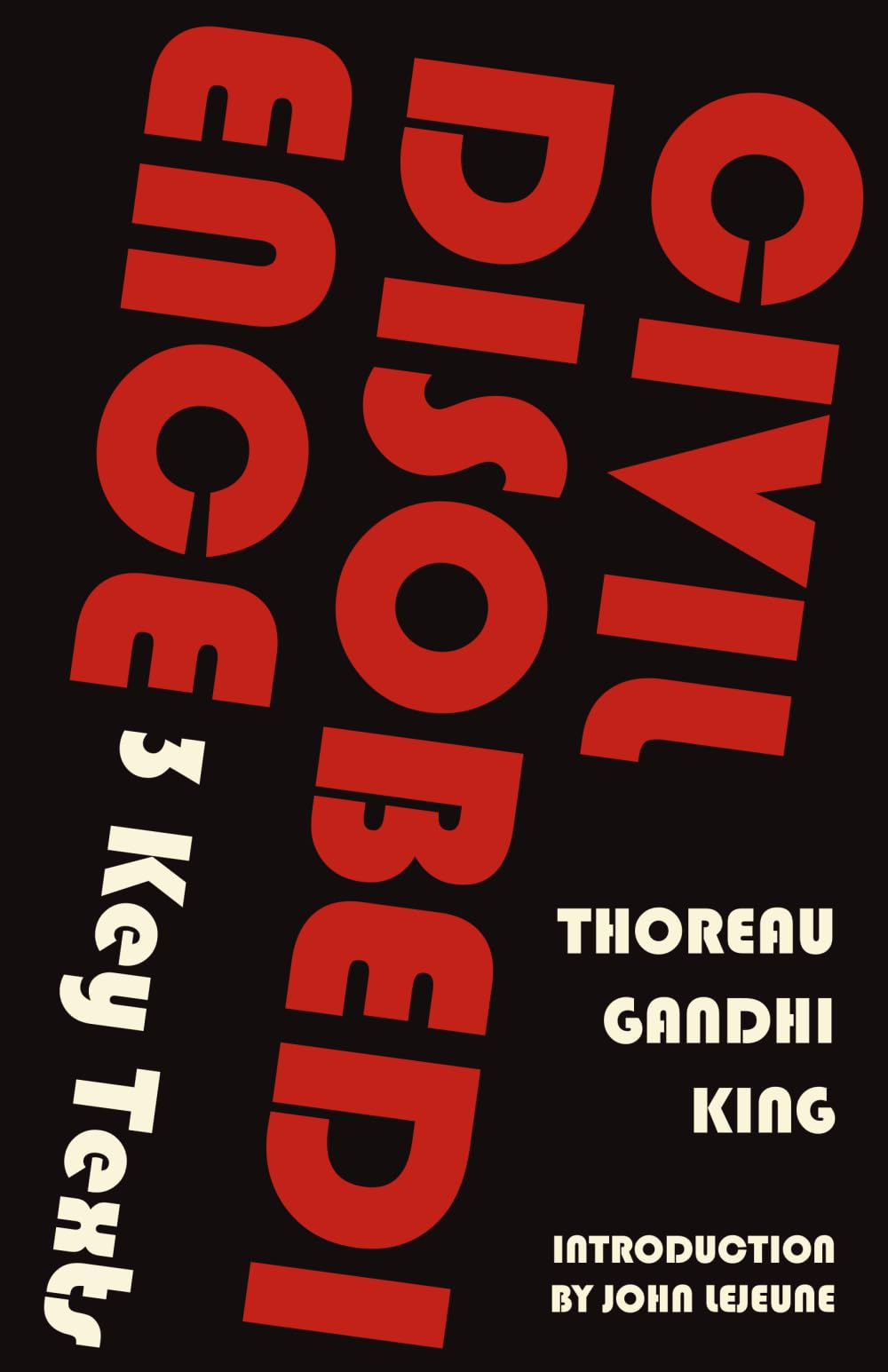
Civil Disobedience—3 Key Texts: Thoreau, Gandhi, King (Warbler Classics Annotated Edition)
$11.95
by Henry David Thoreau



Civil Disobedience—3 Key Texts: Thoreau, Gandhi, King (Warbler Classics Annotated Edition) brings together three of the most influential documents on moral resistance and political conscience: Henry David Thoreau’s “On the Duty of Civil Disobedience,” Mahatma Gandhi’s Hind Swaraj or Indian Home Rule, and Martin Luther King, Jr.’s “Letter from a Birmingham Jail.” Each work, rooted in its own historical crisis, defends principled noncooperation against unjust authority while advancing a vision of justice grounded in conscience. With these complete texts presented together, the book underscores the enduring dialogue between these figures across generations and continents. Includes an incisive introduction by John LeJeune and suggestions for further reading. Henry David Thoreau (1817–1862) was an American writer and philosopher whose essay “Civil Disobedience” argued that individuals must resist unjust laws through conscience-driven noncooperation. His refusal to pay taxes supporting slavery and war inspired later movements for justice, profoundly influencing Gandhi and Martin Luther King, Jr. Mahatma Gandhi (1869–1948) led India’s struggle for independence through satyagraha, or non-violent resistance. Drawing from Thoreau’s ideas, he promoted mass civil disobedience against colonial rule, insisting that moral force outweighed violence. His campaigns of protest and self-sacrifice transformed both politics and the global ethic of resistance. Martin Luther King, Jr. (1929–1968), a Baptist minister and civil rights leader, championed nonviolent protest as the path to racial equality. Inspired by Thoreau and Gandhi, he used civil disobedience—marches, sit-ins, and boycotts—to confront segregation and injustice, linking moral courage with democratic reform in America. John LeJeune is a Professor of Political Science at Georgia Southwestern State University, where he teaches political theory and constitutional law. His research interests include the study of revolutions and political violence, and the scholarship of teaching and learning. HENRY DAVID THOREAU (1817-1862) was an American writer and philosopher whose essay "Civil Disobedience" argued that individuals must resist unjust laws through conscience-driven noncooperation. His refusal to pay taxes supporting slavery and war inspired later movements for justice, profoundly influencing Gandhi and Martin Luther King, Jr. JOHN LEJEUNE is a Professor of Political Science at Georgia Southwestern State University, where he teaches political theory and constitutional law. His research interests include the study of revolutions and political violence, and the scholarship of teaching and learning.