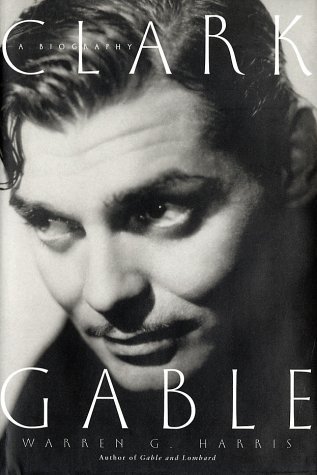



There really was a Hollywood, a place of fashionable men and gorgeous women and the all-powerful studio system that allowed them to defy the conventions that governed the rest of the country. Clark Gable arrived there after a rough-and-tumble youth, and his breezy, big-boned, everyman persona quickly made him the town’s “King.” He was a gambler among gamblers, a heavy drinker in the days when everyone drank seemingly all the time, and a lover to legions of the most attractive women in the most glamorous business in the world. In this well-researched and revealing biography, Warren G. Harris gives us an exceptionally acute portrait of one of the most memorable actors in the history of motion pictures, as well as a sure sense of the milieu and the times of mid-century Hollywood. More than anything else, one is struck by the romance of the era—the glamour and the excess, the playfulness and the lust. The people who were Gable’s intimates are legends in their own right: Loretta Young, Marion Davies, David O. Selznick, Jean Harlow, Judy Garland, Lana Turner, Spencer Tracy, Grace Kelly, and the list goes on and on. Clark Gable reveals newly uncovered information about Gable’s illegitimate daughter, his relationship with Joan Crawford, and his great love for Carole Lombard, his third wife. A recent trend in Hollywood biographies is to abandon the tabloid style in favor of a more scholarly approach. These two new biographies on Clark Gable follow this trend. Harris (Gable and Lombard) has produced a thoroughly researched account of Gable, complete with facts on the writers, producers, studios, costars, and Gable's many lovers. The biography also offers a history of how Hollywood moguls controlled every aspect of a star's creation. The most appealing chapters are on the Gable-Lombard romance, which tragically ended when Lombard perished in a plane crash. Spicer, who teaches professional writing at Victoria University, Australia, offers a take on Gable that is close to Harris's in style and content, sometimes even using the same quotes and description of events. Factual inconsistencies do exist e.g., Harris states that Gable's best friend, Eddie Mannix, called him with the news of Lombard's death, while Spicer has the call coming from Gable's publicist, Larry Barbier. But both bios follow the same format and progression of Gable's life and career, and both offer new information not found in what are at least 15 previous biographies on Gable, one of the best being Lyn Tornabene's 1976 Long Live the King. There are, however, differences between the two books. Harris used his previous research, which includes mostly firsthand accounts from Gable's associates, while Spicer relied heavily on secondary sources that include newspaper and magazine articles as well as Harris's Gable and Lombard. Harris's filmography is more detailed, and he includes an eight-page photo spread, while Spicer's book features photos throughout. Finally, Harris's style is crisper, faster paced, and more interesting; Spicer adds too many little details and becomes too wordy. Both books are recommended, but considering writing style, content, accuracy, and price, Harris's work should be first choice. Rosalind Dayen, Broward Cty. South Regional Lib., FL Copyright 2002 Reed Business Information, Inc. From the popular author of several Hollywood biographies (of, among others, Audrey Hepburn and Sophia Loren) comes this informative life story of an actor who has remained a household name decades after his death. Readers will enjoy the mixture of anecdotal and documentary information, the informal writing style, and especially the refreshing honesty: unlike many biographers, if Harris isn't sure about something, he doesn't conceal the fact. The author also applies commonsense reasoning to several psychological theories often bandied about to explain Gable's behavior. Is it likely, he asks, that Gable spent his life looking for a substitute for his dead mother, as many so-called experts have alleged, when Gable was only an infant when she died? In a genre in which biographers often draw wildly unsupportable conclusions from the flimsiest of evidence, Harris' evenhanded approach provides a welcome breath of fresh air. Readers familiar with the author's earlier Gable and Lombard (1974) may experience a little deja vu from time to time, but there is more detail here. A definite cut above most Hollywood biographies. David Pitt Copyright © American Library Association. All rights reserved “ [With] plenty of glitz...captures that fabled era in Hollywood through the story of its biggest male star.” — Variety “Fast-moving and frank. . . . You’ll give a damn.” — People From the Trade Paperback edition. WARREN G. HARRIS has written critically acclaimed biographies of Cary Grant, Audrey Hepburn, and Sophia Loren, among others. He lives in New York City. Chapter 1 The Kid Clark Gable should not have been born at all. His mother, Adeline, or Addie