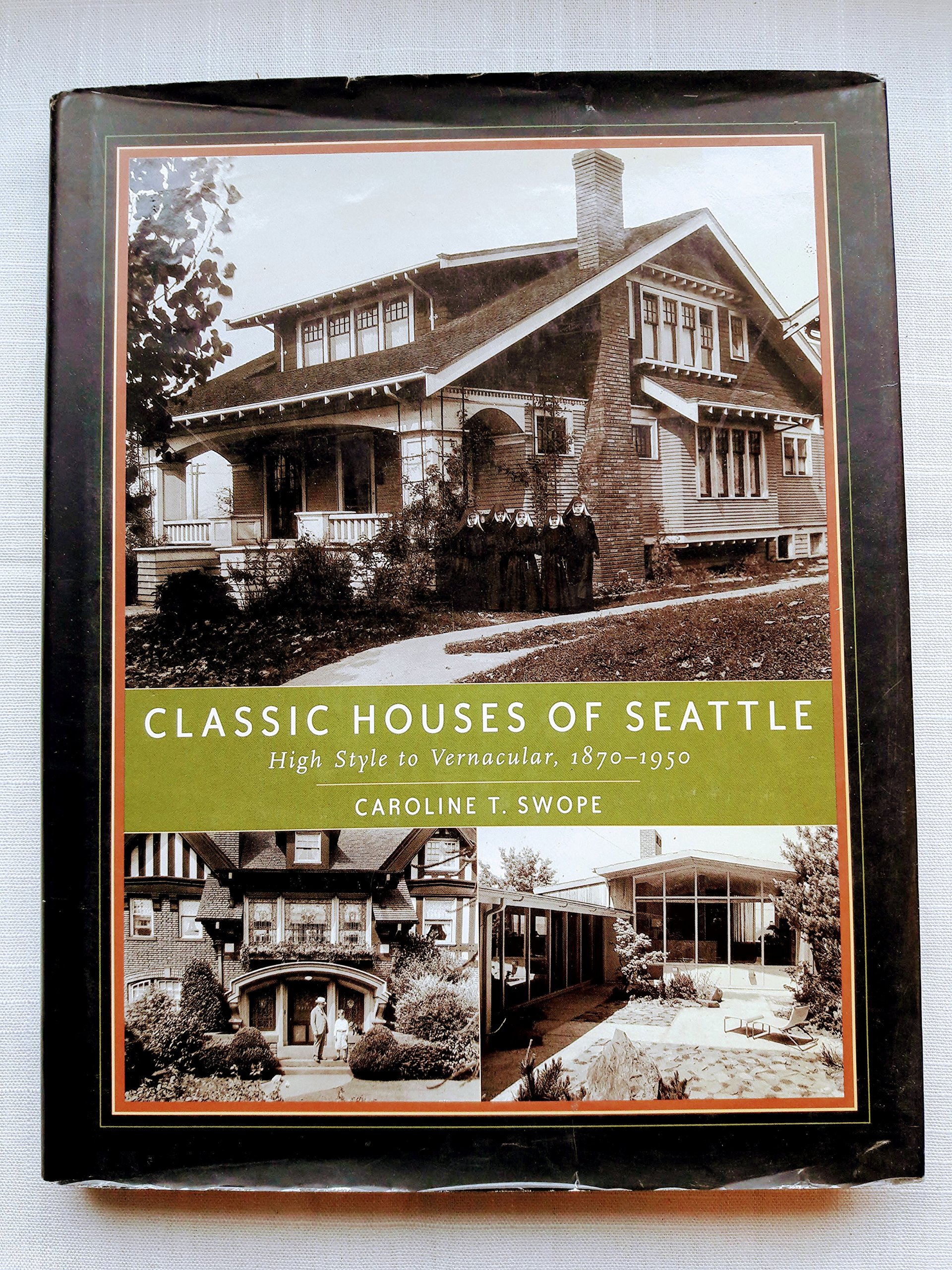
Classic Houses of Seattle: High Style to Vernacular, 1870-1950 (The Classic Houses Series)
$56.26
by Caroline T. Swope



Home owners, history and architecture buffs, and visitors to the Pacific Northwest will all find a treasure trove of information within these pages. With 300 photographs and illustrations, both historic and contemporary, this text provides a comprehensive overview of the city's major residential architectural styles, including Victorian, Craftsman, Tudor Revival, and Modern. The homes featured range from the showplaces of the wealthy to humble cottages and bungalows in residential neighborhoods. Beginning with a historical overview and continuing through descriptions of the 120 featured houses, organized by chronological era, this is the first-ever comprehensive guide to Seattle's historic homes. Checklists of houses by neighborhood and style make this useful for walking tours by residents and visitors alike. Anyone interested in preserving Seattle's architectural treasures will find this an essential resource. Classic Houses of Seattle is a vibrant portrait of the city's development, an important chapter in the story of American residential architecture. "...a thorough guide to the architectural styles of Seattle's residential neighborhoods, a trove of histories of individual dwellings, and will be a welcome companion on your next stroll around town." Lawrence W. Cheek, Sunset March 2007 Explores in detail more than 120 historic Seattle houses depicted in 325 spectacular period photos, many never before published. Photographs are supplemented with historic house plans and original architectural drawings. Includes a how-to guide for researching the history of your house. Caroline T. Swope is an instructor of art and architectural history at Seattle Central Community College. She holds a doctorate in American art and architectural history from the University of Washington and a master's in historic preservation. She has worked on preservation projects at the federal and local levels, and is active in local historical organizations. Craftsman houses, sometimes referred to as "bungalows," are a familiar sight in the Pacific Northwest. The term "bungalow" is architecturally imprecise, since it doesn't actually refer to a style. It describes scale, and it is used to describe small, one- or one-and-a-half story houses, regardless of style. The word "bungalow" originated in India, and evolved from the Bengali word bangala , which described a one-story British colonial structure. During the 1870s, the term was used in Great Britain to describe rustic one-story houses, and for the last thirty or so years of the nineteenth century, it referred to rural weekend or summer homes. Even in 1903, Gustav Stickley, a major proponent of the Craftsman movement, used "bungalow" to describe a type of simple living. Craftsman houses, and bungalows that are designed in the Craftsman style, emphasize function and simple materials. They generally have two bedrooms and one bathroom, with a main floor of less than 1000 square feet of space. While large, more ornamented examples of this design do exist, they are less common than the small structures that fill Seattle. A major developer of the Craftsman style was the California-based architectural firm of Greene & Greene. The Greene brothers, influenced in part by the Japanese pavilion at Chicago's 1893 World's Columbian Exposition, developed an architectural vocabulary based on low-pitched rooflines, deep eaves, exposed or accented wood structural supports, and irregular floor plans. The Greene brothers designed numerous houses in the Pasadena area; the best known was the Gamble House of 1908. The Gamble house used a number of different woods, the varying tones and grains adding aesthetic interest. While there were some high-style Craftsman homes built, most examples of this style are found in working-class neighborhoods, due to their major proponent, Gustav Stickley. Stickley was a furniture designer based in Syracuse, New York. During the 1890s he traveled to Europe and was inspired by the writings of Englishmen John Ruskin and William Morris. Ruskin was a critic who was interested in linking the daily lives of the working populace with art. Morris, a designer and social reformer, was interested in utilitarian art for the masses. In 1899, after Stickley returned to the states, he established the Gustav Stickley Company, which manufactured a wide variety of mass-produced, inexpensive furniture. From 1901 until 1916 he published the Craftsman magazine, which illustrated interiors filled with Stickley furniture and included house plans as well. Many of his designs, including prefabricated houses, were available from the Sears and Roebuck catalogue company, and as a result were shipped throughout the United States. A major proponent of the Craftsman style in Seattle was Jud Yoho, who was active in the speculative housing market as owner of the Craftsman Bungalow Company. He was also president of the Bungalow Magazine , originally published in Los Angeles, and then in Seattle